
ISIS deploys 'death squad' in Iraq.
ISIS is expected to fight to the last man to defend Fallujah, while Iraqi government forces are also under pressure to retake the city.
ISIS is expected to fight to the last man to defend Fallujah, while Iraqi government forces are also under pressure to retake the city.
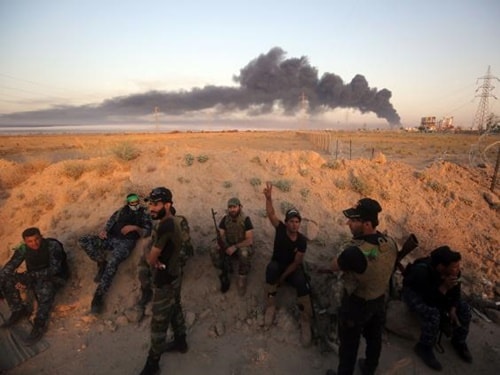 |
| Iraqi government combined forces approach the city of Fallujah. Photo: AFP. |
Islamic State (IS) death squads are increasingly appearing on the streets of Fallujah, about 64 km west of Baghdad, Iraq. They have been ordered to kill anyone attempting to flee or surrender as Iraqi government forces approach the strategic city, according to the Independent.
Iraqi army units began an offensive in the area east of Fallujah on the morning of May 23rd after a night of intense airstrikes.
Experts believe that losing Fallujah would be a major blow to IS. It is a commercial center for Sunni Muslims on the main route to Jordan. On May 23, three IS fighters were killed inside Fallujah, demonstrating signs of armed resistance from the local population against the militants.
The people of Baghdad are putting immense pressure on Iraqi Prime Minister Haidar al-Abadi in his campaign to drive ISIS out of Fallujah following bombings targeting civilians in the capital earlier this month that killed at least 200 people.
"The Iraqi people believe that those suicide bombers all came from Fallujah and that the government must retake the city," said a retired senior Iraqi officer.
The military's failures in pushing IS out of cities bordering the capital over the past two years have somewhat damaged the credibility of the government's armed forces.
However, the Iraqi army currently lacks combat units on the ground and relies heavily on two elite counter-terrorism brigades with 5,000 personnel. Two other regular army divisions are also capable of fighting, but military victories over the past year have mostly relied on air support from the US-led anti-ISIS coalition. These aircraft have helped destroy ISIS facilities from the air while the army conducts ground offensives.
The city of Fallujah has been severely affected by the prolonged war and food shortages. According to some local sources, the city's population has dwindled to just 50,000-60,000 people from 350,000 in 2011, before Iraq descended into full-scale war.
An Iraqi observer who regularly interacts with the city said that residents have been suffering from hunger for six months due to food shortages. A 50kg bag of flour costs nearly $690.
A desert road north of Fallujah could help transport food but is currently under ISIS control. The eastern part of the city is held by Shiite militias, the south by Sunni tribal militias fighting ISIS, and the US-backed government army is stationed in the west. The people of Fallujah fear ISIS, but they are equally apprehensive of the Shiite fighters, whom they consider "Fallujah terrorists."
Observers believe that IS had previously withdrawn from cities like Ramadi, Hit, and Rutba without fighting to the last man, but it is highly likely that the group will fight to the death in Fallujah due to the city's military and geopolitical importance.
Meanwhile, the Iraqi government army was compelled to retake Fallujah because losing the city to ISIS would plunge Baghdad into a terrible nightmare. Furthermore, a victory in Fallujah would symbolize the strength of the government army and the fact that ISIS was clearly weakening.
According to Patrick Cockburn of the Independent, ISIS is losing strength, but the forces fighting the militants are in a similar predicament. The US has intensified ground offensives in Mosul and Raqqa, but ground forces in Iraq and Syria are unlikely to be able to coordinate their actions to retake the two cities this year.
"They don't have a concrete plan for what to do after they collapse," commented Hiwa Osman, an independent political analyst in Irbil. "Only Sunni Arabs can put an end to ISIS, and only when they do that will the war truly end," he emphasized.
According to VNE