

China's stance changed 180 degrees after the ruling on the nine-dash line.
(Baonghean) - Following the ruling of the Permanent Court of Arbitration (PCA) in The Hague on the South China Sea issue, China has expressed its willingness to engage in bilateral dialogue with the Philippines and other relevant countries to find a middle-ground solution in the process of seeking a fundamental resolution. To better understand this new development, Bao Nghe An interviewed Associate Professor, Major General Le Van Cuong - former Director of the Institute of Strategy and Science, Ministry of Public Security.
PV: The ruling in the case of the Philippines suing China has received significant international attention. Could Major General please provide our readers with the most basic points of the ruling?
Major General Le Van Cuong:In January 2013, the Philippines filed a lawsuit against China with the Permanent Court of Arbitration in The Hague, established under Annex VII of the 1982 United Nations Convention on the Law of the Sea (UNCLOS). On July 12th, the PCA issued a ruling on four issues, focusing on two key points:
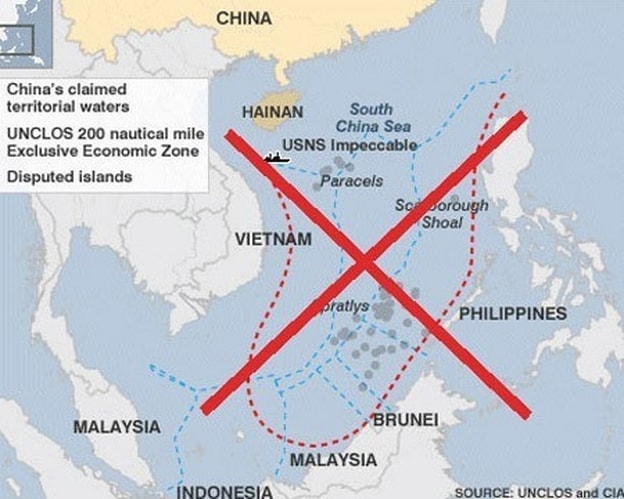 |
| China's absurd nine-dash line encompasses most of the South China Sea. Photo: Internet. |
Firstly, the Permanent Court of Arbitration declared that China's claims of sovereignty and interests within the "nine-dash line" contradict UNCLOS 1982, meaning that China has no legal basis whatsoever to claim rights and interests in this maritime area.
Secondly, regarding the legal status of the features in the Spratly Islands, UNCLOS 1982 divides maritime features into three groups: partially submerged – which do not entitle the state to define a 12-nautical-mile territorial sea or a 200-nautical-mile exclusive economic zone; rocks (which rise completely above the water surface and are not suitable for human habitation) – the owning states are only allowed to establish a 12-nautical-mile territorial sea around them; and islands (land and rocks that rise completely above the water surface at high tide and have sufficient natural conditions for human existence and habitation). According to the recent PCA ruling, all 100 features in the Spratly Islands are partially submerged features and rocks; there are no islands.
With these two rulings, the PCA has stripped China of all legal basis for its "nine-dash line" claim and its sovereignty claims over rocks, including artificial islands that it has built itself, such as Fiery Cross Reef, Gac Ma Reef, Subi Reef, and Mischief Reef, etc.
PV: What is the significance of the Permanent Court of Arbitration's rulings, General?
Major General Le Van Cuong:First and foremost, the ruling demonstrates the supremacy of law in the contemporary world, meaning that in the current situation, any country, large or small, must abide by international law.
Furthermore, the ruling provides additional legal grounds for the Philippines, Vietnam, and many other countries to fight to protect their sovereignty and legitimate interests in the South China Sea, rejecting all of China's "legal basis" and unreasonable claims.
Equally important, the Arbitration Tribunal's ruling helps the international community gain a clearer understanding of the nature of China's claims and the legitimacy of the claims of the Philippines, Vietnam, and other countries.
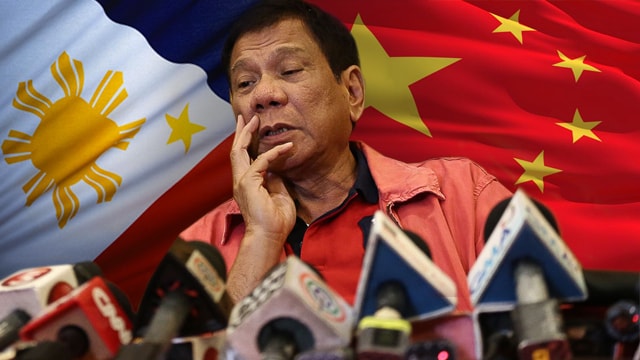 |
| Public opinion is focused on how Philippine President Rodrigo Duterte will handle relations with China in the coming period. Photo: Rappler |
Public opinion overwhelmingly supports the Philippines, Vietnam, and other countries, while criticizing and condemning China's illegal actions in the South China Sea. From the US to Japan, the EU, India, and others, the international community has unanimously voiced its support for the ruling.
Given this situation, China could not act more aggressively when the PCA – the International Arbitration Organization, a United Nations court representing justice and righteousness in the world, accepted by 193 UN members – issued a coercive, internationally legally binding ruling that reflected the conscience and legitimate aspirations of the world's people.
China has, of course, been pushed into a reactive position, facing a more difficult situation than ever before since 1949. Therefore, they are forced to show flexibility. A few days ago, China's State Councilor for Foreign Affairs, Yang Jiechi, indirectly announced that Beijing is ready to engage in bilateral dialogue with Manila and other countries to find a middle-ground, transitional solution in the process of resolving the fundamental issues.
Then, on July 26, Chinese Foreign Minister Wang Yi officially requested US Secretary of State John Kerry to mediate bilateral dialogue between China and the Philippines, while declaring that China was ready to negotiate with relevant parties to find a transitional solution in the process of resolving the root causes of the South China Sea issue. This was a completely new statement, a "180-degree turn" from China's previous aggressive and arrogant attitude.
PV: General, why has there been such a change of heart from the Chinese side?
Major General Le Van Cuong:The recent ruling from the United Nations court has put China in a position where it faces opposition from the entire world.
With no other option, China was forced to take a step back because the more aggressive and belligerent it became, the more isolated it would be. For the first time in decades, China has found itself in such a difficult and passive position, in terms of diplomacy, security, politics, and law.
But this is merely a tactical change to "buy time," not a fundamental change on China's part. They are trying to "buy time" for reconciliation to show that they also bear responsibility and that finding a middle ground, a transitional solution, is consistent with the content of UNCLOS 1982.
In other words, Beijing is choosing to apply the UN Convention where it benefits them, and abandoning it when it is disadvantageous.
The current context is forcing China to change; international pressure means China can no longer do whatever it wants. If boycotted by the international community, China risks collapse. Furthermore, this change by China is tactical in nature and doesn't reveal anything substantial. To ease the situation and make the world think that China also has responsibilities and is willing to engage in bilateral exchanges with other countries, China has chosen this "move" to buy time and save face for Beijing in this difficult situation.
PV: In response to this proposal, how has the Philippines responded, General?
Major General Le Van Cuong:I believe the Philippine president will respond positively to China's offer of dialogue. However, President Rodrigo Duterte will not turn his back on the US, and will only adjust relations with China within certain limits.
In other words, the Philippine president is complying with and respecting the arbitration ruling, but will be more lenient towards China. It is likely that China will increase investment in the Philippines, building highways, airports, ports, etc., to appease public opinion in Manila.
For my part, I believe that Vietnam first and foremost supports China's conciliatory stance, but at the same time clearly recognizes that Vietnam's national interests and legitimate sovereignty in the South China Sea are unchangeable. We still need to persistently fight against China to protect our legitimate rights and interests in the South China Sea. And the PCA ruling is beneficial to the international community in general, and to the Philippines and Vietnam in particular, in the bilateral and multilateral struggle with China on the South China Sea issue.
PV: Thank you very much, Major General.
Thu Giang
| RELATED NEWS |
|---|