

Having suffered a legal blow, China will seek to stir up trouble in the South China Sea.
Tensions are likely to increase in the South China Sea in the short term following the arbitration ruling, before the parties sit down for negotiations.
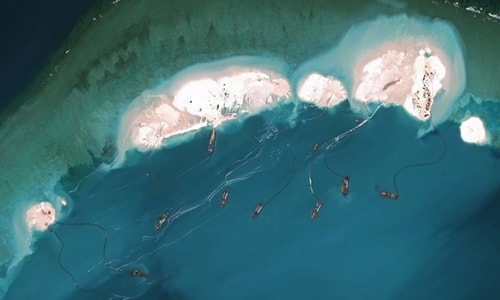 |
| China is illegally reclaiming land on Vành Khăn Reef, part of Vietnam's Spratly Islands. (Photo: Digital Globe) |
On July 12, the Permanent Court of Arbitration (PCA) in The Hague, Netherlands, announced its ruling on the South China Sea case brought by the Philippines, affirming that China has no legal basis to claim historical rights to resources within the "nine-dash line," that China's claim of historical rights based on the "nine-dash line" contradicts the United Nations Convention on the Law of the Sea, and that no entity in the Spratly Islands can give China an exclusive economic zone (EEZ).
Reuters called the ruling a "legal blow" to China, while the US State Department issued a statement emphasizing that the ruling makes a "significant contribution" to resolving regional disputes. However, the chances of it changing the regional landscape and ending the standoff in the South China Sea are slim. Instead, tensions may increase, at least in the short term, according to the Los Angeles Times.
Reaction from China
From the outset of the lawsuit, Beijing declared it would not accept the court's ruling. But this does not mean they will not react when the ruling goes against China's interests. The Philippines, the US, and other countries will then feel the need to act, commented writer Julie Makinen.
"Beijing's position is clear: no acceptance, no participation, no recognition, and no implementation," Fu Ying, former Chinese vice foreign minister, wrote in Foreign Policy magazine on July 10.
Just before the court's ruling, China reacted aggressively, such as landing civilian aircraft on two illegally constructed artificial islands in the Spratly Islands and placing emergency response forces in Beijing on high alert.
The Chinese Foreign Ministry issued a statement saying the PCA ruling was "weak," and that Beijing "does not accept and does not recognize" the ruling. Chinese President Xi Jinping said China is "dedicated to maintaining peace and stability" in the South China Sea but will "not accept views or actions based on the court's ruling regarding the dispute," Reuters reported.
China claims to have the support of 60 countries for its South China Sea stance, but after the ruling, almost no country has publicly voiced support for its rejection of the decision. Meanwhile, a number of countries and international organizations such as Vietnam, the United States, Japan, the European Union, etc., have all welcomed the PCA ruling.
"It is highly likely that Beijing will seek every means to retaliate, both on land and at sea, to demonstrate that it will not succumb to the arbitration ruling. Or they will seek to punish Manila for refusing to drop the case," said Gregory B. Poling, director of the Asia Maritime Transparency Initiative at the Center for Strategic and International Studies (CSIS) in Washington.
According to Poling, China could begin the process of building artificial islands at the Scarborough Shoal, disputed with the Philippines, a move that would seriously harm the environment and is "very concerning from a legal and diplomatic standpoint."
Beijing also has the potential to reposition itself to prevent the Philippine navy from resupplying troops stationed on the old Sierra Madre warship, which the Philippines has used as an outpost at Second Thomas Shoal in Vietnam's Spratly Islands since 1999, Poling predicts.
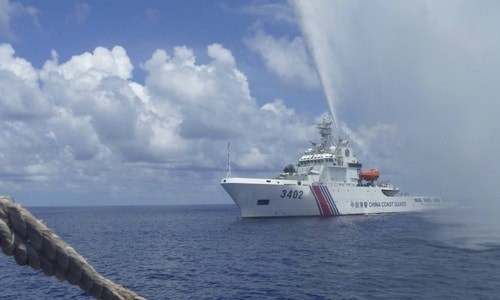 |
| A Chinese coast guard vessel approaches Filipino fishermen near Scarborough Shoal in the South China Sea in August 2015. Photo: AP |
Late last month, the People's Daily, the mouthpiece of the Chinese Communist Party, published an article emphasizing that Beijing is fully capable of towing the Sierra Madre ship away. China claimed that it was not "bullying the weak," but rather that other countries were "bullying the strong," and warned that China's "patience" had "limits."
Furthermore, according to Makinen, China could also declare an Air Defense Identification Zone (ADIZ) over the South China Sea or deploy fighter jets to the runways it has illegally built in Vietnam's Spratly Islands.
Negotiation opportunity
If Beijing actually takes those actions, Washington will be forced to respond.
"The U.S. will likely respond with a massive diplomatic campaign against China and send naval vessels to the South China Sea more frequently to bolster its position on freedom of navigation," commented Thomas Eder, a researcher at the Mercator Institute for China Studies in Berlin, Germany. "Other countries in the region will then feel the need to quickly follow the Philippines' lead and file their own lawsuits in international courts."
Bill Hayton, a veteran BBC correspondent specializing in the South China Sea, believes that there will come a time when China realizes it is approaching a point where its actions will provoke a more forceful reaction from the US and the international community, and Beijing will be forced to adjust and rein itself in.
Some analysts also believe that Beijing will have to stop before its reckless actions, disregarding international law, cause irreparable consequences in the South China Sea. In the long term, China will eventually have to sit down at the negotiating table with other countries involved in the dispute, and at that point, the Arbitration Tribunal's ruling will be an effective tool for those countries to "reason" with Beijing.
"At some point after the ruling is issued, the parties involved will restart negotiations," predicted Jerome A. Cohen, an expert on Chinese and Asian law. "To save face for China, it may not be necessary to explicitly mention the court ruling in any agreement."
Philippine Foreign Minister Perfecto Yasay said the country “welcomes the announcement of the ruling” by the Arbitration Tribunal and is “studying the ruling carefully and thoroughly, which this important outcome deserves,” he said. “At the same time, we call on all parties involved to exercise restraint and calm.”
On July 8, Mr. Yasay told local media that he hoped to quickly begin direct negotiations with China after the court's ruling. However, no one knows exactly when these negotiations will take place.
"It will be a protracted process," Cohen emphasized.
According to VNE
| RELATED NEWS |
|---|