

'The mindset regarding international integration is still changing slowly'
This was one of the points raised by Deputy Prime Minister and Minister of Foreign Affairs Pham Binh Minh in his opening speech at the 18th National Conference on Foreign Affairs in Hanoi on the morning of August 21.
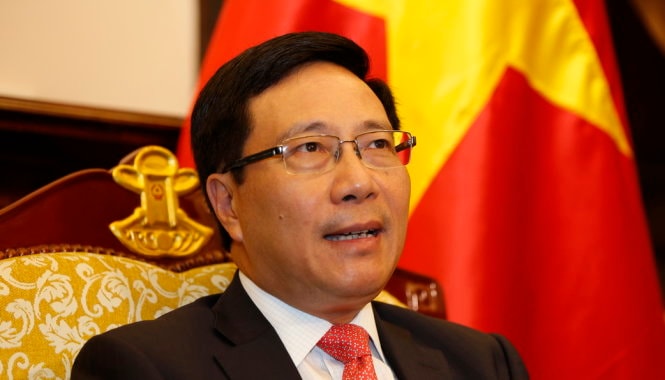 |
| Deputy Prime Minister and Minister of Foreign Affairs Pham Binh Minh - Photo: VIET DUNG |
According to the Deputy Prime Minister, although local foreign affairs work has developed comprehensively in both breadth and depth in recent years, the process of international integration at both the central and local levels still has many limitations, and the mindset regarding international integration is still changing slowly.
The Deputy Prime Minister also frankly acknowledged that foreign affairs work has not yet taken advantage of the opportunities of international integration to improve the quality of growth, capacity, and competitiveness of the economy, nor has it taken advantage of the benefits of expanding markets from deep international integration. Productivity, technological level, and management are still low, and participation in global value chains has not been significant.
Furthermore, economic development and international integration are putting increasing pressure on cultural, social, and environmental issues.
The Deputy Prime Minister outlined four directions and suggested that the conference focus its discussions on them.
Firstly, it is necessary to decisively innovate thinking on international integration, recognizing this as a cause for the entire population and the entire political system; it is necessary to strongly implement the proactive and positive orientation of international integration at the local level, considering this a common task for all departments and agencies.
Local authorities need to integrate international integration into their development strategies and overall planning.
Secondly, localities need to maximize the benefits of international integration, especially international economic integration, to promote trade, expand export markets for local goods and services, participate in regional and global production networks and value chains, diversify markets and partners, promote technology transfer, labor export, and tourism.
Thirdly, it is proposed that localities coordinate with central ministries and agencies to continue effectively implementing regular foreign affairs activities, including the efficient use of ODA and FDI funds, strengthening border and territorial management (for localities with land, sea, and island borders), effectively carrying out citizen protection work, work related to Vietnamese people abroad, cultural diplomacy, external information, and work with foreign non-governmental organizations.
Fourth, continue to improve the organization and structure of local foreign affairs agencies, strengthen training and professional development for foreign affairs officials in terms of expertise, skills, and foreign languages (translation and interpretation) to meet the requirements of the new situation, and further enhance the role and position of local foreign affairs agencies.
For provinces that have not yet established a Department of Foreign Affairs, it is recommended that, based on the needs and actual situation of the locality, they proactively promote the establishment of such a department to have a specialized apparatus to effectively advise and assist the provincial leadership in foreign affairs.
According to Tuoi Tre newspaper