

World's oldest oceanic crust discovered.
The oldest oceanic crust on Earth is located in the eastern Mediterranean, dating back approximately 340 million years.
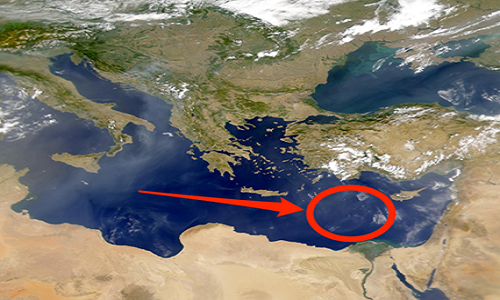 |
The world's oldest oceanic crust is located in the eastern Mediterranean Sea. Photo: Jason Thomson. |
According to Science Daily, Roi Granot, a PhD in environmental geology at Ben-Gurion University of Negev (BGU), Israel, has identified the eastern Mediterranean Sea as containing the world's oldest oceanic crust. The research results were published in the journal Nature Geoscience on August 15th.
Many fundamental tectonic features in the eastern Mediterranean remain a mystery due to the relatively thick sedimentary layers (10-15 km) and the lack of magnetic anomaly data. The research team used sensors to survey the magnetic field of a 7,000 km stretch across the Herodotus and Levant ocean basins in the eastern Mediterranean. They aimed to understand the nature and age of the Earth's crust beneath.
Data obtained shows that the rocks in the Herodotus Basin are characterized by the appearance of "magnetic streaks." This is a sign of the oceanic crust forming at mid-ocean ridges. As magma at mid-ocean ridges cools, the magnetization and orientation of minerals in the rocks are oriented by the Earth's magnetic field.
"Changes in magnetic field orientation over time are recorded at the ocean floor, providing insight into the formation of the Earth's crust, shedding light on tectonic structures and geodynamic processes in the region," Granot said.
By determining the deflection of the magnetic flux, Granot indicated that the oceanic crust in the Herodotus Basin was approximately 340 million years old. Oceanic crust typically returns to the Earth's mantle relatively quickly in subduction zones due to their high density. Therefore, most oceanic crust is less than 200 million years old.
"With the new geophysical data, we've made a major breakthrough in understanding the geology of the study area," Granot said.
According to Granot, the oceanic crust in Herodotus Basin is most likely what remains of the ancient Tethys Ocean, which lay between the supercontinents Gondwana and Laurasia during the Mesozoic Era, before the formation of the Atlantic and Indian Oceans.
According to VNE
| RELATED NEWS |
|---|