

Converting rice paddy land and forest land: All for the goal of development.
(Baonghean) - During the second session of the 17th term of the Nghe An Provincial People's Council, the Provincial People's Committee submitted a proposal to the People's Council for approval and issuance of a Resolution allowing the conversion of 242.39 hectares of rice paddy land, protective forest land, and forest land for the implementation of investment projects in the province. Regarding this issue, reporters from Nghe An Newspaper have gathered opinions from provincial People's Council representatives and voters from various regions.
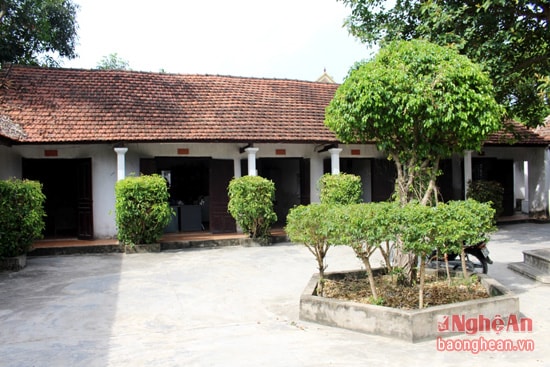 |
| The old Quỳnh Hồng commune headquarters, built more than 40 years ago, needs a suitable area for new construction planning. |
The land areas proposed by the Provincial People's Committee for approval by the Provincial People's Council this time stem from practical requirements and after reviewing Resolution No. 196/NQ-HĐND of Nghe An province (dated December 20, 2015) on changing the land use purpose of rice fields, protective forests, and special-use forests to implement investment projects in Nghe An province. The 242.39 hectares (208.61 hectares of rice fields and 33.78 hectares of protective forests) will be allocated for the construction of 144 public and community facilities to serve socio-economic development. This includes land conversion for the construction of commune and ward headquarters, markets, bridges and roads, cultural centers, land subdivision for housing, and factories and projects.
The need for transformation
According to the Land Law, projects and works that require the conversion of rice paddy land, special-use forest land, or protection forest land must be authorized by the competent authority. The law allows for the conversion of rice paddy land under 10 hectares and special-use forest land under 20 hectares, which falls under the authority of the Provincial People's Council. Based on proposals from the local level, the Department of Natural Resources and Environment has reviewed the projects and works for the Provincial People's Committee to propose to the Provincial People's Council for consideration and approval at this session.
During the discussion, delegate Hoang Nghia Hieu – Deputy Director of the Department of Agriculture and Rural Development – stated that the conversion of land use from rice paddies, forests, and protective forests to serve project works is one of the practical requirements of socio-economic development. This conversion also has the significance of making good use of land resources for the development of the homeland and the country, and basically does not affect food security in the province.
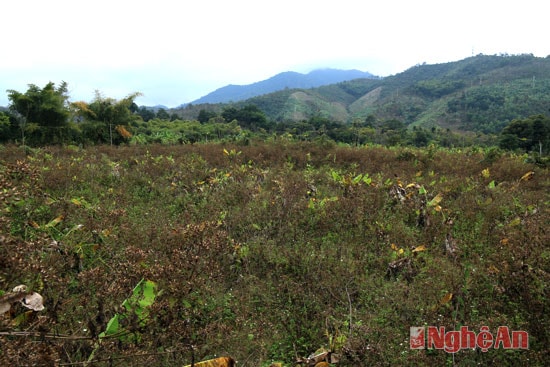 |
| Inefficient land areas will be converted. |
Delegate Tran Xuan Quang (Nghi Loc district) shared: "Consensus is the decisive factor." This stems from the reality of the district. Nghi Loc is a district located in the key economic development area of Nghe An province, with 10 communes located within the Southeast Economic Zone.
In recent years, with the policy of attracting investment through open-door policies, dozens of investment projects have been licensed in the area. However, with so many projects coming in, the pressure on land clearance for the local Party committee and government is immense. To facilitate land use conversion and clearance, the Party committee, government, Fatherland Front, and other organizations have actively participated.
To date, land clearance for the D4 road project, the N5 road section through Nghi Dong residential area, and the N5 connecting road to Hoa Son (Do Luong) has been basically completed. Compensation for crops has been provided, and the land in Zone C of the Nam Cam Industrial Park has been handed over to the Southeast Economic Zone Management Board. The key factor remains the high level of public consensus.
Among the land areas proposed for conversion by the Provincial People's Council this time, many localities intend to use them for building markets and commune headquarters. For example, Quynh Hong commune (Quynh Luu district) has included in its plan and proposed the conversion of 6,000 m2 of rice paddy land to rebuild its current cramped headquarters, which utilizes a row of single-story buildings constructed over 40 years ago.
Mr. Ho Nghia Duong, Chairman of the People's Committee of Quynh Hong commune, said: "If the Provincial People's Council approves the conversion of some rice paddy land for the construction of the commune headquarters, the government and people of Quynh Hong commune will be very pleased. This will provide the commune with a better workplace and a more decent place for people to conduct transactions. In addition, some projects requiring expansion of the premises, such as the District Police headquarters, the Social Insurance office, and the relocation of the District People's Court to a new location, are also awaiting the Provincial People's Council's approval."
Ensuring food security and developing agriculture.
“Along with converting rice land to other projects to ensure socio-economic development, from now until 2020, Nghe An also plans to convert 5,457 hectares of rice land to other crops and combine it with aquaculture. This reality requires principles and objectives to ensure food security. The goal is for the converted area to increase by at least 20% compared to rice cultivation,” – this information was provided by Mr. Hoang Nghia Hieu, Deputy Director of the Department of Agriculture and Rural Development.
Mr. Hieu further stated that the land conversion, based on careful consideration, does not affect food security in the province. From another perspective, the conversion is also a way to cope with the impacts of climate change, market prices, etc. Thus, by 2020, the area (of rice cultivation) will decrease by approximately 7,500 hectares, but food security will still be ensured, and the production of some other agricultural products will increase significantly.
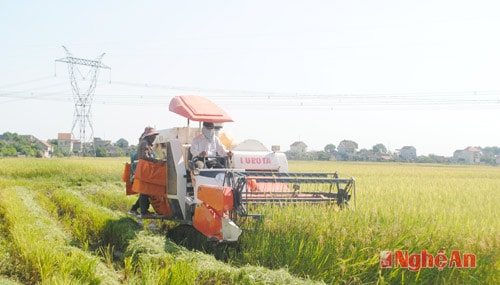 |
| Introducing mechanization into rice farming will increase productivity and efficiency, and ensure food security. |
Based on this, the agricultural sector is closely coordinating with local authorities at all levels to strengthen the review of land resources, develop conversion plans in localities and units; quickly introduce scientific and technological advancements, especially advancements in seeds, into production; promote mechanization for farmers in production and livestock farming; effectively implement support policies and encourage cooperation and linkages in agricultural production and consumption, develop large-scale farming areas; and reduce post-harvest losses...
Mr. Vo Hoang Thach, Vice Chairman of the Vinh City Farmers' Association, said: "In the last three years, the rate of agricultural land reclamation in Vinh City has been very strong, reclaiming about 400-600 hectares each year, about 10 times more than before (during the period 2007-2012, only 50-60 hectares of agricultural land were reclaimed each year). The reclaimed land is mainly concentrated in the construction of key state projects such as urban renovation (WB), the 72m road from Vinh to Cua Lo, the 35m road from National Highway 46 to the Lam River embankment road, etc."
The reclamation of rice paddy land has helped Vinh City develop its infrastructure significantly and beautify the urban area, positioning it as the center of the North Central region. This has led to changes in infrastructure, facilities, and housing for residents, making them more beautiful and modern. However, Mr. Thach also suggested that the land-use conversion raises several issues for the city, such as job retraining, employment opportunities, and the development of production and livestock farming.
PV - Contributor