
New SUV model for Vietnamese customers.
The new SUV model inherits the advantages of a major player in the commercial vehicle industry, competing with Fortuner, Everest, and Pajero Sport in Vietnam.
The new SUV model inherits the advantages of a major player in the commercial vehicle industry, competing with Fortuner, Everest, and Pajero Sport in Vietnam.
While the Toyota Fortuner, Ford Everest, and Mitsubishi Pajero Sport have been around for a long time, the mu-X was launched relatively late, but in a market where the SUV segment is experiencing strong growth. In 2015, Isuzu sold 10,000 mu-X vehicles in the Philippines, and the Japanese automaker has even higher sales targets in Vietnam.
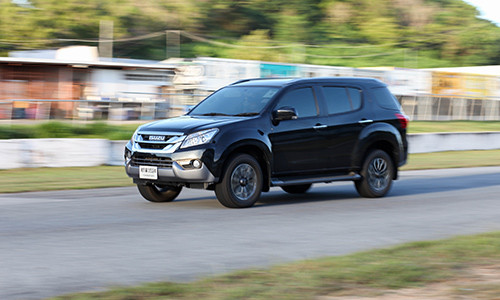 |
Experience the Isuzu mu-X at Bira Circuit racetrack, Thailand. |
During a test drive for Vietnamese media at the Bira Circuit (Thailand), Isuzu offered two engine options: 1.9 and 3.0. Because the 1.9 version meets Euro 4 fuel standards, Isuzu stated that it cannot yet be brought to Vietnam.
The first challenge for the reporters was the mu-X 3.0 version with a 5-speed automatic transmission. This 3.0 version is exported to the Vietnamese market with a localization rate of 90% in Thailand; only the transmission is imported from Japan (automatic) and the manual transmission is from the Philippines.
At Bira Circuit, the Isuzu mu-X had to pass tests for slippery roads, obstacles, control, noise levels, comfort, acceleration, and rough terrain. The SUV has a masculine design, sharp lines, projector headlights, and trendy LED daytime running lights. A sporty rear spoiler has been added.
Unlike in Vietnam, the steering wheel of the Thai mu-X is on the right. Stepping inside, the first impression is the spacious interior, with leather upholstery from the steering wheel to the seats, and a wood-trimmed gear shift. The mu-X engine has the characteristic Japanese diesel engine sound, a very distinct "clack clack." The vehicle is equipped with a 3-liter turbocharged diesel engine producing 163 horsepower at 3,200 rpm and a maximum torque of 380 Nm in the 1,800-2,200 rpm range. It has a 5-speed automatic transmission.
Shifting the gear lever to D and releasing the brake pedal, the mu-X began to move quite smoothly. After exiting the pit lane and onto the track, the instructor reminded the driver to accelerate. The car didn't immediately speed up, but rather seemed to be holding its breath to build momentum, typical of a diesel engine. The engine's roar from the turbocharger echoed through the cabin. The accelerator pedal had good responsiveness, giving a more realistic feel compared to competitors in the same segment.
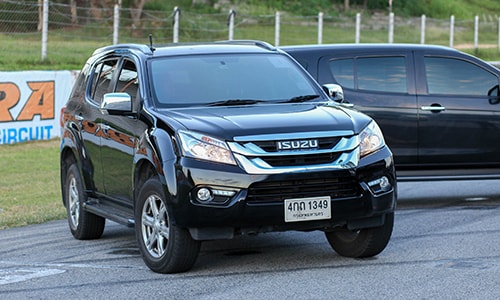 |
The mu-X is for the Thai market. |
At the first left turn, the speedometer showed 70 km/h, and the instructor reminded us to maintain that speed. Contrary to the fear of high-speed corners, the mu-X's steering was quite responsive, light, and easy to control. Thanks to its traction control and electronic stability control systems, the mu-X didn't slip while cornering. During the slippery test on a wet right turn, at the regulated speed of 40 km/h, the grip and balance were quite good.
After navigating the right-hand corner, the speed limit sign indicated 50 km/h, followed by a zig-zag test. During this exercise, the steering was quite precise according to the driver's instructions. The traction control and electronic stability control systems performed well, allowing the mu-X to easily overcome the obstacle; the body's responsiveness was quite stable, a feature lacking on the Toyota Fortuner.
Moving on to the handling test, the permitted speed was 60 km/h. This test was a combination of the previous two, and the mu-X met all the owner's requirements; the body was stable with no wobbling, and the steering was light and precise.
The excitement gradually increased, dispelling initial doubts about the mu-X's handling and stability. Moving on to the noise and comfort test when navigating obstacles at 20 km/h. Overcoming bumps, the feedback from the wheels to the steering wheel was noticeable. The front and rear suspension responded quite well, providing a smooth ride.
The Bira Circuit racetrack is designed specifically for vehicle testing, including rough dirt tracks for off-road challenges. The mu-X surprised drivers with its suspension system, borrowed from Isuzu's trucks and pickups. The SUV moved smoothly over high bumps, without any shaking or wobbling. Steering response remained precise.
Moving on to the 100 km/h straight-line acceleration test, with the accelerator fully pressed, the mu-X accelerates quite impressively thanks to its rear-wheel drive. However, the 5-speed automatic transmission still shows some throttle lag. At this point, engine noise becomes noticeable, reverberating into the cabin.
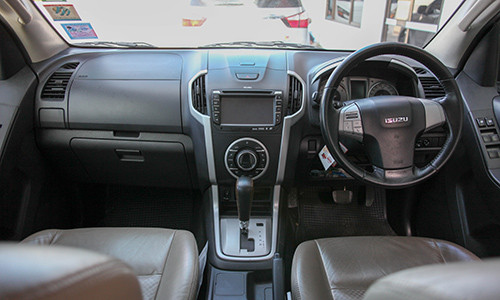 |
mu-X interior. |
In its segment and price range, the Isuzu mu-X becomes the first SUV to be equipped with a nearly complete set of safety features such as anti-lock braking system (ABS), electronic brake force distribution (EBD), emergency brake assist (BA), traction control system (TCS), electronic stability control (ESC), hill start assist (HSA), a robust chassis and frame, and reinforced bars on all four doors.
With years of experience in commercial vehicles, the Isuzu mu-X promises to be a worthwhile option for Vietnamese customers. Leveraging its strengths in trucks and pickup trucks, will Isuzu be able to create a new wave in the market?According to Isuzu's announcement, the mu-X consumes 7.25 liters/100 km in mixed driving conditions for the 2.5-liter engine version and 7.41 liters/100 km in mixed driving conditions for the 3.0-liter version.
In Vietnam, the Isuzu mu-X is sold in two versions: a 2.5 manual transmission priced at 899 million VND and a 3.0 automatic transmission priced at 960 million VND, while its competitor, the Toyota Fortuner, is priced from 947 to 1,156 million VND.
According to VNE
| RELATED NEWS |
|---|