

Sacred Temple of Emperor Quang Trung
(Baonghean) - With the aim of preserving the historically significant milestones related to Emperor Quang Trung, on April 28, 1962, the complex of historical sites and scenic spots of Dung Quyet Mountain and Phuong Hoang Trung Do was recognized by the Ministry of Culture and Information as a National-level historical and scenic site.
With the approval of the Government, the Ministry of Culture, Sports and Tourism, and the People's Committee of Nghe An province, the construction of the temple dedicated to Emperor Quang Trung was commenced on August 15, 2005; and inaugurated on May 7, 2008, to commemorate the 220th anniversary of Phuong Hoang Trung Do. Building the temple in the ancestral homeland of Emperor Quang Trung and within the Phuong Hoang Trung Do historical site, part of the national scenic complex of Dung Quyet Mountain and Phuong Hoang Trung Do - Vinh, is very much in line with its spiritual and historical significance.
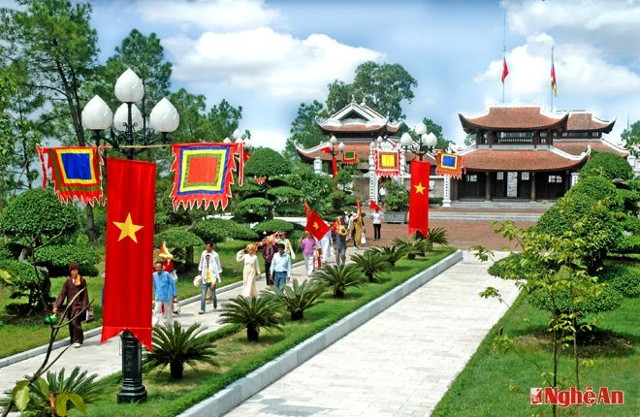 |
| Quang Trung Temple - an attractive tourist destination in Vinh City. |
Nestled in a picturesque pine forest at an altitude of 97 meters above sea level, the Quang Trung Emperor Temple, located on Dung Quyet Mountain in Trung Do Ward, Vinh City, is an indispensable destination in the spiritual tourism guide for visitors to Nghe An. It is also a significant site for young people to visit, learn about, and understand the most glorious chapter in the nation's history…
Following a 1 km winding mountain path, visitors will enjoy the fresh air of nature. After climbing 81 steps, the temple's architecture appears majestic, imposing, and ancient, typical of Vietnamese temple architecture. The temple is built in the four-pillar ceremonial gate style, consisting of one large gate and two smaller gates symmetrically on either side; the large gate has two levels and eight roofs made of lim wood in a layered style, all three gates are covered with curved tiles, and at the main gate on either side are two guardian deities guarding the temple. Next is a four-pillar screen made of Thanh Hoa stone with carved patterns. Behind the screen are two stele houses facing each other, parallel to the main axis. The stele house on the left contains a large drum and a stele inscribed with the achievements of Emperor Quang Trung, recording the glorious milestones in the Emperor's great career.
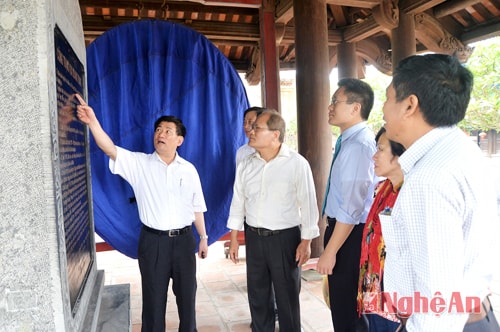 |
| Comrade Ho Duc Phoc introduces the stele at Quang Trung Temple to Professor and Academician Ho Hoang Mat. Photo: Sy Minh. |
The stele on the right contains a large bell and a stele inscribed with a poem by President Ho Chi Minh about Emperor Quang Trung, expressing national pride. Following this are the left and right side buildings, each with three bays and two wings, constructed of ironwood. The right side building is for receiving delegates and visiting groups. The left side building houses a display of documents and artifacts related to the life and activities of Emperor Quang Trung and the Tay Son Dynasty. Between the two buildings is a spacious 1,500m² courtyard with a garden of banyan trees, bodhi trees, and potted plants, blending harmoniously into the picturesque pine forest.
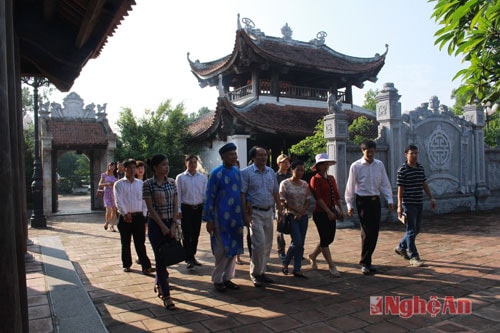 |
| Tour operators survey Quang Trung Temple (Vinh City). Photo: Dao Tuan. |
The lower, middle, and upper halls, considered the center of the entire temple, are designed in the shape of the Chinese character "三" (three), rising in height. All three halls are made of ironwood, carved with motifs in the Nguyen Dynasty style. The lower hall is the largest, covering 180 square meters, comprising three bays with a two-tiered roof structure. Between the two tiers is a balustrade with decorative railings to allow ventilation and natural light, adding to the grandeur, magnificence, and antiquity of the entire temple. The altars in the temple are arranged according to the traditional Vietnamese worship practices of Buddha in the front, and saints in the back. The altar of Shakyamuni Buddha is solemnly placed in the central bay of the front hall, where devotees express their reverence to the Buddha. To the left are the altars of the Four Palaces and the Three Holy Mothers. To the right is the altar dedicated to Nguyen Than, the governor of Nghe An during the Tay Son Dynasty.
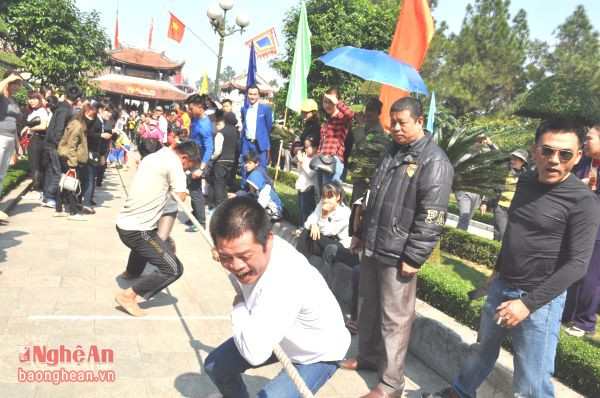 |
| Tug-of-war at the Quang Trung Emperor Temple Festival. (Photo by Thanh Thuy). |
Every year, the Quang Trung Emperor Temple holds two major festivals: the 29th day of the 7th lunar month – the anniversary of Emperor Quang Trung's death – and the 5th day of the 1st lunar month – the anniversary of the Ngoc Hoi - Dong Da Victory. Especially on the anniversary of the Ngoc Hoi - Dong Da Victory, the Quang Trung Emperor Temple organizes a ceremony to issue amulets and blessings, praying for peace and good fortune for everyone in the new year.
Mr. Vu Hong Duc, Head of the Management Board of the Quang Trung Emperor Temple, said: This year's commemoration ceremony for King Quang Trung will take place on August 31, 2016 (corresponding to the 29th day of the 7th lunar month of the Year of the Monkey) at the Quang Trung Emperor Temple - Dung Quyet Mountain - Trung Do Ward - Vinh City. The ceremony has two main parts: The ceremonial part includes the offering of sacrifices, incense, flowers, and thanksgiving; the festive part includes performances of traditional martial arts… All these activities aim to commemorate the merits of King Quang Trung, educate the younger generation about patriotic traditions, and introduce the cultural and historical value of the Quang Trung Emperor Temple to people inside and outside the province.
PV
| RELATED NEWS |
|---|