
The profession of rescuing sex slaves from ISIS
Death constantly lurks for those operating undercover in IS territory to rescue women held captive by the group.
Death constantly lurks for those operating undercover in IS territory to rescue women held captive by the group.
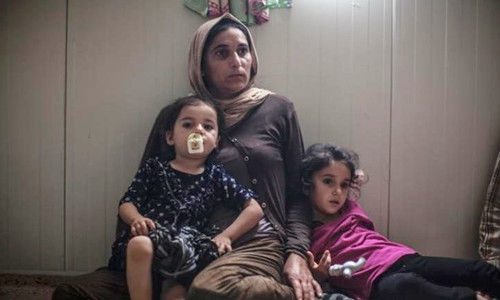 |
Halo and her children were rescued from ISIS. Photo: Telegraph. |
When Halo Kald, a 30-year-old Yazidi, was held captive in Raqqa—a stronghold of the Islamic State (IS) group—a veiled woman approached her and pressed a copy of the Quran into her hand.
"Follow me," the woman said. At that moment, Halo's captors were praying. Was it a trap? Seemingly noticing Halo's hesitation, the woman took out a cell phone and played a recording for Halo to listen to.
Halo quickly recognized the voice as Kurmanji, a Kurdish dialect commonly spoken by the Yazidis. Halo immediately followed the woman."I recognized Abdullah's voice; he had been in secret conversations with me for two weeks. I knew it was my chance to escape," Halo recounted.
According to the Telegraph, in August 2014, ISIS militants raided Halo's village, located south of Sinjar in northwestern Iraq. More than 400 men were subsequently executed and buried in a mass grave. Halo's nine-year-old son, Hani, was also included with the men before being released due to his young age. Women and children were then taken to the ISIS stronghold of Tal Afar, situated between Mosul and Sinjar, and imprisoned with other prisoners in an old school building. Many women were forced into sexual slavery by ISIS.
They might be able to escape, but the chances are slim. Halo remembers a mother and her two children being discovered trying to flee. The ISIS gunmen then took the children away, and she never saw the mother again.
Throughout her captivity, Halo was starved for days and frequently tortured and treated like a slave, but for the sake of her children, she clung to a faint glimmer of hope.
An Arab family linked to ISIS took pity on Halo and lent her a phone so she could speak to her husband, Cihad. Halo then contacted Abdullah, one of the top five Yazidi rescuers in Duhok, Iraq, with a reliable network of about 30 contacts.
"We used the Quran as a disguise, pretending to visit graves to mourn our loved ones," Abdullah revealed. "IS's Achilles' heel is Islam. The Quran acts like a passport, dispelling all doubts."
After passing through checkpoints, Halo was taken to a shelter on the outskirts of Raqqa. She and her children hid in an underground bunker for five days with other Yazidis. Finally, after a nighttime drive, they reached the Kurdish-controlled city of Kobane.
Death lurks
Before being swept away by IS, the Yazidi population in Sinja was over 400,000. IS executed 3,000 Yazidi men and captured more than 6,000 women and children.
Over the past two years, more than 2,500 Yazidi prisoners have escaped or been rescued in operations similar to Halo's. All of the rescuers have faced death at some point.
One of them, Idriss, survived a mass execution. When shot in the leg, he feigned death beneath the bodies of the other victims. After the incident, Idriss refused to leave Iraq. "Helping others escape was a completely natural reaction after experiencing the nightmare of being buried alive."
Abdullah said he had never intended to get involved in the world of human trafficking until his kidnapped niece called from Raqqa. "I was at my brother's house when the phone rang. My niece was asking for help," he recalled.
After freeing his nephew in October 2014, Abdullah formed a team of people specializing in freeing prisoners from ISIS and their collaborators.
Before the war, he was involved in the auto parts business throughout Syria, so he had many connections from Raqqa to Aleppo. Now, he uses that trusted network and has successfully carried out around 250 rescue operations.
"The rescue operation began the moment the kidnapped girl called home. Without that phone call, we couldn't have helped," Abdullah said.
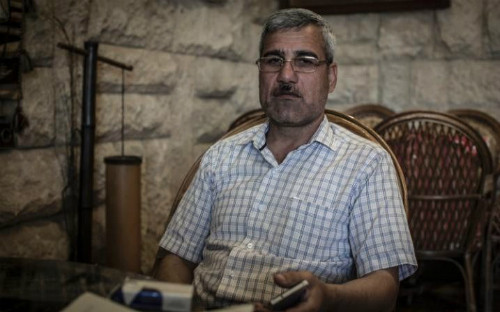 |
Abdullah, a professional ISIS hostage rescuer. Photo: Telegraph |
After the family contacted Abdullah, he began gathering information about the abducted girls. The surveillance was carried out by his contacts on the ground. Sometimes they would monitor the girls' captivity for weeks at a time before attempting a rescue.
Taking prisoners out of custody is the most dangerous part. "We usually do it when the kidnappers are praying. That's when they're most off guard," Abdullah explained.
If undercover agents inside IS-controlled areas were captured, they were certain to be executed. After every two operations, Abdullah rotated his men to ensure their safety. But success also required strategic investments: time and skill.
In central Raqqa, the rescuers rented a bakery and a laundry facility to deliver bread and clothes to the homes of the detained Yazidis. According to Abdullah, his network consisted entirely of local Arabs, some of whom had previously fought for ISIS.
"One of my men, Omar Ahmed, lost an arm fighting for ISIS. He then switched allegiance to me," Abdullah recalled. "Because he had been wounded on the battlefield, no commander suspected anything, making him an invaluable asset."
Abdullah excitedly recounted how he outsmarted ISIS. However, life and death can sometimes be separated by just a phone call. After 38 operations in 11 months, Abdullah's one-man associate was captured.
"Omar Ahmed arrived in Raqqa after receiving a rescue offer. It was an ISIS trap," Abdullah recounted. "He was beheaded in front of a crowd as a warning to others." Each time a rescuer was captured, the network became more difficult, and the work more dangerous.
Omar Ahmed is not the first case, and certainly not the last. "ISIS knows we have insiders," explains Khalil, a Yazidi prisoner rescuer. Khalil's network operates primarily in the Mosul area. "As soon as they suspect someone, they set a trap."
Khalil described how a girl was told by her captors that she would be allowed to return to her family and was instructed to go to the house of Mustafa, an Arab suspected of supporting the Yazidis.
Despite her suspicions, the girl followed the order to be set free. "After a few days, ISIS searched the house and found the girl. It was a trap for Mustafa. They killed him immediately."
The high price
After several Arab traffickers were executed, Abdullah had to pay more and more money to members of his network. "Since the executions, my entire network has been demanding more money," Abdullah said. "In the world of human traffickers, the more dangerous a rescue is, the higher the cost."
People like Abdullah and Khalil became heroes in the Yazidi community, helping to rescue hundreds of abducted women.
However, Amy Beam, an activist in Duhok, has a different perspective. "These Yazidis are usually the ones who like to brag. The real heroes are the Sunni Muslim Arabs who work as intermediaries in ISIS-controlled areas."
According to this activist, people like Abdullah and Khalil are merely remote logistics coordinators. Being Yazidi, they never had the opportunity to operate in ISIS-controlled areas.
Khalaf, a resident of the Qadia refugee camp but originally from the same village of Kocho as Halo, said his family was captured by IS and taken to Mosul.
He recounted how his daughter, Leila, escaped from the jihadists with the help of a local Arab man named Akram. This was the man who called Khalaf when he found Leila and hid her in his house for 45 days along with other fleeing Yazidis.
"Finally, he passed through the checkpoints in Mosul, pretending Leila was his daughter," Khalaf recounted. "Akram refused any money. He knew many Yazidi people and simply wanted to help alleviate their suffering."
Along with his cousin Suleyman, Khalaf rescued hundreds of other Yazidi people who had been abducted from their village. Unlike Abdullah and Khalil, who lived in large, newly built apartments on the outskirts of Duhok, the two cousins lived with the people they sought to help, without seeking ostentation.
"In Sinja, Arabs and Kurds live together. We have many friends, and it was that friendship that helped rescue the abducted women. But once the money started changing hands, rescuing the Yazidis became a kind of business," Khalaf said.
The Arabs who once risked their lives to rescue kidnapped women without expecting any reward are now wondering: "If everyone around us is making money, why can't we, when the mission is so dangerous?"
Within ISIS, there are also fighters who try to sell Yazidi victims back to their families for profit. Last year, Suleyman received a call from Raqqa from his sister. A Moroccan ISIS fighter had bought her and wanted to sell her back to her family. The price offered was $45,000.
According to Khalaf, in the early days of the rescue operations, the amount of money spent was quite small. "Sometimes ISIS members only demanded $2,000 to free the women, but now $20,000 is considered cheap," Khalaf explained. And because the price is so high, many Yazidi families cannot afford it.
Activist Amy Beam argues that rescuing hostages is not a long-term solution. "The only way to protect the Yazidi people and other communities is to defeat ISIS and establish lasting peace in the Middle East," she said.
According to VNE
| RELATED NEWS |
|---|