

Minimum wage increase for 2017: Finalized at 7.3%
The average increase of 7.3% in the regional minimum wage for employees in businesses in 2017 received the highest level of consensus from all parties involved to date.
Deputy Prime Minister Vuong Dinh Hue has agreed with the proposal of the National Wage Council to adjust the regional minimum wage for 2017, increasing it by 180,000 - 250,000 VND compared to 2016, equivalent to 7.1% - 7.5%, with an average increase of 7.3%. Specifically, regions I and II will see an increase of 7.1%, region III an increase of 7.4%, and region IV an increase of 7.5%.
 |
| Deputy Prime Minister Vuong Dinh Hue agreed with the National Wage Council's proposal on adjusting the regional minimum wage for 2017. (Illustration photo: VNA) |
The Deputy Prime Minister's decision was made at a meeting of the Central Steering Committee on reform of wage policies, social insurance, and preferential treatment for meritorious individuals, to discuss the proposed adjustment of the regional minimum wage on the afternoon of September 7th.
According to Deputy Minister of Labour, Invalids and Social Affairs Pham Minh Huan, adjusting the regional minimum wage in 2017 is necessary. This wage is basically approached according to market principles.
The average increase of 7.3% in the regional minimum wage for employees in businesses in 2017 received the highest level of consensus ever. The Ministry is drafting a Decree to solicit opinions from ministries, sectors, and localities before submitting it to the Government for consideration and promulgation.
Deputy Minister Pham Minh Huan stated that implementing the above plan would ensure real wages for workers, improving them in line with a 2-2.5% increase in labor productivity, and moving towards a roadmap that guarantees the minimum needs of workers.
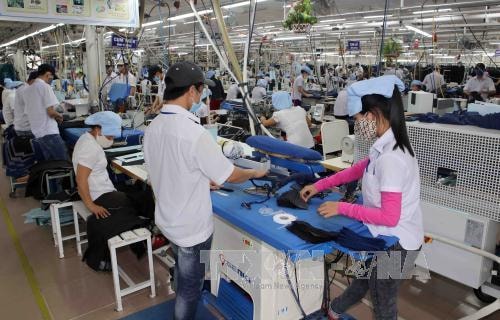 |
| The adjustment of the regional minimum wage in 2017 achieved the highest level of consensus among all parties ever. Photo: Tran Le Lam - VNA |
The above plan also takes into account the difficulties faced by businesses in terms of employment, unemployment, production, and operations, especially in the context of the 2016-2017 implementation of the Social Insurance Law, which requires social insurance contributions based on both salary and salary allowances; the impact on business costs is moderate, contributing to gradually ensuring the minimum living needs of workers and facilitating business production.
The difficulties and challenges highlighted by the Deputy Minister include the increased costs for businesses as they have to adjust both employee wages and social insurance contributions. Currently, the total social insurance contribution rate is 32.5% of wages, with employers paying 22%.
Many employers believe that the social insurance contribution rate is too high and needs to be adjusted down to 18%. Mr. Pham Minh Huan stated that the National Wage Council has calculated and proposed a reduction in the contribution rate for some social insurance costs for businesses.
Speaking at the meeting, Deputy Prime Minister Vuong Dinh Hue, Head of the Central Steering Committee on reform of wage policies, social insurance and preferential treatment for meritorious people, directed the Ministry of Labor, War Invalids and Social Affairs to urgently complete the process of appraising and gathering opinions from ministries, sectors, and business associations on the proposed increase in the regional minimum wage for 2017, and submit it to the Prime Minister for consideration and signing in September 2016.
The Deputy Prime Minister requested the Ministry of Labour, Invalids and Social Affairs to take the lead and coordinate with other ministries and agencies to research and propose additions and amendments to the criteria for determining regional minimum wage levels in the revised Labour Code, in line with reality; and to strengthen solutions for providing labor market information to ensure social consensus in agreeing on annual regional minimum wage increases.
In addition to meeting the minimum living standard, several factors must be considered, such as the relationship between increased labor productivity and wage growth rates, the competitiveness of businesses, and the development of harmonious, stable, and progressive labor relations within enterprises.
According to VNA
| RELATED NEWS |
|---|