

Leaked details of the Russia-US agreement on Syria.
On September 16, AP, citing a senior military source, revealed some details of the Russia-US agreement on Syria signed on September 10.
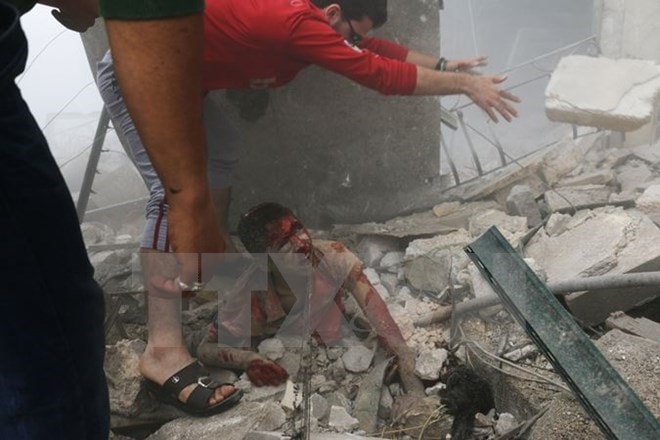 |
| Victims are being transported from the rubble after an airstrike in Aleppo on September 10. (Source: AFP/VNA) |
According to sources, as part of the ceasefire, the US will send its surveillance aircraft from other regions to Syria and increase the number of intelligence analysts to coordinate actions with Russia.
The source stated that the US would have to deploy aircraft from other locations because its military officials are unwilling to halt the coalition's anti-ISIS campaign in Syria and Iraq, led by Washington.
Additionally, the increased number of intelligence experts aims to verify airstrikes against Jabhat Fateh al-Sham (the new name for the Al-Nusra Front), a group that is infiltrating the US-backed rebel forces.
Meanwhile, on the same day, the Russian Ministry of Defense announced that it was ready to extend the ceasefire in Syria for another 72 hours, despite previously asserting that only Russia and the Syrian government forces were strictly adhering to the agreement reached with the United States.
The Russian Defense Ministry statement emphasized that although this was a bilateral agreement, the US had been unable to use its influence to force the rebel groups, which Washington calls the "moderate opposition," to fully comply with the ceasefire agreement.
However, Washington insists that Syrian government forces have not yet withdrawn from several strategic positions to pave the way for UN convoys to reach besieged cities and towns to deliver humanitarian aid. The US also stressed that unless this is done, the joint airstrike plan against extremist jihadist groups between the two countries will not be implemented.
Earlier that day, US Secretary of State John Kerry and his Russian counterpart Sergei Lavrov also held a telephone conversation regarding the implementation of the ceasefire agreement, humanitarian aid, and counter-terrorism cooperation in Syria. Both sides agreed that fighting on the ground had significantly decreased and supported making the ceasefire permanent.
However, Russian Foreign Minister Lavrov also noted to the US that some rebel groups were violating the ceasefire and urged Washington to fulfill its commitment to distinguish between moderate opposition groups and terrorist groups.
For his part, US Secretary of State John Kerry hoped Moscow would use its influence to urge the Syrian army to open the way for UN convoys to deliver humanitarian aid to people in besieged areas, particularly the city of Aleppo in northwestern Syria. In addition, both sides agreed to continue discussions on these issues.
Meanwhile, on the ground in Syria, the Russian Ministry of Defense announced that Syrian government forces had moved troops and weapons back to Castello – a vital route to Aleppo – because opposition groups, which the US calls moderate, had not yet withdrawn in accordance with the Russia-US ceasefire agreement.
However, the Free Syrian Army (FSA), one of the moderate opposition groups, claimed to have retreated about 1.5km from the Castello road, while emphasizing that they had not seen any similar moves from the Syrian army.
Accusations by warring parties in Syria of failing to abide by the ceasefire agreement are complicating the situation in the Middle Eastern country.
According to the Russian Ministry of Defense, Syrian opposition forces violated the ceasefire 144 times.
According to VIETNAM+
| RELATED NEWS |
|---|