

Emperor Quang Trung - The general who was "victorious in every battle"
(Baonghean) - Nguyen Hue (1753 - 1792), also known as Emperor Quang Trung, was the second emperor of the Tay Son dynasty, after Emperor Thai Duc Nguyen Nhac. Besides his glorious military achievements, he was also one of the most talented political leaders with many reforms to build the country, and an outstanding military strategist in Vietnamese history.
Nguyen Hue - Quang Trung was born in the year of Quy Dau (1753). His ancestors were originally from the Ho family in Hung Nguyen, Nghe An; later they moved to Quy Nhon and changed their surname to Nguyen. Witnessing the conflict between the Trinh and Nguyen feudal factions, the division of North and South Vietnam, the suffering of the people, and the misery of the country, in 1771 he and his brothers Nguyen Nhac and Nguyen Lu raised the banner of rebellion in Tay Son (Binh Dinh).
Nguyen Nhac, Nguyen Hue, and Nguyen Lu are renowned for their exceptional martial arts skills and for founding several martial arts styles in Binh Dinh. Nguyen Hue created Yen Phi Quan, Nguyen Lu created Hung Ke Quan, and all three brothers created Doc Lu Thuong. These three brothers – the Tay Son Three Heroes – played a significant role in the formation and development of the Tay Son Binh Dinh martial arts. They not only created martial arts styles but also reformed forms and weapon techniques to teach the army during the early stages of the rebellion.
 |
| Landscape of the Quang Trung King's temple (Dung Quyet mountain, Vinh City). Photo: Sy Minh |
In the year of Tan Mao (1771), Nguyen Nhac launched an uprising, establishing a base to fight against the government in Tay Son (Binh Dinh). During this period of building power, Nguyen Hue assisted Nguyen Nhac in developing the economy and training the military. After two years of rebellion, in the year of Quy Ty (1773), the Nguyen brothers captured Quy Nhon citadel. From there, the Tay Son army attacked neighboring areas. By the end of 1773, they controlled the area from Quy Nhon to Binh Thuan. This "invincible" army weakened the Nguyen lords' government. At that time, Nguyen Hue was only 20 years old, and Nguyen Nhac appointed him as the commander-in-chief to lead the army south. From here, Nguyen Hue's military career and talent were further affirmed.
The Tây Sơn army's campaigns against Gia Định (now Ho Chi Minh City) were all major operations. In particular, the battle of the year Đinh Dậu (1777), which annihilated the Nguyễn lords' government in the South, left a strong mark on the three Nguyễn Huệ brothers. In the year Mậu Tuất (1778), Nguyễn Nhạc ascended the throne as emperor, taking the title Thái Đức. Immediately, Nguyễn Huệ was appointed Long Nhượng General. At that time, Nguyễn Ánh was also appointed lord by the Nguyễn dynasty (1762-1820) and led his army to retake Gia Định.
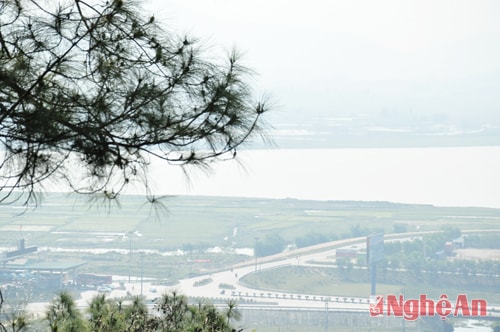 |
| From the Quang Trung King Temple, visitors can look to the left and see the Lam River flowing like a soft silk ribbon. |
In March 1782, Nguyen Hue and Nguyen Nhac led their land and naval forces south, decisively defeating Nguyen Anh's army. Nguyen Anh fled to Hau Giang, then to Ha Tien, and finally took refuge on Phu Quoc Island. Pursued by the Tay Son army, Nguyen Anh eventually fled to Siam to seek assistance. Nguyen Hue arranged a battle formation and lured the Siamese army to Rach Gam - Xoai Mut (above My Tho City) for a major battle that annihilated the Siamese forces. The victory at Rach Gam - Xoai Mut, commanded by Nguyen Hue, struck fear into the hearts of the Siamese. From then on, they "feared the Tay Son like they fear tigers."
Meanwhile, in Northern Vietnam, Lord Trinh's power was weakening, so Nguyen Nhac decided to capture Phu Xuan (Hue). In the year of Bing Ngo (1786), Nguyen Hue was appointed commander-in-chief to lead troops north to defeat Lord Trinh's forces. In April of the year of Mau Than (1788), King Le Chieu Thong abandoned the capital and went into exile. Nguyen Hue then led troops north for the second time to defeat Vu Van Nham, after which Nguyen Hue withdrew his troops to Phu Xuan.
At that time, King Le Chieu Thong of the Le Dynasty fled to the Qing Dynasty to seek help. Immediately, Emperor Qianlong (1711-1799) ordered Sun Shiyi to lead 290,000 troops across the Nam Quan Pass into Dai Viet. Faced with this situation, Nguyen Hue decided to ascend the throne as Emperor, taking the regnal name Quang Trung. He led his army north and completely annihilated the invading Qing army in early 1789 (the year of the Rooster).
On July 29th, 1792 (the year of the Water Rat), Emperor Quang Trung suddenly passed away at the age of 40. The death of Nguyen Hue was an irreplaceable loss for the Tay Son dynasty. His legacy lacked a worthy successor to preserve it, and it quickly fell into the hands of Nguyen Anh.
PV
| RELATED NEWS |
|---|