
Breakthroughs after equitization
Over 13 years of implementing the restructuring and reform of state-owned enterprises (SOEs) towards equitization has proven to be an inevitable and correct direction to improve the operational efficiency of SOEs, thereby promoting economic development.
(Baonghean)Over 13 years of implementing the restructuring and reform of state-owned enterprises (SOEs) towards equitization has proven to be an inevitable and correct direction to improve the operational efficiency of SOEs, thereby promoting economic development.
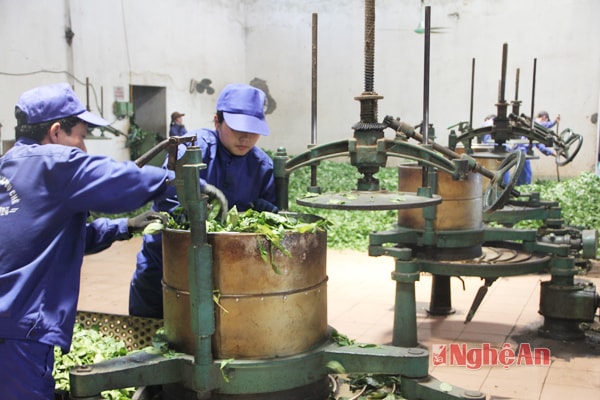 |
| Hung Son Tea Processing Enterprise (Anh Son) operates efficiently after privatization. Photo: Cong Sang. |
Innovation after privatization
Equitization is both a good opportunity for development and a major challenge for construction companies, as this sector requires mobilizing large amounts of capital from shareholders to invest in modern equipment and machinery to meet production requirements. Therefore, many businesses operate efficiently after equitization.
Company 495 Joint Stock Company is a business transformed from Company 495, a limited liability company specializing in road construction and management. Its main task is to maintain and repair roads, ensuring traffic safety on National Highway 7 from Dien Chau to Nam Can Border Gate - Ky Son (127 km), and National Highway 48C from Khe Bo - Tuong Duong to Quy Hop town. From 2002 to 2007, the company faced many difficulties. Despite having 400 employees, the average worker's salary was only slightly over 1.5 million VND, leading many to resign. Mr. Le Canh Hai, Director of 495 Joint Stock Company, stated: “The company underwent equitization in October 2012, with a charter capital of 13.5 billion VND. After converting to a joint stock company model, the unit faced many challenges such as a lack of investment capital for production, outdated equipment and machinery, and fierce competition with many businesses… Faced with this reality, the company reorganized its management mechanism, streamlined its production apparatus to only 230 people, including 10 Traffic Management Units and 3 Construction Teams. At the same time, it mobilized investment capital to purchase additional modern equipment and machinery such as excavators, loaders, transport trucks, rollers, and invested in a stone crushing and screening line with a capacity of 40 tons/hour, and a ready-mix concrete plant in Anh Son. With this capacity, the enterprise has been able to expand its construction projects both within and outside the province.”
Following the equitization process, the company has successfully carried out its road maintenance and repair duties, ensuring traffic safety on the routes under its management. The company has also boldly expanded its production and business activities, undertaking many large-scale projects. Mr. Nguyen Tat Minh, a technical officer at the Concrete Plant of Company 495, stated: “Thanks to equitization, employees have become truly committed and responsible to the company. Everyone works with a greater sense of responsibility, and productivity and product quality have increased, leading to higher incomes. The average monthly salary for employees is 5.6 million VND (twice the amount before equitization). In addition to receiving full insurance coverage, employees are entitled to a 13th-month salary, and the company has established a risk fund of over 320 million VND to support workers in case of workplace accidents…”
The equitization process also "unleashed" and created momentum for the breakthrough of Company 479. In 2005, Company 479 transformed into a joint-stock company, and with a new business management method and capital contributions from shareholders, the company gradually consolidated and developed. After equitization, one of the important factors that helped the company affirm its important position in the field of bridge and road construction in Vietnam was investment in equipment and technological innovation. The success of Company 479 lies in its ability to seize and leverage the advantages of equitization. Therefore, from a unit facing many difficulties, the company has consistently achieved growth rates of 18-25% per year, and in 2013, the company achieved a production value of nearly 500 billion VND. In 2014, the company is focusing on constructing several projects with a production value of approximately 560 billion VND. Mr. Duong Hong Be, Chairman of the Board of Directors of 479 Joint Stock Company, stated: “With the determination to create a competitive advantage in the field of bridge and road construction, the company has focused on investing in equipment and innovating technology. In just the past 5 years, we have invested more than 100 billion VND (out of a total of nearly 192 billion VND in original fixed assets) to purchase 22 cranes ranging from 20 to 80 tons, 14 various types of pile drilling rigs, a ready-mix concrete plant, 8 concrete pumps, 4 sets of cantilever casting vehicles, 2 pile driving hammers, 5 floating platforms, and many other valuable pieces of equipment.”
In the agricultural sector, Nghe An Agricultural Materials Joint Stock Corporation has always been recognized as one of the leading units in contributing to the provincial budget. The achievements today are due to the highly effective implementation of the enterprise's equitization process. Nghe An Agricultural Materials Joint Stock Corporation, formerly Nghe An Production Materials Company, faced numerous difficulties before equitization: capital was less than debt, and the company was entirely dependent on bank loans; infrastructure, technical capabilities, and the professional skills of its employees were all inadequate. In 2005, the company implemented the Party and State's policy on restructuring and reforming enterprises through equitization. To prepare for equitization, the company began accumulating initial capital for its employees starting in 2002. By allocating a portion of their monthly income and annual bonuses, employees and workers contributed 15 billion VND in on-site capital at the time of privatization.
With sound finances and pre-prepared funds for share purchases, the company's equitization was completed in just two months, the fastest and highest quality among the province's enterprises. Notably, 100% of employees received shares. In 2008, the company divested state capital. After nine years of equitization, the company's performance has continuously improved. Its charter capital increased from 17 billion VND to 250 billion VND; revenue increased from 250 billion VND to 1,500 billion VND, contributing 25-35 billion VND to the state budget annually, and the living standards of its employees have improved. Mr. Truong Van Hien, Chairman of the Board of Directors and General Director of the company, stated: Before equitization, the company implemented a system of contracting out to its units, fostering a proactive mindset and avoiding reliance on state subsidies. This, in turn, gave employees a good understanding of market mechanisms. CPH also empowers leaders and assigns responsibility for building a continuously growing company.
An opportunity for screening
It can be said that equitization is the right direction for state-owned enterprises. Not only the Agricultural Materials Joint Stock Company, but also the Song Lam Paper Joint Stock Company, since its equitization in 2004, has marked a comprehensive development step. Before equitization, the company's charter capital was 2 billion VND, but it was still in debt and took two years to repay. Now, the company's charter capital has been increased to 30 billion VND, annual revenue is approximately 100 billion VND, and it contributes about 10 billion VND to the state budget. Thanks to the equitization process, the company's organizational structure operates more efficiently by proactively approaching partners and finding raw material sources to stabilize production. Mr. Hoang Phung, the company's director, said: "Without equitization, the company's operations would not have achieved such high results today. This provides a solid foundation for the company to proactively adapt to the market mechanism."
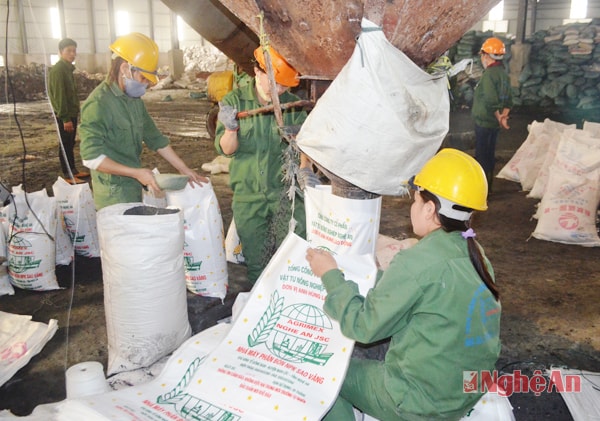 |
| Production line at Sao Vang Fertilizer Company (Nghe An Agricultural Materials Corporation). |
However, some once-thriving enterprises, after equitization, failed to develop and their image faded, such as: Cau Duoc Cement and Building Materials Joint Stock Company, Tourism Joint Stock Company, Mountainous Region Trade and Investment Development Joint Stock Company, Vinh Leather Joint Stock Company, and Livestock Processing and Export Joint Stock Company... Over more than 7 years of equitization, the Mountainous Region Trade and Investment Development Joint Stock Company has faced many difficulties and is operating at a sluggish pace. Before equitization, the company was considered one of the reputable and profitable units highly regarded by the province. However, by 2010, when the enterprise proceeded with equitization, there were still some outstanding debts due to a joint venture with an enterprise in Hanoi.
This is the main reason why the company faced difficulties in the following years. Mr. Nguyen Van Dung, Chairman of the Board of Directors of the company, said: Due to the company's financial difficulties, coupled with the global and domestic economic crisis, the company's business operations were ineffective. Currently, the company has bad debts, and without collateral, it faces significant difficulties in securing capital for production and business. Therefore, after more than 7 years of equitization, the company's operating capital remains stagnant at over 2.2 billion VND, and annual profits only reach 150-200 million VND.
In reality, the transition to the equitization model has proven effective for most businesses operating in the bridge and road construction sector. Some businesses have even achieved "breakthrough" growth in production and business. However, many construction companies have suffered losses, accumulated tax and insurance debts, and had their tax invoices suspended after equitization. This demonstrates that business integrity and construction capabilities are crucial conditions for businesses to survive and thrive.
Mr. Vo Hong Duong, Deputy Chief of the Provincial People's Committee Office and Deputy Head of the Provincial Steering Committee for Enterprise Reform and Restructuring, stated: Most enterprises, after equitization, have affirmed that their financial performance is significantly better than before equitization. The remaining enterprises that have failed to perform well are due to the fact that their management structure and business systems have not been reformed, their management and operational methods have been slow to change, and the quality of their human resources is not high enough... The restructuring and reform in some enterprises have only been a case of "new wine in old bottles."
To date, the province still has 26 wholly state-owned enterprises that have been converted into single-member limited liability companies under the ownership of the Provincial People's Committee. Of these, 7 are public service enterprises operating in the fields of irrigation and environment, receiving annual targets from the State, while the rest are state-owned agricultural and forestry farms. According to the plan approved by the Prime Minister in 2011, 20 enterprises – mainly single-member limited liability companies in agriculture and forestry in the province – will continue to maintain 100% state ownership. Currently, the Provincial People's Committee is carrying out procedures to contribute all capital and assets on land at Song Con Agricultural Limited Liability Company to form Song Con Agricultural and Industrial Limited Liability Company with Song Con Sugar Company. Six more enterprises must undergo equitization during the 2011-2015 period, including the Nghe An, Cua Lo, Dien Chau, Quynh Luu, and Thai Hoa Water Supply Companies and the Nghe An Urban Environment Company.
In the coming period, the province will focus on implementing three key areas. Along with accelerating the equitization process at six enterprises and striving to complete it by 2014, or at the latest by 2015, divestment will be carried out in enterprises that do not require state capital. Recently, the Politburo issued Resolution 30-NQ/TƯ on continuing to restructure, innovate, develop, and improve the operational efficiency of agricultural and forestry companies. Currently, the Provincial People's Committee is awaiting the Government's issuance of an action plan for implementation.
Over the past 13 years, Nghe An province has basically completed the restructuring and reform plan for state-owned enterprises under provincial management, as approved by the government. 167 state-owned enterprises have been restructured and had their ownership forms transformed. This includes 86 enterprises that were equitized, 6 that were sold under contract, 6 that were dissolved, 40 that were merged, 2 that went bankrupt, 1 that was converted into a two-member company, and 26 that were converted into single-member limited liability companies. After the transformation, most enterprises have operated effectively, especially those that were equitized. Charter capital, revenue, profits, budget contributions, and employee income have increased. The total revenue of the 112 equitized enterprises and single-member limited liability companies reached over 5,078,509 million VND; pre-tax profit was 78,734 million VND, and budget contributions reached 354,556 million VND. |
Economic Reporting Team