

Cow urine is selling like hotcakes in India.
Hindus once believed that cows were sacred animals and that their urine possessed miraculous healing properties. Today in India, the practice of using cow urine is experiencing a resurgence and becoming a major trend in the healthcare industry, with numerous benefits.
Holding a large basin, Susheela Kumari patiently walks around behind 24 cows on a farm in Bulandshahar, 80 km east of New Delhi. She intently watches the animals' tails, ready to wait for the slightest movement, such as a wagging tail or arching her back as if preparing to urinate.
Every day, Kumari and two colleagues have to stand guard by the cow shed, collecting about 15-20 liters of the animals' urine. Kumari shared: "The most difficult task in our job is waiting to collect the cow's urine because you never know when the animal needs to urinate. And the owner doesn't want to waste a single drop."
Susheela Kumari collects cow urine. |
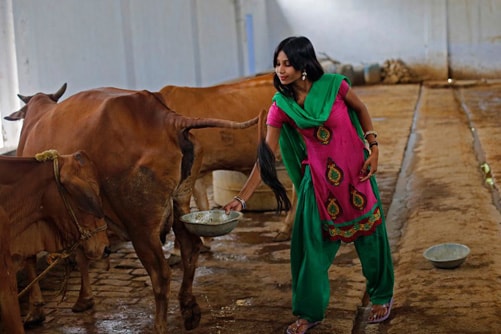
Most farm workers rely on experience to determine when a cow will urinate. This requires patience as well as knowledge of each cow's habits. A worker collecting cow urine is paid 1,200 rupees a month.
Over the past two years, Indian Prime Minister Narendra Modi has implemented policies to protect dairy animals such as goats and cows. The Mumbai government launched the Rashtriya Gokul Mission in 2014 with a total investment of $87 million to build cattle farms, prevent illegal slaughter, and tighten measures against the smuggling of cattle to neighboring Bangladesh.
Accordingly, instead of being sent to slaughterhouses, old cows that have stopped producing milk are transferred to a private farm to extract their urine. A portion of the profits from selling cow urine is used to build the farm and care for the cows. Currently, each liter of distilled cow urine sells for 80-100 rupees (US$1.2-1.50) in India, more expensive than cow's milk (40-50 rupees).
Cow urine is poured into a purification vessel to remove impurities. The distilled portion is filtered, processed into powder or concentrate form, and then sold to manufacturers of traditional medicines. A research team led by Dr. BA Golakia, head of the biotechnology department at Junagadh Agricultural University, analyzed samples of cow urine and discovered traces of gold and 388 substances with significant medicinal value. Approximately 30 different remedies can be prepared from cow urine.
Cow urine is in high demand in India. One of the biggest buyers of cow urine in India is Baba Ramdev, the founder of Patanjali Ayurveda Ltd. He pays 150,000 rupees per day to buy cow urine as a raw material for making soap, detergents, and herbal products. Patanjali's best-selling product is Gaunyle floor cleaner made from cow urine. The company produces 20 tons of Gaunyle floor cleaner daily and still cannot meet market demand. Their product can compete with major international brands such as Unilever and Colgate-Palmolive.
Virendar Kumar Jain, director of the Cow Urine Therapy clinic with 15 experienced doctors in Indore city, said his facility consumes 25,000 liters of cow urine per month and has used this material to treat 1.2 million patients over the past two decades, treating everything from endocrine disorders to cancer. Every day, the facility receives 4,000 online orders through websites like Amazon.
However, some people believe cow urine carries dangerous pathogens. Associate Professor Navneet Dhand, a specialist in biology and epidemiology at the University of Sydney, points out three diseases that humans can contract from cow urine: leptospirosis, which can paralyze liver and kidney function; and bacteria that cause arthritis, pneumonia, and heart attacks.
According to Baotintuc
| RELATED NEWS |
|---|