

The biggest worry for boarding students right now is natural disasters.
(Baonghean) - A reporter from Baonghean Newspaper had a conversation with Mr. Nguyen Van Hung, Principal of Yen Tinh Secondary School in Tuong Duong District.
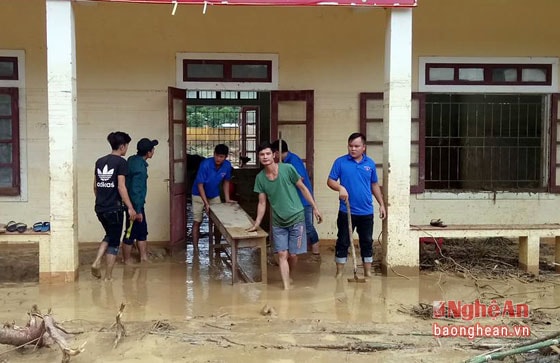 |
| Local forces in Tuong Duong district participated in helping Yen Tinh Secondary School clean up the school premises (photo: Pham Oanh). |
- Hello Mr. Nguyen Van Hung. I understand that Yen Tinh Secondary School has a significant number of boarding students. I would like to discuss this matter with you. First, according to Decision No. 85/2010/QD-TTg, boarding students are those studying at ethnic boarding schools in areas with particularly difficult socio-economic conditions; and other public primary and secondary schools in these areas, approved by the District People's Committee to stay at school for the week because they cannot travel to and from school daily; along with regulations on support policies. What is the actual situation at Yen Tinh Secondary School, sir?
- Boarding students, if viewed simply, are those from remote villages more than 5km away, often living in makeshift shelters built by their parents or staying with relatives near the school. Nowadays, many schools have received government-built boarding facilities, providing practical policy support such as financial assistance for food and accommodation. These provisions are also stipulated in Government Decree 185. Yen Tinh Secondary School has 104 boarding students, and we are also implementing this decree to ensure they can stay and study with peace of mind... From a more humane perspective, boarding students are the most disadvantaged group. They not only have to travel far to school but also face other difficulties related to their mental well-being and living conditions. If we do not closely manage their studies and living arrangements, there are security risks, and the lack of parental care is also a significant disadvantage. For example, if, on the morning of September 14th, all the students at our school hadn't been staying together in the school's dormitory, it would have been very difficult to guarantee their safety from the heavy rain and flooding...
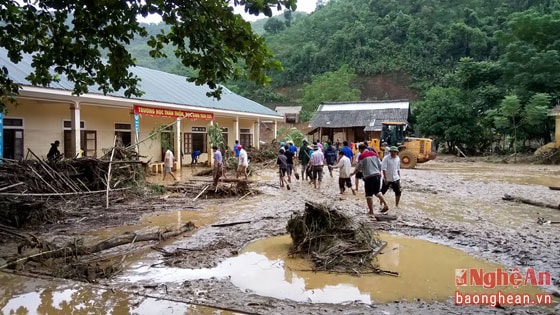 |
| At this point, almost all the desks, chairs, and books at Tuong Duong Secondary School are unusable (photo: Pham Oanh). |
- Despite having over one hundred boarding students, Yen Tinh Secondary School is still not recognized as a boarding school for ethnic minorities. Naturally, this is due to regulations! But as we understand it, this doesn't significantly affect the quality of teaching and learning...
- Specifically, the Ministry of Education has regulations stating that a junior high school must have over 50% boarding students to be recognized as a boarding school for ethnic minorities. Our school is only a few students short of meeting this requirement. As far as I know, many schools have boarding students but haven't been officially recognized as boarding schools for ethnic minorities. However, the state still provides financial support for their meals and accommodation. Other benefits for boarding students are also guaranteed. Or the school will create the best possible conditions for them to live and eat together to ensure their safety.
If there is any disadvantage, it's only this: schools that haven't been officially recognized as boarding schools for ethnic minorities don't receive funding to hire cooks. The school itself assigns cooks. To hire cooks, parents of children in the school's boarding facilities have to contribute money. In our case, we have to hire two cooks, costing 5 million VND per month. This amount is divided equally among the students. Considering the relatively large number of students, this amount, when divided equally, might seem insignificant. However, many parents in mountainous areas struggle to provide food for their children, so paying an additional fee for their children's education is a heavy burden.
- Thus, it shows that in practice, besides government policies, for the learning life of boarding students to be better, it is very important for the Education sector and local authorities to take practical and timely actions and solutions...
- This is something I've always thought about. Local authorities in areas with boarding students need to coordinate with schools to ensure the safety of their children. As I said, the biggest concern for boarding students is security, especially in places where they have to stay in rented rooms or temporary shelters. Secondary school students are at an age where they are growing and are beginning to face social conflicts, so it's difficult to avoid them. The coordination between local authorities and schools will be a good source of moral support for students who have to study far from home. For areas frequently facing natural disasters like flash floods, the "responsibility" of local authorities is even more necessary. These students lack experience in dealing with natural disasters; timely assistance, coupled with a sense of responsibility from the local authorities, is even better. Of the dangers I've mentioned, the highest risk is still boarding students living in rented rooms and areas frequently affected by natural disasters...
Thank you for the conversation!
HV(Perform)
| RELATED NEWS |
|---|