

Will Vietnam purchase Buyan-M class Kalibr missile boats?
A Russian source claims that Vietnam wants to purchase light missile frigates equipped with Kalibr cruise missiles, belonging to the Russian "Buyan-M" class.
Russian expert: Vietnam wants to buy Buyan-M missile boats.
Currently, Russian military experts believe that the "Tarantul" class missile fast attack craft of the Vietnamese Navy (part of the Project 1241 "Molnya" missile boat series), manufactured by the Soviet Union, are now old and outdated, and therefore need to be replaced with modern warships in the near future.
These experts argue that the old warships do not meet modern combat requirements (for example, they lack stealth technology) and cannot fully protect the country's territorial waters. Therefore, Vietnam will not continue to build more ships of this type in the future.
Recently, information has emerged about Vietnam replacing its outdated, Soviet-era "Molnya" class missile boats. The first type of vessel mentioned by experts is the light missile frigate (under 1000 tons) of the "Buyan-M" class (Project 21.631), which is being mass-produced for the Russian navy.
The Buan-M is Russia's most advanced naval warship project, of world-class caliber (the first commissioned in 2013). Therefore, to date, only five "Buan-M" ships have been deployed to the Russian Navy, but four more ships of this project are under construction.
Having only recently entered service with the Russian Navy (March 2013), the small "Buyan-M" class missile frigate, part of Project 21631 (with a displacement of only 949 tons), has already proven the truth that: "Small doesn't mean weak."
Compared to the Soviet Molnya-class ships, the features and equipment systems of the "Buyan-M" project missile boats adhere to the most advanced standards, and their armament is considered to be more powerful than most heavy frigates in the world.
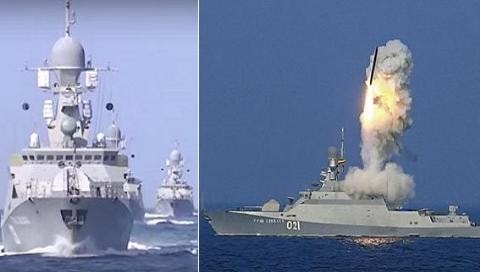 |
Russia's Buyan-M small warships have stunned the world with their Kalibr cruise missiles. |
This light frigate demonstrated its potential to the world last October and this August, when the Caspian Fleet's Buyan-M task force launched attacks on Islamic State (IS) terrorist strongholds in Syria.
On October 7, 2015, four warships of the Russian Caspian Fleet (three Buyan-M vessels) officially joined the operation to attack the terrorist organization "Islamic State" (IS) with the launch of 26 Kalibr-NK cruise missiles from the Caspian Sea into Syrian territory.
These warships launched 3M-14T land-attack cruise missiles of the Kalibr-NK system (the ship-based version) from the Caspian Sea, traveling over 1500km, through Iranian and Iraqi territory to strike ISIS ground targets in Raqqa and Aleppo in Syria.
Less than half a month later, on October 20, a similar devastating barrage of fire fell on IS for the second time, eliminating all targets. And last August, Kalibr cruise missiles from Buyan-M class ships once again struck fear into the hearts of Islamic State terrorists.
Russian experts believe that, following this resounding success, the Vietnamese Navy is seriously considering replacing its Soviet-era Molnya-class ships with Russia's latest "Buyan-M" light missile frigates. In addition, about 10 other countries are also considering purchasing this type of vessel.
The power of the Kalibr-NK cruise missile series.
The Kalibr missile family was developed by the OKB Novator Institute in Yekaterinburg, part of the Almaz-Antei Air Defense Corporation. It is a family of missiles with two versions: anti-ship and ground attack, with numerous variants deployed on various launch platforms.
The Kalibr missiles share a common development origin with the KS-122 strategic cruise missile, part of the S-10 Granat system, which has a range of over 2,500 km, is capable of carrying a 100kt nuclear warhead, was developed by Novator, and entered service with the Soviet Navy in 1984.
However, its successor, the Kalibr family of missiles, is more advanced in its capabilities, capable of both striking land targets at ranges of thousands of kilometers and destroying large surface warships up to 660 km away.
The Kalibr has variants for the Russian Army (Kalibr-M) and Air Force (Kalibr-A), but these missiles are most commonly deployed in the Russian Navy. They are currently being produced for submarines (Kalibr-PL) and surface ships (Kalibr-NK).
In the Kalibr missile system, in addition to torpedoes and anti-submarine missiles, the basic anti-ship version specifically for submarines is designated 3M-54, while the basic land-attack version is 3M-14; the version used on surface ships has a "T" added to its name.
The 3M-14 missile, designated SS-N-30A by the Russian Ministry of Defense (DOD), is an inertial-guided ground-attack variant deployed on Russian submarines, with a range and capabilities comparable to the American Tomahawk cruise missile.
It has a basic length of 6.2 m (20 ft), a warhead weighing 450 kg (990 lb), a range of 1,500–2,500 km (930–1,550 mi), and a subsonic cruising speed of Mach 0.8.
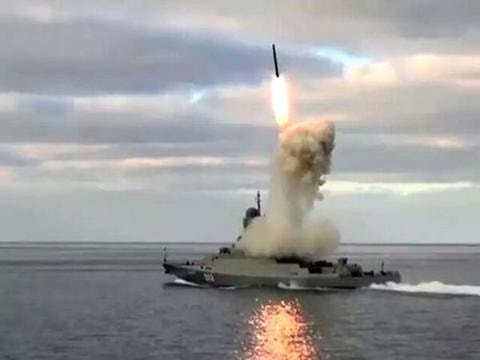 |
Even with a displacement of only 949 tons, Buyan-M class warships can carry up to 8 cruise missiles. |
The 3M-14T missile, also known by its DOD designation SS-N-30A, is deployed on surface ships with a vertical launch system (VLS) and features turbo-vectoring. Its basic length is 8.9 m (29 ft), with other parameters similar to the 3M-14.
The 3M-54 missile, designated SS-N-27A by the Russian Ministry of Defense (DOD) (NATO code name: Sizzler), is a supersonic anti-ship submarine-launched missile with a length of 8.22m, a 200kg warhead, but a maximum range of up to 660km. The final segment of its flight occurs at an altitude of 4.6m above sea level, with a speed of 2.9 Mach.
The 3M-54T missile also has the same designation and code as the 3M-54. This is a surface-launched anti-ship missile (ship-to-ship). Aside from the change in length (8.9 compared to 8.22m), all other parameters of this ship-to-ship missile are identical to the submarine-to-ship version.
Russian Kalibr missiles are deployed on surface ships and submarines of the naval forces. With the ability to launch 3M-14T missiles carrying nuclear warheads of hundreds of kt, a series of small tactical vessels like the Buyan-M possess superior firepower compared to strategic weapons, and are also more difficult to counter.
Therefore, despite being nicknamed "the little guy," in the future, the Buyan-M class warships will be the key to the strength of Russia's surface fleet.
According to Datbin