

Is Nghe An still poor or not yet rich?
(Baonghean) - Over the past three years, Nghe An province's socio-economic development has seen many remarkable advancements. The presence of large domestic and foreign investors in the area has become more evident, indicating the initial steps in the economic restructuring process. However, there are still many concerns about whether Nghe An can create enough momentum to achieve the goal of becoming a prosperous province and a leading province in the region by 2020, as outlined in Resolution 26 of the Politburo.
A reporter from Nghe An Newspaper had a conversation with Comrade Nguyen Xuan Duong -Deputy Secretary of the Provincial Party Committee, Chairman of the Provincial People's Committee.
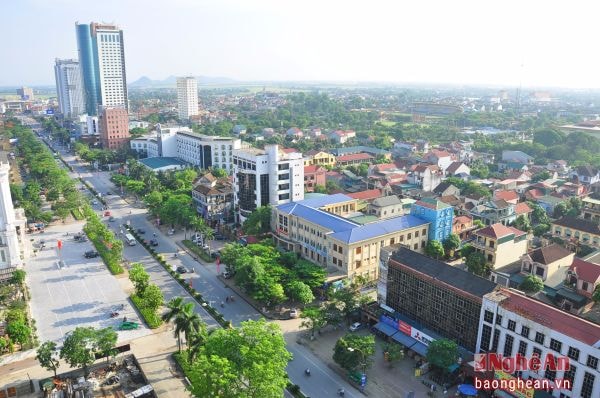 |
| View of Quang Trung Avenue (Vinh City). Photo courtesy of Tran Hai. |
PV:Mr. Chairman of the Provincial People's Committee, in August, Nghe An province held a working session with Prime Minister Nguyen Xuan Phuc to report on the results of the three-year implementation of Resolution No. 26 of the Politburo on the direction and tasks for the development of Nghe An province until 2020. At this meeting, the Prime Minister stated that "We should not rush development, but we cannot allow prolonged delays given Nghe An's inherent strengths." What are your thoughts on the Prime Minister's opinion?
Comrade Nguyen Xuan Duong:Comrade Nguyen Xuan Phuc's comments and assessments encompassed both the advantages and shortcomings in the socio-economic development process of our province. No one can deny Nghe An's inherent strengths such as its large area, central location, diverse topography, rich history and culture, abundant natural resources, and human capital.
In recent years, our investment attraction efforts have yielded many positive results (in the three years from 2014 to 2016, 300 projects were licensed with a registered capital of nearly 150,000 billion VND). This is thanks to intensified promotional efforts to raise awareness among investors about Nghe An's rich development potential. Simultaneously, we must acknowledge the outstanding efforts in reforming mechanisms, improving administrative procedures, and offering preferential policies to investors. The comprehensive development of infrastructure is also a key solution that Nghe An has focused on to attract investment, creating a foundation for sustainable socio-economic development.
However, that is only the initial success – that is, the step of promoting and attracting investors. It is necessary to seriously and objectively acknowledge that the province's policies and administrative mechanisms still have some shortcomings. During his meeting with the province, the Prime Minister also emphasized the need for thorough administrative reform, both in terms of procedures and human mindset, to avoid the situation where "the top is smooth, but the bottom is rough."
I agree with the observation that Nghe An is not rushing its development. The objective reason is that our province has a large geographical area and there is a relatively large disparity and difference between regions. In recent years, the province's economic structure has gradually shifted from agriculture to industry and services, but this sector is still young and cannot yet compare with provinces that have been industrialized for a long time.
Currently, Nghe An province has approximately 24 businesses per 10,000 people, which is still low compared to the national average of 53 businesses per 10,000 people. However, it is important to affirm that Nghe An will not sacrifice sustainable values for the sake of economic gain. This may be a slower path, but it is also safer, limiting environmental impacts and risks to national security and social welfare.
That being said, it doesn't mean Nghe An accepts "prolonged delays" on its development path. We will need to be more "bold" in promoting key areas such as spiritual tourism combined with resort tourism in the delta and coastal regions; high-value agricultural economy with local brands in the Mekong Delta; high-quality human resources with the studious tradition of Nghe An;…
PV:Regarding the investment environment, transparency, and efficiency in administrative procedures, the Provincial Competitiveness Index (PCI) is considered the most accurate indicator reflecting the assessment of businesses. In 2015, our province ranked 32nd, a drop of 4 places compared to 2014. What does this "fall in ranking" indicate, Comrade?
Comrade Nguyen Xuan Duong:The Provincial Competitiveness Index (PCI) is a reliable indicator that investors refer to when choosing a destination. In the overall socio-economic development plan, and in investment attraction projects in particular, our province has identified improving the PCI as a crucial goal to elevate Nghe An's position on the national and regional investment map.
In fact, if we consider the index, Nghe An's results in 2014 and 2015 did not change significantly: 58.82 points in 2014 and 58.47 points in 2015. Overall, Nghe An is still ranked in the group of relatively good provinces, while this group extends to include provinces in the top 15.
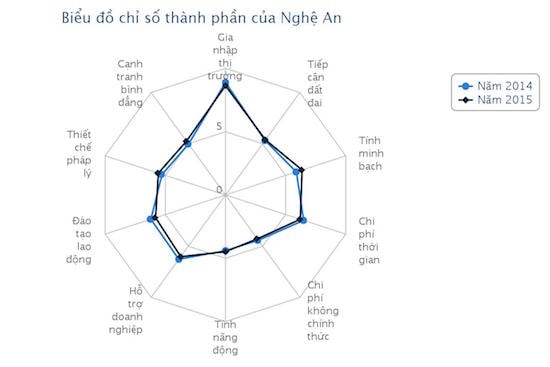 |
| Comparison of the PCI component indicators of Nghe An province in 2014 and 2015. Source: VCCI |
I think dropping a few places in the rankings doesn't necessarily mean we're falling behind in improving our investment environment. Nghe An is still changing, but when some neighboring provinces change faster, we inadvertently fall behind them. Of course, in the long run, we must use neighboring provinces as a driving force to compete and move forward, rather than standing still and watching them develop.
Rankings over one or two years don't tell the whole story, so they should be used as a general guideline to get a sense of where you stand. To see significant change, you should compare it over a longer period. Specifically, compared to 2010, at the beginning of the previous term, Nghe An ranked only 46th nationwide, considered an average province. By 2015, there had been a very positive transformation.
PV:Comrade, the goal set forth in Resolution 26 of the Politburo is for Nghe An to become a relatively prosperous province by 2020. However, Nghe An remains a poor province, with insufficient revenue to cover expenditures, and is dependent on the central government budget. Is the goal of becoming a relatively prosperous province in four years too far-fetched?
Comrade Nguyen Xuan Duong:First, one issue needs clarification - Is Nghe An really a poor province? According to information from the Ministry of Planning and Investment, there has been no official ranking or assessment of the wealth or poverty levels of provinces.
The methods currently used to measure poverty are also very diverse, based on different criteria and benchmarks. If we consider a visual criterion to measure poverty, we can discuss the poverty rate: According to the multidimensional poverty standard applied for the period 2016-2020 by the Ministry of Labor, Invalids and Social Affairs, Nghe An ranked 30th out of 64 provinces and cities nationwide in terms of poverty rate in 2015 (Dien Bien ranked first, Binh Duong ranked last). Thus, Nghe An is in the middle group.
In fact, how can a province that already has an international airport, a major seaport, a large international border crossing, and will soon have an inter-provincial and international highway passing through it be considered a poor province?
It's true that Nghe An's revenue isn't enough to cover its expenses; this is also a common situation for about 80% of provinces and cities nationwide. I think it's an inevitable phase that every locality must go through when shifting its economic structure.
Looking at the list of the top 10 provinces in terms of total budget revenue, we see Ho Chi Minh City, Hanoi, Ba Ria - Vung Tau, Hai Phong, Dong Nai, Quang Ninh, Quang Ngai, Binh Duong, Vinh Phuc, and Khanh Hoa – all industrial and service provinces. Provinces like Nghe An, Thai Binh, An Giang, Kien Giang, Dong Thap, and Hau Giang, while making significant contributions to the national agricultural structure, cannot compare in economic value to the industrial and service sectors. In fact, all of these provinces are currently receiving government subsidies.
It's impossible to assess the wealth or poverty level of a province solely based on budget revenue and expenditure. Da Nang has always been considered one of the provinces with the highest quality of life in the country, and is the third largest city after Hanoi and Ho Chi Minh City. However, Da Nang's total budget revenue in 2015 ranked only 12th (nearly 12,000 billion VND), while Nghe An's total budget revenue ranked 13th (over 10,000 billion VND).
We started from a low base, arguably a poor province compared to the rest of the country. But that's no longer true. It's projected that by 2020 we will balance our budget, meaning we will have completed the infrastructure investment process to enable socio-economic development to "take off".
Globally, countries are classified into groups: developed countries, developing countries, and poor countries. Developing countries are those that are not yet wealthy, but have potential and are undergoing rapid development. The case of Nghe An is similar. I think we need to change our mindset, our ingrained belief that Nghe An is still a poor province. Only then can we broaden our perspective, dare to think and act, and overcome the inertia in our thinking.
PV:Thank you for this conversation!
PV(Perform)
| RELATED NEWS |
|---|