

The feudal law of avoiding conflict of interest prohibited 'entire families from holding official positions' in one place.
Citing the Law of Avoidance from the feudal era, National Assembly Deputy and historian Duong Trung Quoc stated that there have long been strict regulations to prevent "entire families from holding official positions" in a locality.
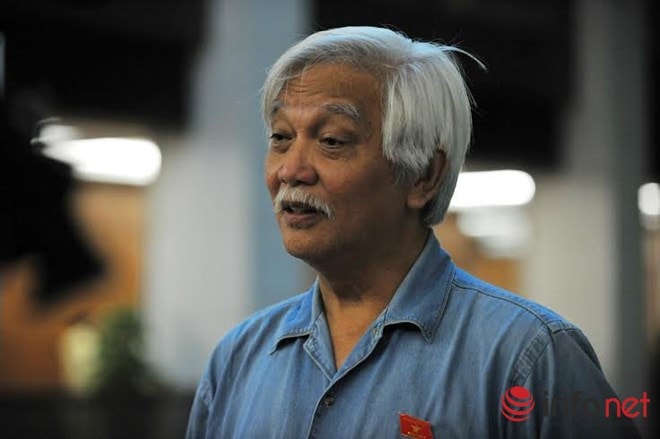 |
| National Assembly Deputy and historian Duong Trung Quoc. Photo: infonet.vn |
Recently, information circulating on social media about numerous relatives of Mr. Trieu Tai Vinh, Secretary of the Ha Giang Provincial Party Committee, holding leadership positions in local agencies has sparked much controversy. The Secretary of the Ha Giang Provincial Party Committee has also responded to the press, affirming that his relatives (wife, younger brother, younger sister, brother-in-law) were promoted according to proper procedures; however, public opinion remains skeptical and concerned.
Without commenting in detail on this specific case, National Assembly Deputy and historian Duong Trung Quoc merely cited the Law on Avoidance of Official Appointments, which originated during the reign of King Le Thanh Tong, to discuss the regulations for appointing officials in the past.
Historian Duong Trung Quoc stated that the Law of Avoidance stipulated that relatives such as brothers, fathers and sons, teachers and students, classmates, and people from the same hometown were not allowed to hold official positions in the same place. If anyone encountered such situations, they had to report it to the imperial court and relevant authorities so that arrangements could be made to transfer them to another location.
“This law was also strictly applied in the Hương, Hội, and Đình examinations. The aforementioned principle aimed to prevent those in power from abusing their positions to favor, cover up, or collude with relatives (family, clan, teacher-student relationships, local connections) to carry out negative acts in the management of public agencies,” historian Dương Trung Quốc stated.
The Law of Avoidance was first promulgated during the reign of King Le Thanh Tong regarding the appointment of feudal officials during the national administrative reform.
Furthermore, the Le Dynasty Penal Code (also known as Hong Duc Code) stipulated: "Officials are not allowed to marry, form marital alliances, or become in-laws in the areas they govern; nor are they allowed to acquire land, gardens, fields, or houses in the areas where they hold high office, or employ people from their hometown as assistants."
During the reign of Emperor Minh Mạng, the Law on Avoidance of Contradictions became even more thorough, expanding its scope and application to include new regulations, such as:
Officials in the ministries, in the capital, and in the provinces and districts were required to be transferred to other positions if fathers, sons, brothers, uncles, aunts, or cousins worked together. However, the Imperial Medical Institute, which specialized in medicine and treatment and required hereditary succession, was exempt from the Law of Avoidance. Officials whose hometown was in a particular prefecture or district were also prohibited from working in the government office of that prefecture or district.
Officials in the prefectures and districts who were from the same village had to be transferred to a different office. Officials were not allowed to hold office in their own hometown, their wife's hometown, or even the place where they studied when they were young. People related by marriage, or teacher and student, were also not allowed to hold office in the same place.
Specifically, the law also clearly states that provincial officials are strictly prohibited from establishing relationships, forming friendships, or marrying women and girls in the areas under their jurisdiction, and are forbidden from purchasing houses or land within their administrative areas.
Earlier, at the first session of the 14th National Assembly, on the sidelines of the National Assembly, also discussing the appointment of officials, National Assembly Deputy Duong Trung Quoc asked: There is a common refrain that people often hear: "The process is correct, but the result is wrong." Where does the problem lie?
“Clearly, there are loopholes for people to exploit. They are very sophisticated, not weak at all. This has become abnormal. Someone responsible for the loss of assets, like Trinh Xuan Thanh, is being promoted. Meanwhile, we always talk about responsibility, but responsibility is a very abstract concept. We think that at this time, linking it to individual responsibility is extremely important. Praise and criticism must be clear and specific,” said historian Duong Trung Quoc.
According to Mr. Duong Trung Quoc, everything is done by people, meaning it depends on the quality of the people performing the task. The second important factor is the supervision of the people; without that supervision, irregularities surrounding the appointment of officials occur.
According to Infonet.vn
| RELATED NEWS |
|---|