
Return to the countryside to get rich.
(Baonghean) - Leveraging their youthful energy, mastering science and technology, and driven by a desire to get rich, many young people in towns and cities have returned to rural areas to exploit land resources and establish farms to develop the economy. Many successful models have generated hundreds of millions of dong in income annually, becoming shining examples for people in other localities to learn from and replicate.
(Baonghean) - Leveraging their youthful energy, mastering science and technology, and driven by a desire to get rich, many young people in towns and cities have returned to rural areas to exploit land resources and establish farms to develop the economy. Many successful models have generated hundreds of millions of dong in income annually, becoming shining examples for people in other localities to learn from and replicate.
Technology engineers return to the village to open farms.
After graduating from Vinh University of Technology and Education with a degree in Information Technology Engineering, Van Si Hai, from Block 8, Mai Hung Ward (Hoang Mai Town), packed his bags and went to Hanoi to work for a computer company. After 5 years, having accumulated experience, he returned to his hometown to establish his own computer company, which was relatively successful. However, after researching various livestock farming models online, he decided to experiment with raising specialty animal breeds.
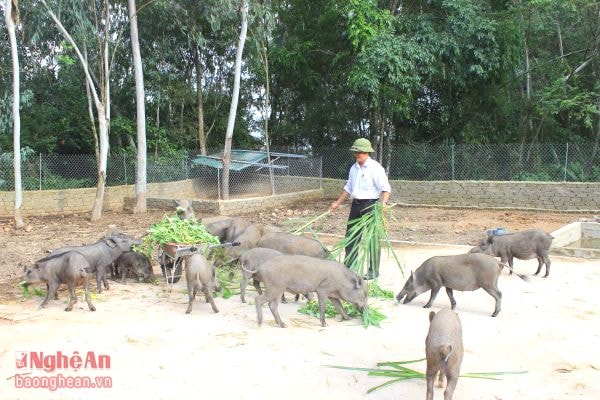 |
| Mr. Van Sy Hai is feeding the wild boars. |
In early 2015, when Mai Hung ward implemented a policy to develop farm-based economic activities, Mr. Hai renovated his family's 8,000 square meter plot of land near the foot of the hill to develop a farm. Along with his savings and a loan of over 200 million VND from the bank, he invested in a mixed livestock farm raising wild pigs, Dong Tao chickens, pheasants, and turtles.
Initially, pig farming was relatively difficult due to a lack of experience. He actively participated in training courses on livestock farming techniques organized by the ward, learned from successful economic models, and searched for information online. With a herd of over 60 wild pigs, including many sows, his family sells more than 100 piglets and dozens of market pigs each year.
Mr. Hai even went all the way to Hung Yen province to buy Dong Tao chicken breeds to raise. He built eight coops, using tarpaulins to protect them from the sun and rain, ensuring good ventilation, and making sure they received all necessary vaccinations. The chickens' feed mainly consists of corn and chopped banana stalks mixed with bran. To ensure a steady supply of chicks, he takes the eggs to a local incubator for hatching. From just a few dozen chicks initially, he now has a flock of over 100 chicks and broiler chickens for sale to restaurants.
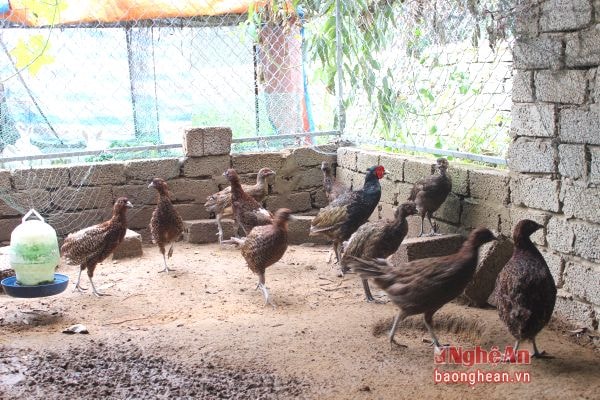 |
| Mr. Hai's flock of over 30 pheasants has begun to breed. |
According to Mr. Hai, the value of Dong Tao chickens depends on the size of their legs. Demand for chickens increases significantly during holidays and Tet (Lunar New Year). Because his family has control over the breeding stock, their chickens are usually much cheaper than elsewhere, and they sell out as soon as the chicks hatch.
Building on his existing successes and experience, Mr. Hai expanded his business to include raising pheasants and turtles. After more than a year of care, his flock of over 30 pheasants has now reproduced. He has successfully hatched pheasant chicks and kept the young birds for breeding to increase the size of his flock. The success of his integrated farming business has brought his family an income of nearly 200 million VND per year.
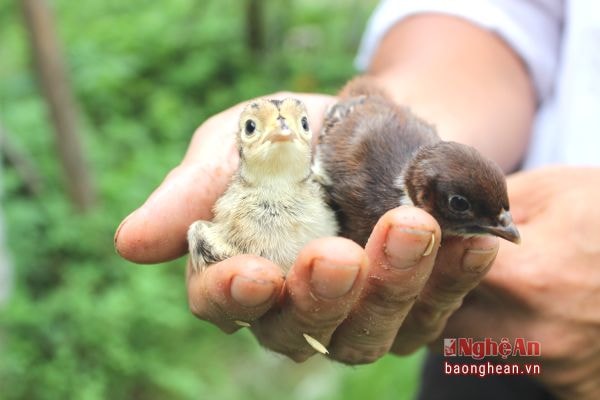 |
| Mr. Hai has successfully hatched pheasant chicks. |
With his remaining hillside garden area, Mr. Hai plans to expand his farm further with new, economically efficient plant and animal breeds. Commenting on this model, Mr. Le Duc My, Vice Chairman of the Mai Hung Ward People's Committee, said: “Although it has only been in operation for over a year, Mr. Hai's integrated livestock farm model has proven effective, providing a stable income. The ward encourages people to visit and learn from it to replicate the model.”
From the city to the mountains to raise wild boars.
Mr. Bui Van Hung, residing in Cau Giat town (Quynh Luu district), decided to purchase hilly land in the mountainous Ngoc Son commune to establish a farm raising wild pigs and wild ducks. His farm generates nearly 500 million VND in income annually.
With the capital he had accumulated after many years of working abroad, in 2010, Mr. Bui Van Hung decided to move to the pristine hilly area near Khe Gang dam in Ngoc Son commune to develop his business. With an area of 3 hectares, he hired machinery and workers to level the ground to build barns and fence off areas for livestock farming.
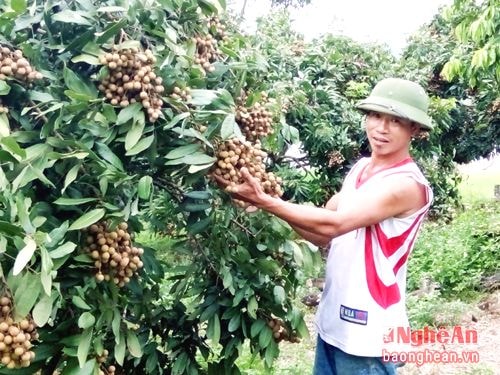 |
| Mr. Bui Van Hung has planted over 200 longan trees, each yielding fruit that brings in 100 million VND per year. |
After researching the market and realizing that raising wild boars had an economic value 2-3 times higher than raising regular pigs, he boldly went to the northern provinces to buy wild boar breeding stock. Initially, he bought 10 pairs of wild boar sows for breeding. After a year of raising them, the herd began to reproduce. Currently, he is raising 100 wild boars, including 10 breeding sows.
According to Mr. Hung, wild boars typically breed twice a year, with each litter containing about 7-8 piglets. When the piglets are 3 months old, they are separated from the herd and raised individually. Besides bran and corn, wild boars can utilize other local food sources such as water hyacinth, vegetables, grass, cassava, and potatoes.
“Raising wild boars may seem simple, but if you don't understand the proper care techniques and their growth cycle to proactively prevent diseases and supplement their feed, it won't be economically effective. The advantage of raising wild boars is its high economic efficiency, with prices ranging from 120,000 to 130,000 VND/kg,” Mr. Hung shared. Thanks to successful wild boar farming, his family earns approximately 350 million VND per year.
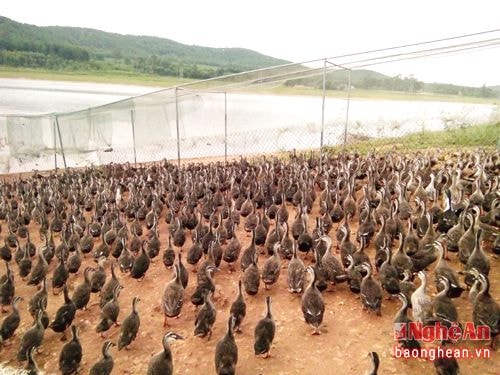 |
| Hung's flock of wild ducks. |
Besides raising wild boars, in 2014, Mr. Hung continued to raise commercial wild ducks on a scale of 2,000-2,500 birds per year. Each batch takes about 4 months to raise before sale, with an average weight of 1-1.5 kg/bird, at an average price of 100,000 VND/bird. From raising wild ducks, he earns nearly 200 million VND extra each year. Mr. Hung shared: "Raising wild ducks requires spacious land, because wild ducks have the characteristic of flying far, so when raising them, you need to set up nets around the farm."
"Although wild ducks are a species of wildlife, knowing their characteristics means you don't have to worry about them flying away. They are also a popular delicacy among the locals." Within the farm area, Mr. Hung also planted 200 longan trees, which are currently in harvest season, averaging 100 million VND per year per harvest.
From a barren hillside, Mr. Bui Van Hung has transformed it into a profitable area, generating an income of approximately 500 million VND per year from his farm. His model also provides stable employment for 4-5 local workers with a decent income.
Thanh Thủy - Việt Hùng - Thanh Nhàn
| RELATED NEWS |
|---|