

Post-Brexit, is the UK a 'thorn in the side' of the EU?
(Baonghean) - European Union (EU) defense ministers have for the first time discussed proposals from France and Germany to strengthen military cooperation within the EU at a meeting in Bratislava, Slovakia. With the UK's decision to leave the EU, France and Germany are leading efforts to enable the EU to take responsibility for its own security operations. However, until Brexit is complete, the UK remains a thorn in many of the bloc's defense plans.
Strengthening the EU's response capabilities.
At a meeting of EU defense ministers, France and Germany presented a comprehensive plan for the bloc's defense cooperation strategy, before submitting it to EU leaders at the summit in December.
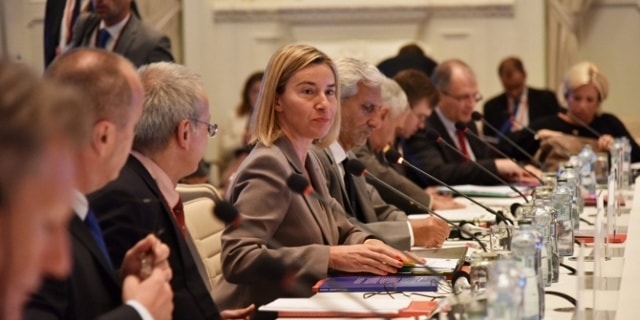 |
| EU defense ministers discussed the proposal from France and Germany for the first time. Photo: Internet. |
This plan includes many elements such as increasing budget spending on military missions, jointly developing equipment such as helicopters and drones, expanding peacekeeping operations abroad, and building stronger defense systems to combat cyberattacks…
In particular, having a common political-military headquarters would help Europe coordinate joint missions more effectively (currently, the EU is conducting 30 missions across three continents). According to German Defense Minister Ursula von der Leyen, the plan aims to pool the strengths of European nations, enabling their militaries to act together swiftly in any situation. "The issue is that we need to become stronger and more effective together. None of us can fight major crises, including the Russia-Ukraine conflict, alone," said Ursula von der Leyen.
Following the UK's decision to leave the EU, France and Germany are jointly promoting various initiatives to ensure the EU can handle its own security operations without the UK. This foresight from France and Germany is understandable, as the UK has historically been the largest contributor to the bloc's defense plans, possessing defense capabilities far superior to other EU member states.
Beyond its financial resources, and as a close ally of the US, having fought alongside the US military in numerous campaigns, the British army is also considered the most battle-hardened and experienced among European countries. Therefore, the plan presented in Bratislava is part of an effort by the two leading forces in the EU to fill the void left by Britain after its departure from the EU.
An opportunity for France and Germany.
In the past, Britain has frequently opposed deeper military cooperation with the EU, arguing that the bloc's military plans could undermine the North Atlantic Treaty Organization (NATO). Britain has argued that requiring member states to allocate additional budgets to new military cooperation activities would negatively impact their contributions to NATO.
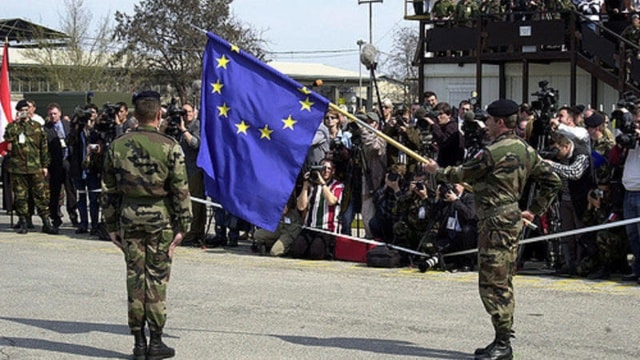 |
| The EU is seeking to ensure its own security capabilities in the absence of the UK. Photo: Eurative. |
Moreover, Britain fears that any new military cooperation mechanism risks creating a "competitor" to NATO. As a close ally of the US within the world's largest military alliance, Britain clearly does not want to pose any obstacles—even potential ones—to NATO.
Some analysts also suggest that Britain's deeper concern is that with broader military cooperation plans, including the creation of a joint army, overall control and coordination would fall into Brussels' hands. This is completely incompatible with Britain, which has long sought a special mechanism to exert greater influence over the bloc's collective decisions.
Now that it has decided to leave the EU, Britain will be even less enthusiastic about the idea of deeper military cooperation because its ability to influence Brussels will be diminished.
Meanwhile, France and Germany are hoping that the current situation will be more favorable for advancing military cooperation plans within the bloc, now that they no longer have to consider the UK's position. German Foreign Ministry spokesman Martin Schäfer bluntly stated on September 26th: "I cannot imagine that a country that has decided to leave the EU could prevent the rest of the countries from doing what they want."
Nevertheless, to pave the way for these plans, Germany and France jointly rejected speculation about an "attempt to create an alternative or rival organization to NATO." Germany and France asserted that a strong NATO benefits the EU. Conversely, a stronger EU defense policy would also help NATO operate more effectively.
After Brexit, the UK remains a "thorn in the side".
Nevertheless, the UK still retains full voting rights on EU military decisions until it completes Brexit – expected in 2019. Until then, the EU will find it difficult to proceed with its ambitious plans without the UK's consent.
Meanwhile, Britain also has the advantage of consistently receiving support from member states such as Poland and the Baltic states. Always seeking NATO's "protection" against threats from Russia, these countries are just as fearful as Britain of a weakened NATO.
 |
| The building where the meeting took place. Photo: Eurative. |
At a meeting in Bratislava on September 27, Britain continued to demonstrate that it is not an easily marginalized partner in the EU's calculations. British Defence Minister Michael Fallon affirmed: "We will continue to oppose any idea of establishing an EU army or EU military headquarters."
To secure British support for joint military cooperation plans, German Defence Minister Ursula von der Leyen and French Defence Minister Jean-Yves Le Drian had to pledge that there were no plans for a European army.
Although the establishment of a European army remains a long-term goal for the Chairman of the European Parliament's Foreign Affairs Committee, Elmar Brok, the EU will have to accept a "one step back to take two steps forward" approach for now. This is perhaps a suitable "delaying tactic" for the EU, both to wait for the UK's complete departure from the EU and to make necessary changes to existing agreements, creating the legal framework necessary for the establishment and operation of a common military force.
Thuy Ngoc
| RELATED NEWS |
|---|