
'Red Family' in the cradle of revolution
(Baonghean) - Cat Van (Thanh Chuong) is one of the cradles of revolution with many clans and families rich in patriotic traditions, including the family of Mr. Tran Huu Hoang (commonly known as the late Mr. Man) with 4 children who joined the Party ranks in the early years of its establishment.
(Baonghean) - Cat Van (Thanh Chuong) is one of the cradles of revolution with many clans and families rich in patriotic traditions, including the family of Mr. Tran Huu Hoang (commonly known as the late Mr. Man) with 4 children who joined the Party ranks in the early years of its establishment.
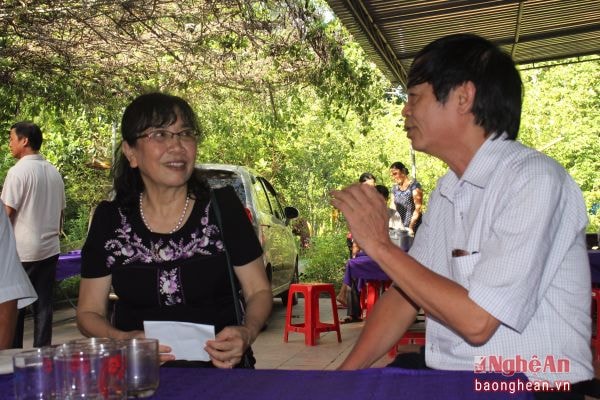 |
| Ms. Pham Thi Dao, daughter-in-law of Mr. Tran Huu Doanh and a cadre of the Thanh Chuong District Party Committee, reminisced about the revolutionary traditions of the Cat Van area. |
We visited Hamlet 12, where the local people, descendants of the Tran Huu family, and friends from near and far were gathered under the old roof of Mr. Tran Huu Hoang's house (also known locally as the late Mr. Man) to celebrate the 110th birthday of Mr. Tran Huu Doanh (son of the late Mr. Man) - former Secretary of the Thanh Chuong District Party Committee, a staunch and indomitable communist fighter.
Mr. Tran Huu Hoang and Mrs. Gian Thi Chuan had five children (three sons and two daughters), in order: Tran Thi Dich, Tran Huu Oanh, Tran Thi Tuyet, Tran Huu Doanh, and Tran Huu Quan. Under the colonial-feudal regime, they faced severe oppression and extremely difficult living conditions, but the couple remained determined to raise their children to be good people, hoping that they would one day contribute to the country and society.
Among the children, Tran Huu Doanh proved to be intelligent, academically gifted, and full of character. He graduated early from the Franco-Vietnamese School in Thanh Chuong and passed the entrance exam to Vinh National School, where he was taught by famous teachers such as Tran Phu, Ha Huy Tap, Tran Van Tang, and Tran Mong Bach, and studied alongside friends who later became revolutionaries: Nguyen Tien, Hoang Tran Tham, and Chu Van Bien... Here, Tran Huu Doanh and his classmates were soon enlightened about the revolution and participated in the struggle in various forms, most notably the movement demanding that the authorities reduce the sentence for the patriot Phan Boi Chau.
Next, he participated in the movement of students in schools organizing a memorial service for Phan Chu Trinh, protesting against the French colonialists' dismissal of teacher Ha Huy Tap, and was admitted to the Hung Nam Association. He, along with his friends Nguyen Tiem (later the first Secretary of the Nghe An Provincial Party Committee) and Hoang Tran Tham, founded the Nghe An Student Union to lead the student struggle movement in schools. With guidance and assistance from teacher Ha Huy Tap, Tran Huu Doanh established a reading group and the Hung Nam sub-group at Con Market and Cat Ngan commune, successfully organizing a struggle to help the people of Cat Ngan commune reclaim the Tho Son alluvial plain that had been seized by local gentry.
In 1927, introduced by Nguyen Thi Minh Khai, Tran Huu Doanh participated in a training course on the theory and methods of proletarian revolutionary movement organized by the Youth Association. In 1929, after the founding of the Indochinese Communist Party, the Nghe An Student Union was established and became very active. Led by Comrade Nguyen Phong Sac, Tran Huu Doanh and his comrades founded the newspaper Xich Sinh to propagate and encourage the struggle movement of students in schools in Vinh city and districts throughout the province.
When the French colonialists discovered the revolutionary activities, they expelled the participants from school. Expelled, Tran Huu Doanh returned to his hometown and gathered 30 enthusiastic young people from Cat Ngan commune to establish a farming camp in Khe Truong. This served as both a production site and a place for martial arts training, reading, and political study. Tran Huu Doanh's farm attracted not only young people from Thanh Chuong district but also young people and students from Vinh, Nam Dan, and Nghi Loc. In November 1929, the Indochinese Communist Party branch in Cat Ngan was established, and Tran Huu Doanh was elected its secretary.
With the founding of the Communist Party of Vietnam, the Mân family became a base for revolutionary activities, serving as a place of rest, lodging, and work for many cadres of the Provisional Regional and Provincial Party Committees: Nguyễn Phong Sắc, Lê Viết Thuật, Lê Xuân Đào, Nguyễn Liễn, Nguyễn Bình… Even more noteworthy, all five children in the family enthusiastically mobilized the people to participate in the struggle against the French, with four becoming Party members in 1930-1931. Trần Hữu Doanh was one of the first Party members in Thanh Chương district, serving as Secretary of the Cát Ngạn Commune Party Branch.
Tran Huu Oanh and Tran Huu Quan were in charge of the Red Self-Defense Team, tasked with protecting the base and suppressing collaborators. Tran Thi Tuyet was one of the first women in Thanh Chuong district to join the Party, actively participating in demonstrations during the Nghe Tinh Soviet movement, mobilizing the masses to fight fiercely, forcing 30 soldiers at the Dao Ngan outpost to retreat to another location. Tran Thi Tuyet was the woman who carried the hammer and sickle flag, leading the Cat Ngan commune's demonstration on September 1, 1930.
Following the May 1st, 1930 protest, the family of the late Mr. Mân was classified as dangerous by the French colonial authorities because four of his children were communists. In 1930-1931, they sent soldiers three times to search and burn down their house and property, but Mr. and Mrs. Trần Hữu Hoằng steadfastly refused to reveal anything. The cowardly enemy arrested Mrs. Trần Hữu Doanh and her four-year-old daughter, but this did not shake or sway the resolve of the late Mr. Mân's family.
Amidst the revolutionary storm, the French colonialists ruthlessly suppressed and drowned the movement in bloodshed, and many comrades in the leadership of the Regional Party Committee, Provincial Party Committee, and District Party Committee were successively arrested by the enemy. In January 1931, Mr. Tran Huu Doanh was appointed by the Nghe An Provincial Party Committee as Secretary of the Thanh Chuong District Party Committee, directly leading the people's struggle against the enemy's policy of brutal repression; in April 1931, he was transferred to the Provincial Party Committee.
In February 1932, he returned to Luu Son to establish the Anh Thanh Party Branch, one of the last branches of the Thanh Chuong and Anh Son Party Committees during the Nghe Tinh Soviet Uprising. Comrades Le Viet Thuat, Le Xuan Dao, and Sieu Hai were successively arrested, but Tran Huu Doanh remained steadfast, encouraging the remaining comrades to retreat into the forest to operate secretly and wait for the opportune moment.
In June 1932, Tran Huu Doanh was ambushed, captured, tortured, and imprisoned by the enemy, moving from Thanh Chuong prison to Vinh prison. However, the enemy's indomitable spirit proved ineffective, and the court ultimately sentenced him to life imprisonment with hard labor and exile to Lao Bao prison. Along with Tran Huu Doanh, two other sons of the late Mr. Man, Tran Huu Oanh and Tran Huu Quan, were also sentenced to life imprisonment with hard labor and exiled to Buon Ma Thuot prison. Tran Huu Doanh's sister, Tran Thi Tuyet, was also arrested in Do Luong in 1931 and sentenced to 15 years in prison.
During those years, Mrs. Gian Thi Chuan (the wife of the late Man), disguised as a merchant, traveled long distances to visit her children in prison, giving strength and encouragement to the imprisoned revolutionary fighters. Tran Huu Doanh and his comrades always upheld their integrity, remained steadfast in their stance, and championed the slogan "Transform imperialist prisons into revolutionary schools." In prison, he took advantage of opportunities to impart cultural and political knowledge and methods of struggle to his comrades, motivating them to resist the prison guards' tactics and organizing hunger strikes to force them to make concessions.
In March 1941, Tran Huu Doanh and 119 other prisoners were transferred from Buon Ma Thuot prison to Dak Min prison. The French colonialists' aim was to use hunger, cold, disease, and torture to eliminate these staunch communists. Unwilling to endure imprisonment, these outstanding individuals constantly thought of ways to escape and continue their activities.
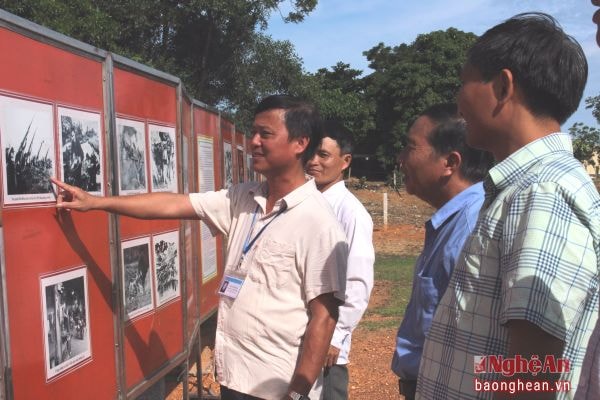 |
| Officials and residents of Cat Van commune view the exhibits commemorating the 110th anniversary of the birth of Mr. Tran Huu Doanh. Photo: Dao Tuan |
On the night of December 5, 1942, Tran Huu Doanh, along with his comrades Truong Van Linh, Nguyen Tao, and Chu Hue, cleverly deceived the guards and escaped from Dak Min prison. Although discovered by the enemy, with their resourcefulness and unwavering determination, the four communist fighters trekked through forests and streams for months to find their way back to their homeland. Upon arriving in Cat Van, he disguised himself as a trader of forest and agricultural products to deceive the enemy and rebuild the revolutionary base in Cat Ngan commune and other communes in Thanh Chuong district and Anh Son prefecture.
On April 5, 1945, Tran Huu Doanh, while on his way from his base in Vinh Giang to Giang Son, encountered a group of French soldiers. He was shot and killed just as the country was about to gain independence, leaving behind his devoted wife and young son who never knew his father. After the August Revolution of 1945, comrades Tran Huu Doanh and Tran Huu Quan escaped from prison and continued their activities, contributing their efforts and intellect to protect and build their homeland. They are respected veteran revolutionary cadres by their comrades and fellow citizens.
The descendants of the late Mr. Mân's family are always proud and determined to follow the example of their ancestors, becoming useful members of society and their homeland. Mr. Trần Minh Chánh (the only son of Comrade Trần Hữu Doanh) is a PhD holder and Head of the Law Faculty at the National Economics University (now deceased). His daughter-in-law, Mrs. Phạm Thị Đào, was formerly the Deputy Director of the Vietnam Steel Corporation; his siblings Trần Hữu Phượng, Trần Hữu Phùng, Trần Thị Như Tường, Trần Hữu Thuật, Trần Quyết Thắng... are police officers, civil servants, and businesspeople, always conscious of preserving family traditions and showing gratitude to their homeland, contributing billions of dong to build bridges and roads, leaving behind positive imprints, worthy of being descendants of a revolutionary family.
Cong Kien - Dao Tuan