

The sacred Mai Bang Temple (Cua Lo Town)
(Baonghean) - Mai Bang Temple (Nghi Thuy Ward, Cua Lo Town) worships General Le Khoi, Che Thang's wife Nguyen Thi Bich Chau, Thuy Tinh Phu Nhan, and six founding figures of the village. These figures created a life for and blessed the people engaged in fishing and farming, encouraging education and intellectual development.
Therefore, the local people erected a temple to commemorate the deities' contributions and to pray for their protection and blessings, hoping for a prosperous and happy life. A characteristic of coastal fishermen is their constant presence on the water, their livelihoods at sea always depending on nature.
Therefore, before each fishing trip, local fishermen respectfully pray to the gods at Mai Bang Temple, hoping they will bless their boats with safe journeys and abundant catches of shrimp and fish.
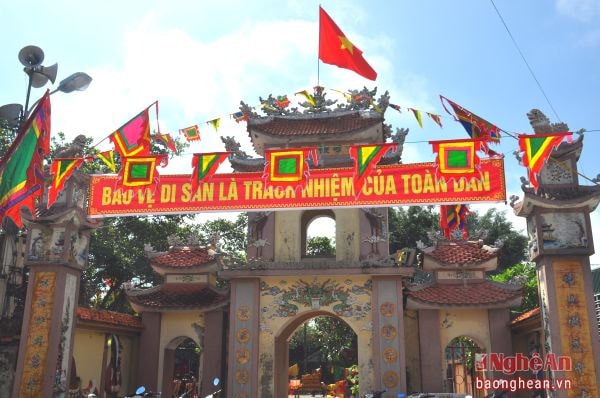 |
| Panoramic view of Mai Bang Temple - Nghi Thuy - Cua Lo Town |
According to the elders in the village, Mai Bang Temple was built in 1780, initially as a single thatched-roof structure. During the Nguyen dynasty, Mai Bang Temple was renovated on a large scale, comprising an upper, middle, and lower hall, with a floor plan in the shape of the Chinese character "三" (three). The temple grounds covered an area of approximately 2,500 square meters, and it contained many ritual objects and was carefully guarded. In 2004, the people contributed their labor and resources to restore and renovate the lower hall. In 2007, the triple-arched gate and the upper hall were restored and renovated using funds from the Nghi Thuy Ward People's Committee combined with donations. Since then, cultural activities at the temple have been restored to their former state.
The temple now boasts a spacious and airy grounds, providing an excellent setting for traditional ceremonies. It still preserves the original central hall and many valuable ancient ritual objects such as incense altars, ceremonial tables, couplets, large inscriptions, dragon thrones, ancestral tablets, incense burners, and offering trays... all meticulously carved by ancient artisans with high skill, creating beautiful and vivid depictions.
Through the worshipped figures and artifacts, couplets, large inscriptions, royal decrees, ancestral tablets, and especially the 13 extremely valuable original royal decrees, which serve as primary source materials for future generations to study the historical periods of Mai Bang village, the temple's long-standing existence is evidence of its existence, contributing to the education of patriotic traditions for the younger generation.
On the first and fifteenth days of the lunar month, and during the Lunar New Year, the people of Mai Bang village come to the temple to offer incense and worship. In particular, Mai Bang Temple hosts two major festivals each year on the 12th day of the 2nd lunar month and the 3rd day of the 5th lunar month. The festival at the beginning of the year, on the 12th day of the 2nd lunar month (the village's founding day), is also a fishing prayer ceremony, where the villagers gather in large numbers to organize solemn rituals.
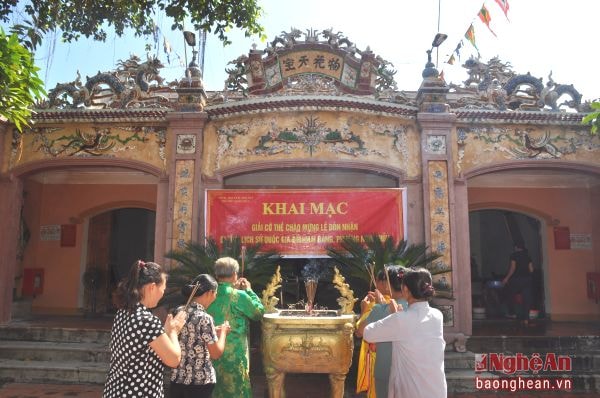 |
| Mai Bang Temple - a place where locals frequently come to offer incense and pray for calm seas and boats returning with abundant catches of shrimp and fish. |
During the festival on the 3rd day of the 5th lunar month, commemorating the death anniversary of King Chieu Trung Le Khoi, the people organize processions and offerings to the deity. Through these rituals, the people of Mai Bang recall the traditions of their ancestors, educating future generations about unity and love for their homeland. Besides spiritual and cultural activities, the temple also hosts traditional folk cultural activities combined with modern games, enriching the lives of the coastal fishermen.
Before making important decisions (going far away, children taking university or college entrance exams, getting married, or preparing to go out to sea...), the villagers would come to the temple to light incense and pray. On the first and fifteenth days of the lunar month, an average of over a thousand people visit the temple daily to light incense, not including the number of tourists from all over who come to visit and admire the temple's scenery.
Besides spiritual and cultural activities, the temple also organizes folk cultural activities such as tug-of-war, card games, etc., combined with modern games, contributing to enriching the local cultural identity. This is also one of the intangible cultural activities that is maintained and developed, reflecting the people's tradition of "drinking water, remembering the source."
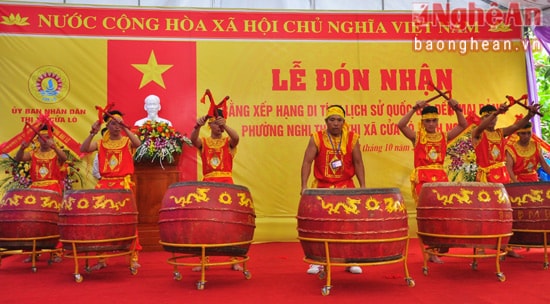 |
| A drum performance welcomes the ceremony for receiving the Certificate recognizing Mai Bang Temple as a historical relic. |
In 2012, Mai Bang Temple was recognized as a provincial-level historical relic by the People's Committee of Nghe An province. In 2015, after reviewing the local authorities' submission and conducting a survey by a specialized team, the Ministry of Culture, Sports and Tourism recognized the outstanding values of the relic that needed further protection and promotion, and subsequently classified the temple as a national-level historical relic.
Mr. Nguyen Thanh Hoa, a cultural officer of Nghi Thuy ward, affirmed: To promote the value of the Mai Bang Temple, a National Historical Monument, and to develop it into an attractive tourist destination in Cua Lo town, the ward will establish a temple management team; create a summary of the historical value of the monument for visitors to learn about; select, restore, and maintain traditional activities and good local customs; and coordinate with local schools to organize extracurricular learning activities at the monument for students, helping them understand more about the construction and development of their community and learn about the figures who made great contributions to their homeland and country.
At the same time, students are assigned to clean and work at the temple on major holidays so that they learn to appreciate the values left by their ancestors; and opportunities are organized for local people and tourists from near and far to learn about and visit the historical site when they come to Cua Lo.
PV
| RELATED NEWS |
|---|