

The Prime Minister's task force and the determination to eliminate the 'longest road'.
In a short period of time, the Prime Minister's Task Force inspected six units, and all the issues that emerged will be reported at the upcoming regular government meeting.
On September 26th, the Prime Minister's Task Force inspected the Hanoi People's Committee regarding the implementation of tasks assigned by the Government and the Prime Minister since the beginning of the year. Prior to this, immediately after its establishment by Prime Minister Nguyen Xuan Phuc on August 19th, the Task Force inspected the Ministry of Planning and Investment, the Ministry of Finance, the Government Office, the Government Inspectorate, and the Vietnam Electricity Group.
The monitoring and implementation of tasks have been carried out since 2014 according to Decision No. 42 of the Prime Minister. Specifically in 2016, as of August 31st, the Government had assigned 6,272 tasks to ministries, agencies, and localities. Of these, 2,723 tasks were due for completion, 2,501 tasks were completed (91.8%), and 222 tasks were overdue but not yet completed (8.2%).
Thus, over the years, the situation has improved significantly as the number of overdue tasks has gradually decreased (43.9% in 2013, 40% in 2014, 21% in 2015, and 8.2% in the first eight months of 2016).
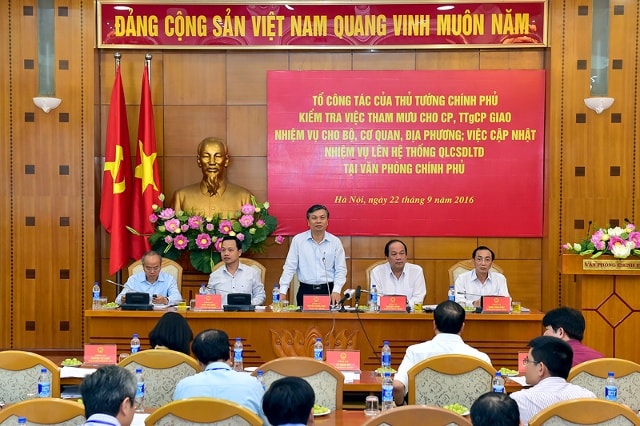 |
| The Prime Minister's Task Force worked with the Government Office on September 22, 2016. Photo: VGP |
However, in the initial stages of implementing Regulation 42, a comprehensive and thorough assessment of the quality of task execution was not conducted; it only focused on statistical data collection, and difficulties and obstacles in task implementation were not promptly identified and resolved. Therefore, the Government Office advised, proposed, and submitted to the Prime Minister the establishment of a working group to inspect the implementation of tasks assigned by the Government and the Prime Minister.
As affirmed by the Head of the Task Force, Minister and Head of the Government Office Mai Tien Dung, during inspections of various units, the spirit of the Task Force is "impartiality and fairness," with utmost openness, transparency, and objectivity. The inspected agencies must clearly state any delays or shortcomings in task implementation, explain the specific causes, and provide a commitment to a completion deadline.
For example, at the Hanoi People's Committee, the Prime Minister's Task Force thoroughly investigated a highly publicized case regarding the handling of violations at the 8B Le Truc building. Task Force leader Mai Tien Dung frankly stated, "We must develop a comprehensive plan to reduce the building's height, with a final completion deadline. Saying we're cutting floors now and will address the height issue in 2017 is not appropriate. We must avoid misleading the public."
Earlier, at the Government Inspectorate, discussing the reasons for delays in many tasks, Team Leader Mai Tien Dung emphasized that the Government Inspectorate had only superficially assessed subjective causes, citing too many objective reasons, and the most important reason being the sluggishness in internal administrative procedures, specifically the slow establishment of inspection teams compared to the Prime Minister's requirements. "The working methods must change" was the task force's demand for the Government Inspectorate.
At the Ministry of Planning and Investment, the Task Force clearly stated the Prime Minister's reminder that, alongside decisive reform actions, the Ministry still harbors a mentality of clinging to its own authority and a system of requesting and granting favors… Meanwhile, the Prime Minister reminded the Ministry of Finance about the situation where Party Secretaries and Chairmen of provinces and cities approach the Ministry to request low budget allocations.
Notably, although the head of the Task Force is the Minister and Head of the Government Office, the Government Office was also one of the first places inspected. During the inspection, the Government Office had to admit fault for cases of assigning tasks to the wrong lead unit, unreasonable deadlines, "assigning tasks on the 23rd but requiring a report by the 24th," and situations where documents containing non-confidential information were still stamped as confidential…
In fact, during the inspections, some units requested that the press "consider" not reporting on the matter due to its "sensitivity," but the Minister, Head of the Government Office, and Head of the Task Force immediately responded and emphasized that, except for classified information, the press should publicly disclose to the public all delayed tasks, their causes, and responsibilities.
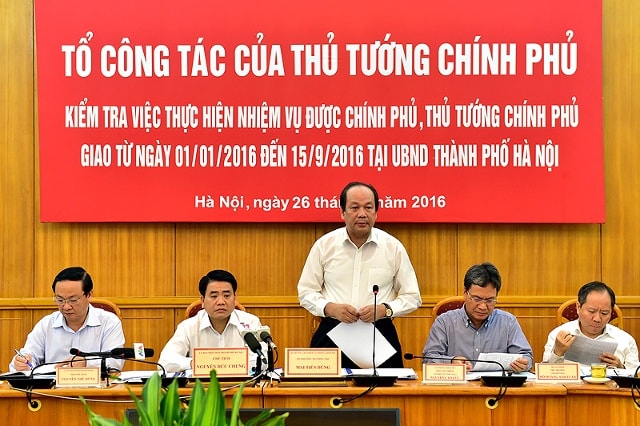 |
| The Prime Minister's task force worked with the Hanoi People's Committee on September 26, 2016. Photo: VGP |
Prime Minister Nguyen Xuan Phuc has repeatedly pledged to the people his determination to build an honest, constructive, and proactive government—a government that sets an example for society in terms of matching words with actions, and is determined to "eliminate the longest gap between words and deeds." As economist Pham Chi Lan commented, the Prime Minister is trying to revitalize the system with the hope that the entire administrative apparatus will move forward.
The task force, established by the Prime Minister, was specifically aimed at the aforementioned objectives. Through six inspection sessions at six agencies, not only were numerous issues and incidents brought to light by the task force, but many ministries, departments, and localities also showed significant changes in awareness and action, and administrative discipline and order were tightened.
In the near future, the Prime Minister's Task Force will continue to establish inspection teams to examine ministries, agencies, and localities that still have many outstanding tasks. Clearly, this is a very new undertaking and conflicts are inevitable, but all efforts are for the common goal. The number of 222 outstanding tasks is not large, but they are often difficult and complex tasks that are of great concern to the public and the media. The public and the people expect a significant and noticeable improvement, so that ministries, agencies, and localities will fully, seriously, promptly, and effectively carry out their assigned tasks, ending the practice of "shooting aimlessly" in leadership and management.
According to Chinhphu.vn
| RELATED NEWS |
|---|