

New UN Secretary-General: A Choice of Hope
(Baonghean) - On October 13th, the United Nations General Assembly officially commenced.Former Portuguese Prime Minister Antonio Guterres has been appointed as the new Secretary-General, replacing Ban Ki-Moon.Observers comment that, holding the "blue flag for peace" of the United Nations, Antonio Guterres will have a lot of work to do in the coming time.
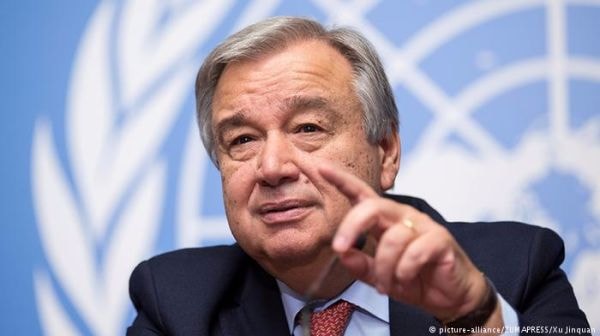 |
| The new Secretary-General, Antonio Guterres, is expected to bring a fresh perspective to the United Nations' direction. (Source: DW) |
A transparent election
The process for electing the 9th United Nations Secretary-General this year, which began on July 21st, is considered clearer and more transparent than in previous years. Member states have the right to nominate candidates, while applicants must submit applications along with their personal profiles. This is also the first time in UN history that candidates have participated in public debates and hearings before the UN General Assembly, which are broadcast live worldwide.
Along with former Portuguese Prime Minister Antonio Guterres, a number of other prominent figures are running for the position, including Danilo Turk, former President of Slovenia; Irina Bokova, Director-General of UNESCO; Helen Clark, former Prime Minister of New Zealand and currently Director-General of the United Nations Development Programme; and Susana Malcorra, Minister of Foreign Affairs of Argentina. During the campaign, Guterres and the other candidates publicly presented their policy priorities, responsibilities, and strategic vision for becoming Secretary-General of the United Nations.
In the voting rounds, ambassadors from the 15 countries of the United Nations Security Council scored each candidate. To win, the nominee had to receive at least 9 affirmative votes and not be vetoed by any of the 5 permanent members of the Security Council (Russia, the United States, the United Kingdom, France, and China), or at least not receive any abstentions.
Finally, with 13 votes in favor, 2 abstentions, and no vetoes, Antonio Guterres triumphed over a host of other strong candidates. Guterres will serve as Secretary-General of the United Nations from January 1, 2017, to December 31, 2021. Current Secretary-General Ban Ki-Moon described Antonio Guterres as an “excellent choice” to succeed him.
From engineer to Prime Minister
Antonio Guterres was born on April 30, 1949, making him 67 years old this year. After the 1974 Carnation Revolution in Portugal ended the dictatorship, he joined the Socialist Party. Two years later, in 1976, Guterres, formerly an engineer, became a member of parliament in the country's first democratic elections.
In 1992, Guterres became the General Secretary of the Portuguese Socialist Party. In 1995, he won the general election and served as Prime Minister from 1995 to 2002.
During his time as Prime Minister, Guterres made impressive contributions to the country's economic growth and significantly reduced unemployment. He pursued a leadership style based on dialogue and discussion with all sectors of society. In 2000, he was instrumental in Portugal's rotating presidency of the European Union.
He was also a supporter of a unified European Union. For example, Portugal was one of the first countries to adopt the common currency in 1999. A veteran politician and diplomat, Guterres was also fluent in four languages: English, French, Spanish, and Portuguese. However, in 2002, he decided to resign after his Socialist Party suffered a defeat in the local elections at the end of 2001.
Subsequently, for a long period of 10 years, from 2005 to 2015, he served as the United Nations High Commissioner for Refugees. During this time, Guterres was dubbed a "tireless advocate for refugees" with a series of policies aimed at protecting the rights of this group. He was also known for reducing administrative staff and expanding the rapid response team for global emergencies, particularly refugee and humanitarian crises.
The term of office is not a bed of roses.
Not only does Antonio Guterres possess extensive political and diplomatic experience, but he is also considered a unique United Nations Secretary-General. He is the first head of government from a country to become UN Secretary-General, a position typically reserved for former foreign ministers. Furthermore, Guterres's appointment is considered surprising given that Portugal is a member of the North Atlantic Treaty Organization (NATO).
Prior to the voting rounds, public opinion generally believed that Russia would never vote in favor of a NATO candidate and would only support one candidate from Eastern Europe. Furthermore, observers also hoped that the United Nations could have a female Secretary-General, especially given the strong female candidates.
However, with his extensive experience and achievements over the years, Mr. Guterres was chosen. But this also comes with heavy responsibilities, especially in the context of the United Nations facing much criticism recently for its inability to resolve major conflicts in Syria and Yemen, as well as its limited impact on the migration crisis.
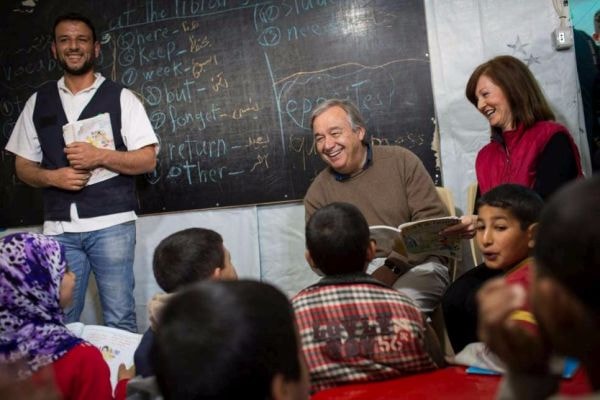 |
| Antonio Guterres speaks with Syrian refugee children. (Source: UNHCR) |
Specifically, the Secretary-General will have to reform and operate the United Nations machinery effectively. Next, the task is to find solutions to balance the interests of the major powers, given that relations between Russia and the West are at their worst level since the Cold War. The latest crisis is that the UN Security Council has been unable to avoid approving both draft resolutions on the Syrian crisis, one proposed by Russia and the other by France.
Furthermore, the Secretary-General needs to play a role in preventing conflicts between nations, de-escalating international disputes, combating extremism and terrorism, addressing climate change and the refugee crisis, and promoting sustainable development globally. Specifically, pressing issues such as tensions in the South China Sea and East China Sea, the Ukraine crisis, the situation on the Korean Peninsula, instability in the Middle East, and especially the rampant spread of extremist terrorism will present challenging tasks for the new Secretary-General, Antonio Guterres.
Although the challenges are immense, with his experience, talent, and inherent qualities, Mr. Guterres is expected to steer the United Nations through all the storms, especially the current refugee issue. Only then can the United Nations maintain its role as a messenger building bridges of peace between nations worldwide.
Phuong Hoa
| RELATED NEWS |
|---|