

Challenges in teaching using the VNEN model
(Baonghean.vn) - This was the feedback from teachers at Nghi Lam Secondary School during a survey conducted by the Provincial People's Council working group at schools in Nghi Loc district on the morning of October 17th.
The survey team included Ms. Nguyen Thi Thanh An, Deputy Head of the Culture and Social Affairs Committee of the Provincial People's Council, as the team leader, along with representatives from the Nghi Loc District People's Committee and relevant departments and units.
In accordance with the 2016 work program, the Culture and Social Affairs Committee of the Provincial People's Council conducted a survey on the collection and expenditure of tuition fees and other fees in schools, as well as the implementation of new teaching models at Nghi Lam Secondary School and Nghi My Kindergarten in Nghi Loc district.
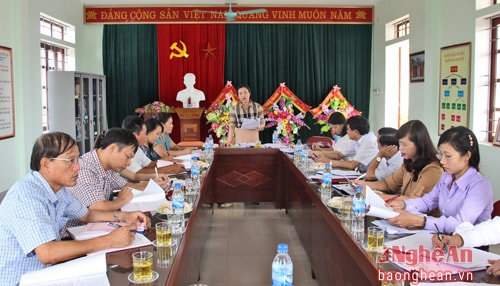 |
| The inspection team worked with Nghi My Kindergarten. |
At Nghi My Kindergarten, after hearing the school representative's report on the monitoring activities, the delegation provided feedback on several related issues. According to the report, in the 2015-2016 school year, the school had 33 teachers, including 17 permanent staff and 5 contract teachers. In the 2016-2017 school year, the school had 25 teachers and staff; including 18 permanent staff and 2 contract teachers; with a total of 295 students. In the 2016-2017 school year, the class had a minimum of 23 children and a maximum of 43 children.
For the 2015-2016 and 2016-2017 school years, the tuition fee for daycare and daycare was 80,000 VND/month. In the 2015-2016 school year, tuition fees totaled over 194 million VND; agreed-upon payments to caregivers amounted to 81 million VND; drinking water expenses totaled 12 million VND. Social contributions to education amounted to 135 million VND. Expenditures included: 90% for tuition fees to cover salaries and 10% for other activities.
The school representative proposed increasing tuition fees to 100,000 VND/month to reduce the need for socialized funding and suggested that 40% of tuition fees be used to cover salaries, leaving 60% for school activities.
During the inspection, members of the working group questioned various issues related to the revenue and expenditure of Nghi My Kindergarten. Representatives from the school's leadership, the Department of Education and Training, and the People's Committee of Nghi Loc district also explained the issues of concern to the working group, including expenditures, teacher staffing quotas, and staffing quotas for school support personnel.
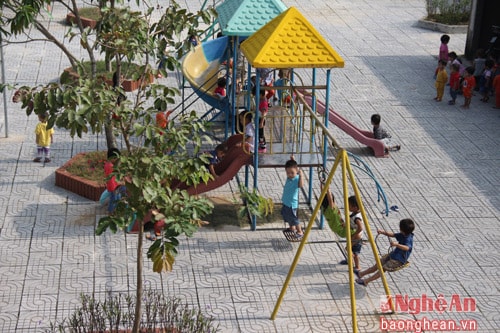 |
| Children at Nghi My Kindergarten during playtime. |
Concluding the monitoring session, Ms. Nguyen Thi Thanh An - Deputy Head of the Culture and Social Affairs Committee of the Provincial People's Council - commented on some shortcomings and deficiencies in the financial management and documentation of Nghi My Kindergarten, which need to be addressed and rectified. She requested the Department of Education and relevant authorities to pay more attention to supporting and disseminating educational policies to the people, creating conditions for the school to operate effectively and serve the interests of the students.
To conduct a survey on teaching and learning according to the new VNEN teaching model at Nghi Lam Secondary School, the working group visited several classes and listened to teachers' feedback on this teaching model.
The 2016-2017 school year was the second year that Nghi Lam Secondary School implemented the VNEN teaching model; it was the only secondary school in Nghi Loc district to implement the VNEN teaching model since the 2014-2015 school year. A total of 7 classes across grades 6 and 7 implemented the VNEN model.
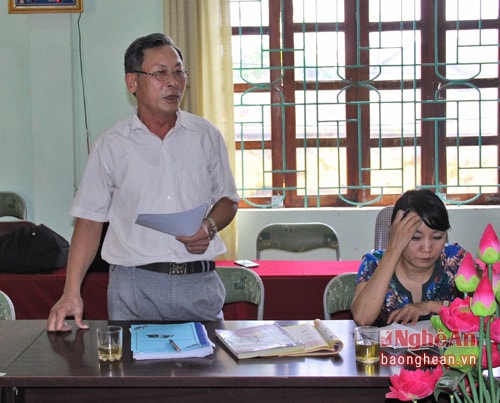 |
| Mr. Nguyen The Thieu, Principal of Nghi Lam Secondary School, reported on the implementation of the new VNEN teaching model to the delegation. |
Regarding the implementation of the new VNEN teaching model, Principal Nguyen The Thieu stated that the facilities and equipment for teaching under the VNEN model are limited and lack investment. Most teaching equipment is made by students and teachers themselves, and even textbooks for this new program are difficult to obtain.
Regarding the teaching staff, there are also some shortcomings in implementing the thematic approach and concretizing the integrated content in the textbooks. Regarding the assessment of student learning outcomes, there are still inadequacies. The regulation requiring parents, students, and teachers to participate in commenting on and evaluating students is difficult to implement effectively and efficiently, leading to difficulties in evaluating and awarding titles at the end of the semester. Students are not assessed quantitatively as in the traditional method, creating a lazy and dependent mindset. Parents are unable to determine their children's academic abilities, so some do not support the program.
However, teacher Nguyen The Thieu also affirmed that the new VNEN teaching model has noteworthy advantages, namely helping students to be proactive, creative, and self-disciplined in learning and developing teamwork skills. In the 2016-2017 school year, according to regulations, the two grade levels taught under the VNEN model at Nghi Lam Secondary School had 7 students with excellent overall academic performance (6.9%); 94 students completed the program (92.2%) and 0.2% did not.
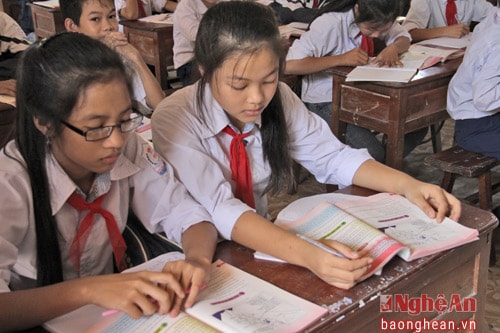 |
| Students of class 7A at Nghi Phuong Secondary School during a History lesson. |
Speaking at the survey, Ms. Dinh Thi Hoa and Ms. Nguyen Thi Dung, teachers from Nghi Lam Secondary School, expressed their concerns: while the new model makes students more active, practical discussion is difficult due to large class sizes; there is a disparity in exam performance between students following the new model and those following the provincial-wide exam system; and students following the VNEN model need additional knowledge enrichment.
Therefore, teachers at Nghi Lam Secondary School wish to maintain traditional teaching methods while applying creative and proactive approaches in teaching; they expressed that the VNEN model is not yet suitable for application in the locality.
The supervisory team recorded the feedback from the schools to compile and advise on the content for the review at the 3rd session of the 17th Provincial People's Council.
Hoai Thu
| RELATED NEWS |
|---|