

Finding the answer to the question posed 15 years later by the 'father' of BRICS.
(Baonghean) - The 8th BRICS Summit, comprising Brazil, Russia, India, China, and South Africa, took place over two days, October 15th and 16th, in Goa, India, coinciding with the 15th anniversary of its formation and development. This was an opportunity for leaders to discuss a common plan to develop BRICS to its full potential.
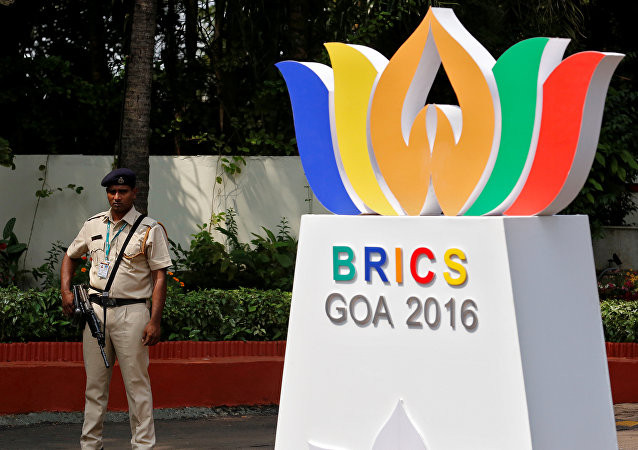 |
| The 8th summit was held in Goa, India, from October 15-16. Photo: Sputnik. |
Not up to par.
In 2001, Jim O'Neil, a senior economist at Goldman Sachs, first introduced the concept of "BRIC," an acronym for Brazil, Russia, India, and China. It wasn't until 2009 that the group held its first summit in Russia, and a year later, BRIC changed its name to BRICS with the addition of South Africa.
Exactly 15 years later, in an article, the "father" of the BRICS concept questioned whether these large and promising economies had achieved their goals.
In fact, ever since the concept of "leading emerging economies" emerged, the world has placed much attention and expectation on the breakthrough development of this group of countries. The formation of BRICS reflects the alliance between nations that want to break free from the "snake-like grip" of the Europe-America-Japan trio.
With a population accounting for 43% of the global population and 26% of the world's land area, the BRICS countries truly have many opportunities for development. Furthermore, each country possesses its own potential and strengths: Brazil has a strong agricultural sector; Russia has world-leading oil and gas reserves; India boasts advanced information technology and a vast knowledge base; China has a large workforce; and South Africa has the largest economy in Africa.
According to the International Monetary Fund (IMF), BRICS currently accounts for 15% of global economic output. The total foreign exchange reserves of BRICS countries amount to $4.4 trillion, with China accounting for approximately three-quarters of that. The BRICS group has become a leading force, playing a driving role in the global economic recovery after the financial crisis.
The most notable achievement demonstrating the cohesion and cooperation among BRICS countries is the establishment of the New Development Bank in July 2014. This banking model is seen as a counterweight to the financial institutions dominated by the West for decades. Experts believe this is a concrete step towards establishing a more equitable global order.
However, BRICS' achievements seem to fall short of their potential. Moreover, after 15 years of formation, BRICS is now facing significant challenges.
Due to the sharp drop in global oil prices, Russia's economy is facing significant difficulties, while China's industrial production has also declined sharply. Brazil and South Africa are both facing a double crisis.
Besides serious economic and social difficulties, there is also political instability. Although India has much potential, it has not truly achieved a breakthrough, and the number of poor people remains high in society.
Furthermore, an unfavorable external economic environment has also significantly impacted the growth of emerging economies. All these signs indicate that BRICS needs a new strategy for the next phase to boost member countries' growth and revitalize the group's position.
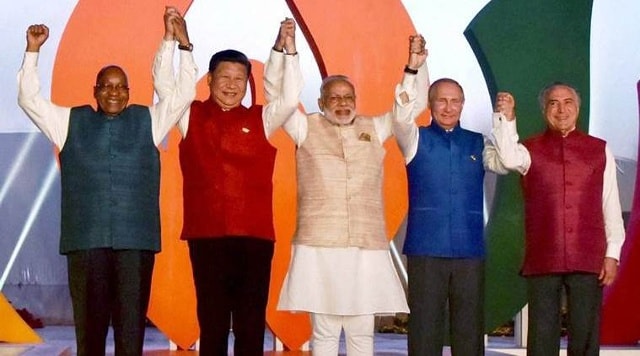 |
| BRICS leaders pose for a group photo on October 15 in India. Photo: PTI. |
Coordination is needed.
At this 8th BRICS Summit, in its role as BRICS Chair this year, India has put forward the theme "Building Rapid, Multi-Participatory and Collective Solutions." This means that BRICS recognizes the need for closer coordination among its members in order to adapt to and address both internal and external challenges.
Observers believe that for a long time, the BRICS members have developed in a "each man for himself" manner. While China prioritizes exports, Russia focuses on exploiting natural resources.
Therefore, when adverse factors from the global economic environment strike, the response becomes fragmented and leads to overall weakness. Recognizing this, the agenda of this BRICS summit focuses on strengthening intra-bloc economic cooperation, especially mechanisms that create linkages between the member economies.
Specifically, at the meeting of BRICS finance ministers and central bank governors on the evening of October 15th, the ministers agreed to move towards new areas of cooperation proposed by India, such as the establishment of a BRICS Economic Research and Analysis Institute, and a BRICS credit rating agency was also discussed.
Previously, China had proposed the establishment of an intra-bloc free trade area, emphasizing that this step would create “an important form of cooperation” among member countries.
According to China's Ministry of Commerce, establishing a free trade area would enable BRICS countries to eliminate tariff and non-tariff barriers, fully demonstrate their competitive advantages, and promote trade and investment liberalization within the bloc. The ministry argues that a free trade area would help BRICS countries achieve common benefits and development, as well as promote South-South cooperation on a global scale.
According to economic experts, the BRICS economies will continue to play an active role in shaping the global structure of growth and development. Despite facing many significant challenges, if the BRICS can skillfully overcome these obstacles, they can fully realize their true potential.
Thanh Huyen