

What are the options for dealing with wasteful and inefficient projects?
The government needs to provide a detailed report on its plan to address wasteful and inefficient investment projects that are of public concern.
On the morning of October 17th, the Standing Committee gave its opinion on the report on the socio-economic situation in 2016 and the plan for 2017.
The verification report of the Economic Committee, presented by Chairman Vu Hong Thanh, assessed the implementation of tasks and solutions according to the National Assembly's resolution. It stated that the Government had directed ministries and agencies to implement many solutions to support businesses in terms of market access and credit, ensuring continued growth in line with the economic recovery. The rational management of the money supply has helped stabilize interest rates and support exchange rate stability amidst a sharp increase in the CPI compared to 2015.
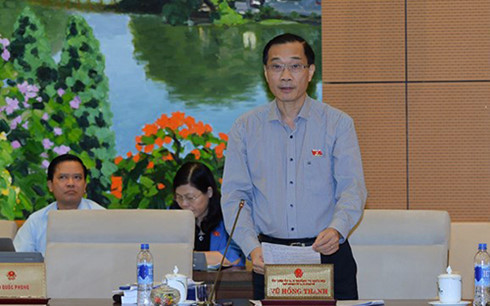 |
| Chairman of the National Assembly's Economic Committee, Vu Hong Thanh. |
However, the high rate of non-performing loans and the weakness of some commercial banks, coupled with the fact that government bond interest rates, although reduced, remain quite high, making it difficult to lower interest rates for businesses borrowing capital, the auditing agency analyzed.
Regarding the restructuring of credit institutions, some opinions suggest that many obstacles remain, and risk management, operation, auditing, and internal control activities at some credit institutions still result in risks. The divestment of investments by credit institutions in non-financial sectors or high-risk investment areas, as well as the divestment of state-owned corporations and enterprises in the banking sector, remains slow.
Real estate lending has slowed down, but risk control still needs to be strengthened to ensure the sustainable development of the market. Newly identified non-performing loans have not yet been fully resolved.
"According to the State Bank of Vietnam's report, non-performing loans (NPLs) as of September 2016 amounted to approximately 2.62% of total outstanding loans. If we include NPLs transferred to VAMC (approximately 4.8%) and restructured loans, the NPL ratio would be much higher," said Mr. Vu Hong Thanh, and he requested that the Government provide a clearer report on upcoming solutions for handling NPLs acquired by VAMC and restructuring bank loans for large domestic enterprises.
Reports are needed on the handling of wasteful and inefficient projects.
The review report indicated that many opinions suggest that the restructuring of state-owned enterprises has seen little progress. The pace of equitization of state-owned enterprises is slow, partly due to a lack of decisive involvement from ministries and agencies, and the failure to clearly define the responsibilities of enterprise leaders.
Furthermore, the number of enterprises wholly owned by the State remains large, and the production and business efficiency of many state-owned enterprises is not commensurate with their potential and the resources allocated by the State.
The auditing agency suggested that the Government should provide a detailed report on the effectiveness of the management and use of state capital and the plan for handling wasteful and inefficient investment projects that are of public concern.
Specifically, projects include the Dinh Vu fiber production plant (total investment of VND 7,000 billion), the Dung Quat Bio-Ethanol plant (one of the three key national ethanol plants, total investment of VND 2,200 billion), the second phase of the Thai Nguyen Iron and Steel Plant expansion project (total investment of VND 8,000 billion), the Phuong Nam pulp mill project in Long An province (total investment of VND 3,000 billion), and the Ninh Binh Fertilizer Plant project (total investment of VND 12,000 billion).
According to VOV