

Strengthening the management of ODA funds.
(Baonghean.vn) - Public debt is a topic of public concern, and ODA loans are managed by many ministries and agencies. To manage this capital effectively, a suitable financial management mechanism is needed.
On the afternoon of October 25th, at a specialized press conference of the Ministry of Finance, Mr. Hoang Hai, Deputy Director of the Debt Management Department (Ministry of Finance), stated that on average, the state budget spends approximately 1 billion USD annually on foreign debt repayment (including principal and interest). However, this figure is still lower than the budget's obligation to repay domestic loans. While only over 350 trillion VND of borrowed capital was mobilized, reaching 77.5% of the annual plan, in the first nine months of the year, the budget had to spend over 176.8 trillion VND on debt repayment, including over 140 trillion VND on domestic loans and over 36.6 trillion VND on foreign loans.
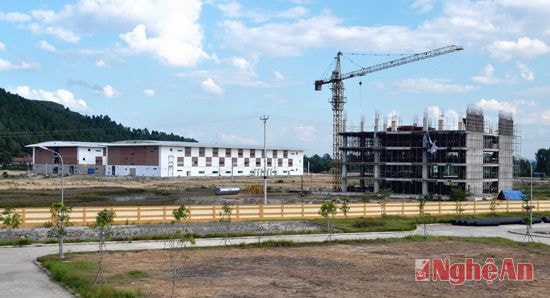 |
| The water treatment plant in Nam Giang (Nam Dan district, Nghe An province) uses ODA funding from Finland. Photo: Hoang Vinh. |
Although all of this falls within the limits set by the Ministry of Finance at the beginning of the year and approved by the Government, it is still something to consider because from July 2017, Vietnam may be removed from the list of countries eligible for preferential development loans by the World Bank as it becomes a middle-income country. The pressure to repay foreign loans will be greater, new loans will be less preferential, interest rates will be higher, and loan terms will be shorter…Therefore, it is necessary to calculate and restructure the debt, and at the same time, find ways to use borrowed capital effectively and balance it with the ability to repay the debt," Mr. Hoang Hai said.
At the press conference, representatives from the Ministry of Finance answered questions from the press regarding the increased costs resulting from slow disbursement, the new circular prohibiting disbursements exceeding the budget, which could lead to more projects being delayed and investors being penalized; how ODA public debt and debt refinancing will be managed, and what sources will be used to repay debt in the future.
Currently, the debt of state-owned enterprises (SOEs) is 1.5 trillion VND, based on the principle of self-borrowing and self-repayment. However, if SOEs fail to repay, will the state budget step in to cover the costs? In response to these questions, a representative from the Ministry of Finance stated that to use ODA funds effectively, it is necessary to gradually shift from grants to relending through credit institutions. The Ministry of Finance is currently submitting regulations on relending at the local level for approval. The appropriate relending ratio will be determined based on the economic and financial capacity of each locality. Accordingly, localities will bear the majority of debt repayment costs and will be the main entities responsible for calculating and determining whether a project is capable of repaying the debt.
Regarding the assessment of the effectiveness of ODA utilization, the Ministry of Finance stated that the Government assigned this task to the Ministry of Planning and Investment, while the Ministry of Finance is responsible for tightening the management of guarantees, setting requirements for borrowing and repayment obligations; and is also responsible for relending, and has now submitted a proposal to the Prime Minister for a decision on relending through credit institutions. Furthermore, the Ministry of Finance is currently proposing amendments to the Law on Public Debt Management.
Red River
| RELATED NEWS |
|---|