

A sudden pivot or a risky gamble?
(Baonghean) - During his four-day visit to China, Philippine President Rodrigo Duterte once again shocked the world by boldly declaring his intention to "separate" from long-time ally the United States in both military and economic spheres.
While the unpredictable nature of this leader is nothing new, this is still a major blow that has caused the Obama administration to frown and raised many big questions about the future of relations between countries in the Asia-Pacific region.
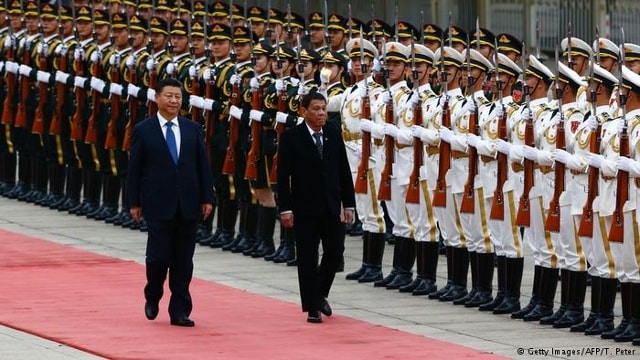 |
| Duterte and Xi Jinping review the honor guard during the welcoming ceremony for the Philippine president's visit to China. Photo: EPA. |
Out with the old, in with the new.
The Philippine president's six-year term has only been underway for about five months, but the Southeast Asian nation's foreign policy strategy has already shifted significantly compared to the previous administration. During his first trip to China, Duterte boldly declared at a business forum in Beijing his intention to reshape the Philippines' relationship with its closest ally: a "pivot" away from the US and toward China.
“America has now failed. I have adjusted myself to align with the Chinese ideological current, and I may also go to Russia, talk to Putin, and tell him that only three countries are standing against the world – China, the Philippines, and Russia. That is the only way forward,” said the leader from Manila.
Duterte also clarified the type of "separation" he envisioned: "I declare a separation from the United States both militarily and economically, though perhaps not socially."
His remarks not only risk damaging U.S.-Philippine relations but also impact U.S. relations with the Asia-Pacific region, a central pillar of Obama's foreign policy ambitions as he seeks a strong American position in the Pacific Century. While the White House is striving to highlight the positive aspects of its long-standing relationship with the Southeast Asian island nation, Duterte's comments have also stirred controversy in Washington.
State Department spokesman John Kirby affirmed that the U.S. would demand an explanation, stating that the latest statements “are a continuation of a rather aggressive tone that the U.S. believes is inconsistent with the kind of relationship the U.S. has built, is building, and will continue to build with the people of the Philippines.”
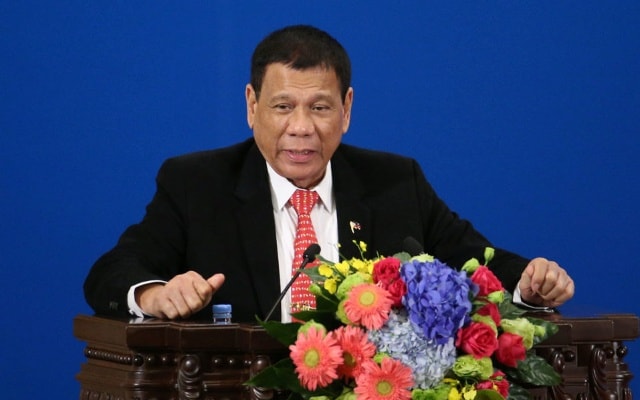 |
| President Duterte speaks at a business forum in Beijing on October 20. Photo: AFP. |
Looking back over the past 30 years, the Philippines has consistently been ranked among the most important allies of the United States in Asia. The stable bilateral relationship has not only brought many benefits to the United States, but has also significantly contributed to the rise of this Southeast Asian nation.
It can be seen that close relations with the US in the defense sector have helped free the Philippines from the urgent need to build a powerful military to defend itself. From there, Manila's armed forces are able to focus primarily on combating threats from internal forces, such as insurgent groups operating in the South.
Now, people are questioning whether the Philippine navy is capable of self-reliance and protecting itself from external threats, given that its leader has severed ties of friendship and eroded its alliance with the world's leading power.
For the U.S., its overall strategy in the Asia-Pacific aimed at counterbalancing China's growing power and influence in the region could collapse at any moment. Duterte's actions come at a particularly inopportune time for Washington, given the limited time remaining in Barack Obama's presidency. And even after the presidential election on November 8th, the U.S. will need more time to reposition its strategy toward both China and Southeast Asia.
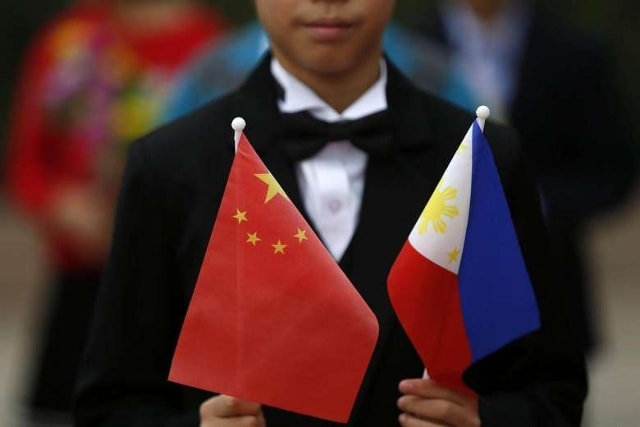 |
| Is the Philippines "pivoting" towards China? Photo: EPA. |
Is this a bait-and-switch tactic?
DW commented that President Rodrigo Duterte's recent statement was indeed an unprecedented diplomatic move, perhaps even seen as "a gift Duterte is giving to his new friend in Beijing," in an attempt to reverse the already strained relationship between the Philippines and China.
It's not hard to see that while Philippines-US relations are deteriorating, the biggest beneficiary is China. Duterte's visit to Beijing and his eloquent speeches have been very pleasing to China.
Just a few months ago, China and the Philippines were on opposite sides of a fierce battle over overlapping territorial claims to islands and rocks in the South China Sea. China lost the case brought by Manila at the International Arbitration Court in The Hague. Despite fierce criticism from the international community, the country has loudly refused to recognize the court's ruling.
But the situation has changed; now China seems to have gotten what it wanted: bilateral dialogue instead of multilateral settlement. According to DW, Duterte has personally handed that "victory" to his Chinese counterpart Xi Jinping, in exchange for billions of dollars in economic aid, trade agreements, and infrastructure projects.
Analysts suggest that Duterte is trying to demonstrate that his "independent" foreign policy is a great success, but is overlooking the significant risks involved in this strategy. He may reap some short-term benefits for the Philippines, particularly in the economic arena, thanks to the money received from China in exchange for distancing himself from the United States.
However, even in the Philippines, many experts warn that changes in Duterte's policy are unlikely to make the Philippines a more "independent" country, but simply shift it from dependence on the US to reliance on China. Despite all this, Duterte pays no heed to such concerns, stubbornly insisting on a foreign policy of "putting all his eggs in one basket"!
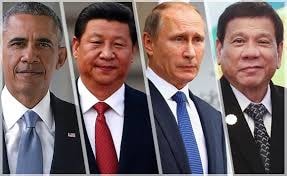 |
| Duterte wants to "decouple" from the US and move closer to China and Russia. Photo: Internet. |
Opening the door wide to Beijing and slamming it shut to the US is how the Philippine president is putting himself in a very dangerous position. If he naively believes that his giant neighbor China views the Philippines as an equal partner, Duterte may have made a huge mistake. Instead of the diplomatic tactic of "walking a tightrope" to balance relations with major powers, Duterte's strategy could backfire.
Particularly in the economic sphere, Mark Williams, chief economist for Asia at Capital Economics, commented: "If relations with the US deteriorate, there will be reason to worry, because the US invests heavily in the Philippines. A pivot to China offers no benefit, as China is a much smaller investor."
Indeed, two-way trade in goods between the US and the Philippines reached $18 billion in 2015, and US companies invested more than $4.7 billion in the Philippines. The US also accounted for about one-third of the total $17.6 billion in remittances sent to the Philippines this year. While the damage to the island nation from saying "goodbye" to the US is obvious, analyzing Duterte's recent rhetoric reveals that this doesn't seem to be a major concern for the politician.
Phu Binh