

BOT fees are not commensurate with people's income.
The Ministry of Planning and Investment stated that recent years have witnessed a boom in investment in the form of BOT (Build-Operate-Transfer) contracts in the transportation sector, contributing significantly to the policy of socializing investment to further develop transportation infrastructure in the context of limited state budget resources. However, this investment wave has been accompanied by a proliferation of BOT toll stations, with varying toll rates in some locations, and in others, rates that are not commensurate with the affordability of the people.
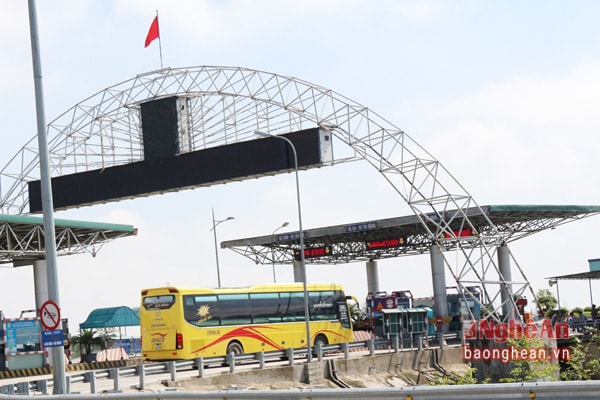 |
| Toll station at Ben Thuy II Bridge (Vinh City). Photo: PV |
The Ministry of Planning and Investment believes that revenue losses in BOT projects essentially fall into two categories: firstly, losses compared to projected revenue (e.g., traffic volume not matching surveys and forecasts), also known as passive losses; and secondly, losses compared to actual service usage (e.g., manual operations lacking transparency causing revenue shortfalls), also known as active losses. Based on this, the Ministry of Planning and Investment has proposed a set of solutions for each issue to control and prevent revenue losses in BOT projects.
Regarding planning solutions, according to the Ministry of Planning and Investment and the Ministry of Transport, localities need to review and study the transportation infrastructure network plan to determine which routes require BOT investment and which can be funded by the state budget. In particular, attention should be paid to approving BOT investments only on routes with parallel roads to ensure people have the right to choose. Based on this, the plan for BOT toll stations nationwide should be finalized and published. The construction and operation of BOT toll stations in accordance with the plan, if implemented effectively nationwide, will be a prerequisite for proactively allocating traffic volume rationally, controlling traffic flow, and thereby reducing revenue losses.
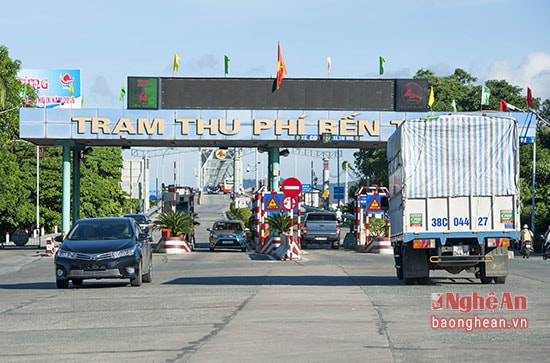 |
| Ben Thuy Bridge Toll Station |
Regarding policy and legal solutions, it is necessary to supplement the law with regulations requiring toll stations to be located within the project area to eliminate the situation where the construction is in one location and tolls are collected in another. This would ensure relative fairness, as customers would not have to pay for services they do not use. In addition, the basis for establishing the toll fee framework according to Circular No. 159/2013/TT-BTC and the basis for issuing separate circulars on toll rates for each toll station need to be clarified to limit the "request-and-grant" mechanism. A reasonable toll rate should be developed and applied proportionally to each road. For example, on the same road or on roads with similar scale and technical standards, a typical toll rate could be developed based on the length of the invested section (VND/km x km invested).
This allows investors to more accurately predict toll rates before making investments, and people feel they are being treated more fairly when traveling on different sections of the same road.
Furthermore, legal regulations could be amended to require investors to complete the final settlement of their total investment capital before collecting tolls. This would ensure that the toll collection period and the toll rates based on the finalized investment capital more accurately reflect investment efficiency. These solutions aim to avoid public discontent, which could lead to large gatherings and traffic blockades, as seen at some toll stations recently, paralyzing toll collection operations and resulting in revenue losses.
Regarding technological solutions, promoting the application of advanced technology and reducing manual methods in toll collection will certainly contribute to reducing revenue losses. For example, on newly constructed roads, under favorable conditions, a closed toll collection system using magnetic cards could be implemented. This would ensure fairness, as customers only pay for the services they use (actual kilometers traveled), while also accurately controlling traffic flow and revenue based on recorded data.
However, given the current situation, the closed toll collection system and the use of magnetic cards can only be applied to certain sections (such as the Phap Van - Cau Gie section). Most BOT projects involve the renovation and upgrading of existing roads with many level crossings, thus requiring open toll collection. Therefore, a roadmap for implementing non-stop toll collection technology is needed soon. With this technology, toll payments are made through the customer's toll account, and all transactions are managed through the bank. This would both save costs in the total investment capital of BOT projects and enhance transparency, preventing toll revenue loss.
Finally, regarding solutions to improve management and supervision capacity, it is necessary to understand that investors always have conflicts of interest with fee payers, and from a business perspective, investors tend to maximize profits on their invested capital. Therefore, when entrusting investors with fee collection, even if they have done well in terms of planning, legal policies, and technology, the relevant authorities still need to improve their capacity to closely manage and supervise, and resolve obstacles in the fee collection process for capital recovery. Only in this way can fee collection be ensured to be objective, continuous, and effective, preventing fee losses.
Furthermore, communication solutions are necessary. The Ministry of Planning and Investment believes this is a solution that cannot be overlooked; on the contrary, it needs to be promoted in the coming period. A sound policy requires public understanding and support from its inception to its implementation and completion. In the past, public opinion guidance has not been effective. Investors, often perceived as greedy and selfish, will lack the inspiration and determination to invest.
Customers, often feeling frustrated and overwhelmed by the maze of BOT toll stations, will react by either choosing cheaper options for themselves, even if it is more costly for society (if there is a choice in using the service), or restricting their own travel (if there is no other choice in using the service).
The Ministry of Transport stated that, based on practical implementation and discussions with the Ministry of Planning and Investment, it is very difficult to prepare bidding documents for PPP projects and BOT contracts without the participation of state capital. For these projects, the most suitable criterion for evaluating bids and selecting investors is the toll collection period for capital recovery. The Ministry of Transport has reported to the Prime Minister requesting permission to use the toll collection period for capital recovery as a criterion for selecting investors to implement PPP projects and BOT contracts in the transport sector in cases where state capital is not involved.
Red River