

The green arches of Vinh City
(Baonghean) - Occasionally, in my dreams, I still encounter the childlike excitement and exhilaration of those days when I followed my older siblings and fell asleep under that green canopy. Those were the days when I was only six or seven years old, toddling along with my older sister to a camp in the Cua Nam flower garden. Oh! The feeling of standing amidst a forest of towering mahogany trees, with their large, gnarled trunks and branches, was so strange in the eyes of a child.
After the war and bombings, Vinh was constantly in a frenzy of reconstruction. Yet, amidst the chaotic, even somewhat desolate urban landscape of one of the most heavily damaged areas, we children still found peaceful, dreamy spaces in the Cua Nam flower garden or the Cua Bac park.
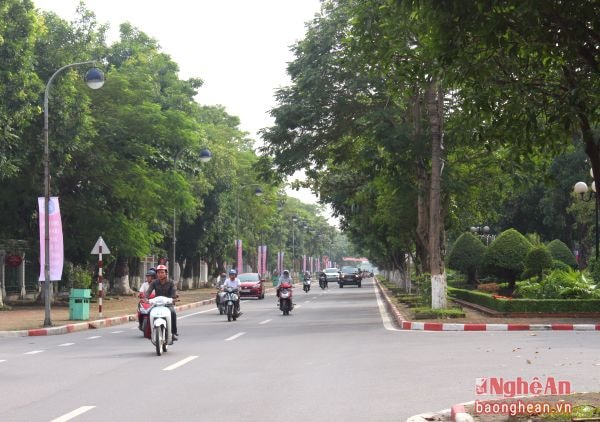 |
| Trees line Le Mao Street. |
Later in life, having witnessed the various stages of Vinh City's development, I always believed that the city's administrators of the past were absolutely right to create green spaces that, with their aesthetic vision and love for the city, allow life to flourish.
If, in the eyes of a child, a large canopy of trees was once called a forest, then today's Vinh City must surely be a vast wilderness. I brought up the story of the city's greenery to those who planted it, and Mr. Nguyen Anh Dung, Deputy Head of the Planning and Technical Department of Vinh City Parks and Greenery Joint Stock Company, told me that Vinh ranks 5th in the country in terms of green cover per capita. The proportion of green space in Vinh is only behind Hanoi, Ho Chi Minh City, Hue, and Can Tho. The entire city of Vinh currently has 242 hectares of green space, including 50 hectares in Quyet Mountain Forest Park, 55 hectares in Hung Hoa mangrove forest, 60 hectares of trees along streets, and nearly 40 hectares in agencies, units, and schools… In addition, it's impossible to count the tens of thousands of trees planted by residents themselves in their homes, residential areas, or in various agencies and units.
Anyone paying attention will notice that over the past 10 years, many tree species along the streets of Vinh City have begun to be replaced. People are gradually cutting down unsuitable trees to plant new ones. For example, the paulownia tree is being cut down, and the milkwood tree is being added to the list of restricted trees that need to be pruned. According to surveys conducted by relevant authorities, there are still about 15,000 paulownia trees in Vinh, accounting for 30% of the city's large timber trees. "Paulownia trees are brittle, easily broken, have many thorns, and shed leaves frequently; their lifespan is only about 20 years," said Mr. Nguyen Anh Dung. Therefore, on many streets, people are starting to see trees like the black star tree or the Dipterocarpus tree. And according to the city's plan, 40 main streets in Vinh will be identified by specific, distinctive tree species. The form of these "tree-lined streets" can be seen on Ho Tung Mau Street with its lush green mango trees, Truong Thi Street with its rows of straight oil palm trees, or Le Nin Street with its glossy, oil-like leaves of the black star tree...
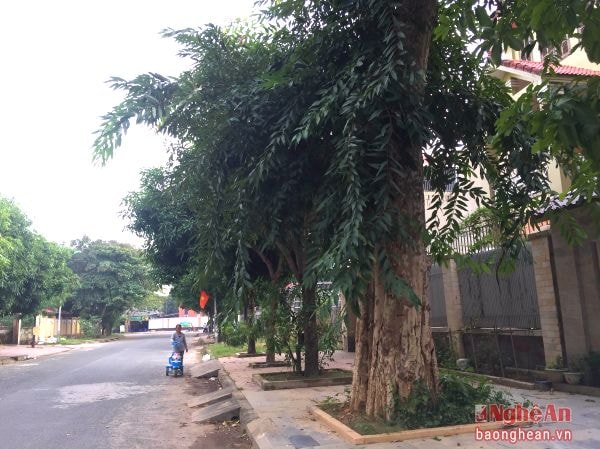 |
| A view of the Trung Do new urban area (Vinh City). |
Mr. Nguyen Anh Dung added that there were many times he and his colleagues had to chase away buffaloes, goats, and cows because they were damaging the trees. When the buffaloes and cows were caught and no one came to claim them, and there was no place to keep them, they had to release them into the garage. Every day, they assigned people to cut grass to feed them. When someone finally came to claim them, they had to form a committee, get confirmation from the authorities and the police… it was incredibly complicated. Moreover, no one wanted to fine the owners of the buffaloes and cows because most of them were poor. Yet, there was one time when a cow owner let his cow roam freely and damaged the trees, even smashing the car window because he thought they had caught the cow without permission. “Then there was the time we caught a goat and brought it back to the unit, and unfortunately it died. So we had to ask the police to come and draw up a report, call the veterinary agency to inspect, disinfect, and sterilize it, costing tens of millions of dong – the cost of several goats,” Mr. Dung recounted with a sad smile. But gradually, people understood the role and importance of trees, so recently the situation of cutting down trees has significantly decreased. Many people even proactively stand up to protect trees from damage by irresponsible individuals. In many cases, officials and workers of the Greenery Company have been "reprimanded" by residents for pruning branches before the rainy season.
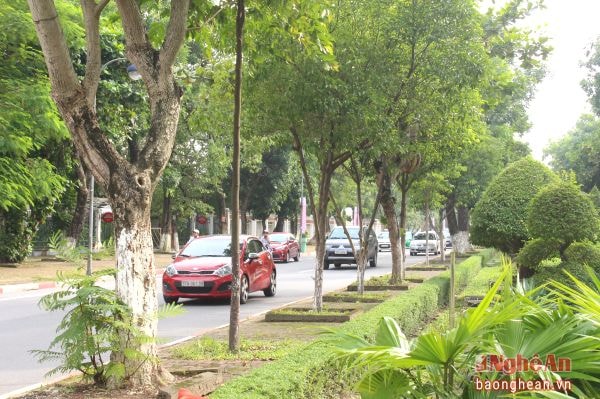 |
| In autumn, the lush green trees on the city's avenues are carefully tended. |
As everyone knows, Vinh, located in the heart of North Central Vietnam, has a harsh climate, especially in the summer with its scorching heat and hot winds. More than anyone else, the residents of Vinh understand the importance of greenery. Therefore, many families in residential areas have proactively planted numerous trees in their yards and around their living environment. It's not surprising if someone visiting Vinh, walking down a small street, suddenly feels as if they've wandered into a forest of rustling leaves. There you'll find mango trees, banyan trees, fig trees, plum trees, and even large, mottled white-barked trees. When planting trees has become a self-motivated need for each household, protecting green spaces is almost a matter of course for everyone.
Those visiting Vinh for the first time will surely find this small city both strange and delightful. Perhaps it's just my own speculation stemming from my boundless love for the city. But just visit Ho Chi Minh Square, Nguyen Tat Thanh Park, Cua Bac Park, Cua Nam flower garden, and many other streets, and you'll see for yourself...
Dao Tuan
| RELATED NEWS |
|---|