

The challenges ahead for the new Spanish Prime Minister.
(Baonghean) - It took the Spanish people two elections and 10 months of political deadlock to finally find a fully functional government. The disagreements are over, but the road ahead remains a significant question mark for the new government in Madrid.
The knots have been untied.
After a 10-month wait, Spain finally has a Prime Minister. On October 29th, conservative leader Mariano Rajoy won a vote of confidence in the Spanish Parliament to become Prime Minister.
The political deadlock in Spain began after the December 2015 general election, when no party won a majority in Parliament. Negotiations to form a new government failed, forcing Spain to hold a second election on June 26th, but the results were largely the same. Rajoy's People's Party (PP) won the most seats in Parliament but still did not secure a majority to form a new government on its own.
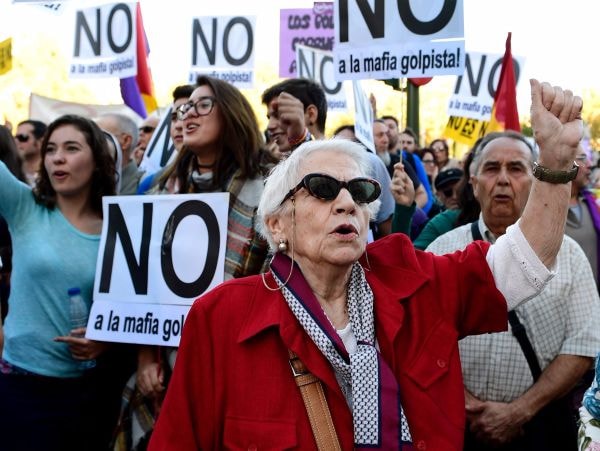 |
| Opponents of Rajoy's second term in office in Madrid (New York Times). |
The political uncertainty in Spain lasted until October 27th. In last Thursday's confidence vote, Rajoy needed a majority in the 350-seat parliament to be confirmed. This did not materialize. However, in the second vote on October 29th, the leader only needed more votes in favor than against to return to power.
According to Spanish media reports, the People's Party is expected to form a minority government, after securing support from the smaller Ciudadanos Party and tacit backing from several Socialist Party (PSOE) MPs who abstained. In the vote, Rajoy received 170 votes in favor, 111 against, and 68 abstentions from members of parliament.
In reality, the knot of the political crisis in Spain wasn't necessarily untied in the country's parliament. It was resolved within the Socialist Party itself. After two elections in the past 10 months, members of the Socialist Party were divided on whether to form a coalition with the People's Party to create a new government. In fact, the internal discord within the Socialist Party was even more heated than the negotiations in parliament.
The situation culminated in the resignation of Socialist Party leader Pedri Sanchez, who stubbornly defended his stance against the government led by the People's Party leader and interim Prime Minister Rajoy. To achieve this, more than half (17 out of 35) of the Socialist Party's leadership resigned collectively to force Sanchez out. In a final move, senior members of the party unanimously agreed to remove the obstacles, allowing interim Prime Minister Mariano Rajoy to take office for a second term. Thus, Socialist Party members sacrificed party unity to help form a new government, saving Spain from a third election in just two years.
Reasonable, timely
Supporting the People's Party leader, Mariano Rajoy, as Prime Minister is essential at this time for members of the Socialist Party. First and foremost, this is for the greater good of the nation, given the economic crisis that has severely impacted the job market, with unemployment at one point soaring to 27%. The Eurozone's fourth-largest economy is also projected to fail to meet its 2017 budget deficit target. Restoring stability at the top political level is a prerequisite if Madrid seeks comprehensive reform.
It is also important to note that the political crisis significantly affected the Socialist Party's prestige. It paved the way for the rise of two new members in the political arena: the left-wing Podemos Party and the liberal Ciudadanos Party. The strong opposition to former President Sanchez's methods actually backfired. It further complicated the issue, leading many to fear that the Socialist Party would lose voter support to Podemos.
Evidence of this can be seen in recent local elections, where the Socialist Party suffered defeats in both key regions of Galicia and the Basque Country. Meanwhile, Prime Minister Rajoy's People's Party maintained its absolute majority in regional local councils and avoided defeat in the Basque Country. If the Socialist Party continues to unilaterally reject political solutions for the country, while other parties quietly accumulate voter support, a high probability is that it will isolate itself from the country's social life.
Challenges await.
Good news has come to Spain as the political deadlock has been broken. Despite the absence of a true government for the past 10 months, the Spanish economy has shown positive signs. Unemployment fell to 18.9% in the third quarter, compared to 20% three months earlier. This is the lowest unemployment rate in Spain in the past six months.
According to the Spanish National Institute of Statistics, approximately 253,900 people have escaped unemployment during this period. Meanwhile, the country's central bank optimistically forecasts economic growth this year at around 3.2%, a figure considered quite good in Europe at this time. Many even jokingly say that Spain probably doesn't need a government to help the country get through this crisis.
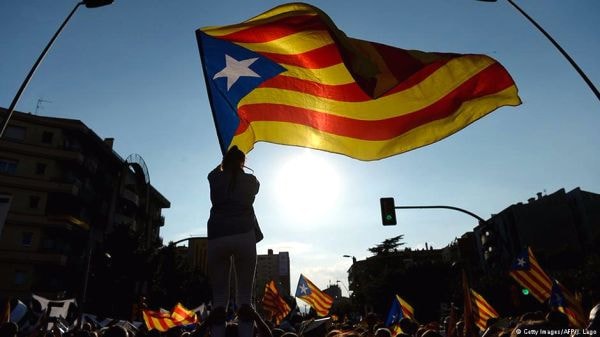 |
| The referendum on Catalonia's independence next year will be a thorny issue for Prime Minister Rajoy (DW). |
But in reality, the new Prime Minister Rajoy will likely have many headaches ahead. His People's Party is actually still in a precarious position. It holds the fewest seats in Parliament of any ruling party in Spain since the 1970s. This is a major drawback if Rajoy wants to pass important policies in Parliament.
The first test will be the 2017 budget plan. Otherwise, another election will likely take place in the near future. At that point, the opposition will certainly not allow him to return to power. Besides the economic front, the biggest pressure on the new government comes from Catalonia. The regional government is planning a referendum on independence next September.
Prime Minister Rajoy, who has refused any discussion on this topic, would certainly be very unhappy if an unexpected outcome occurred in Catalonia. The problem is that the opportunity to reverse the situation still exists. Catalans could still be persuaded if they were granted more autonomy, as the Socialist Party has proposed. The question is how Prime Minister Rajoy will negotiate.
Thanh Son
| RELATED NEWS |
|---|