

Real estate investors from the North are aggressively moving south.
Many real estate investors from the North have flocked to Saigon and the Southern provinces to seek real estate investment opportunities because the return on investment in this market is attractive, prices are "softer," and liquidity is better.
Social housing: Supply and demand are mismatched.
Joining the wave of real estate investment southward quite early, from the beginning of 2000, Mr. Duc, who worked in the steel industry in Cau Giay district, Hanoi, accumulated 50 gold bars and bought 5,000 square meters of agricultural land in Phuoc Thien ward, District 9, Saigon. Based on the current gold price of 36.8 million VND per tael, the land is worth nearly 2 billion VND. At that time, the real estate market was still in its infancy. He completed the legal paperwork, built a 100 square meter house, and used the remaining land as an estate, growing ornamental plants and fruit trees, digging a pond, raising ducks and chickens, and hiring someone to look after it each month.
In 2014-2015, land prices in this area skyrocketed as investors rushed to acquire land in suburban areas. Mr. Duc's land was repeatedly offered at 10 billion VND, then 13 billion VND, but he held onto it and refused to sell. "I've held onto this property for 16 years, intending it as an investment for retirement. Over time, land prices will continue to rise, so I'm not in a hurry to sell," he said.
Moving south later, in 2013, Mr. Tuan, residing in Hai Ba Trung District, Hanoi, sold his house on Lac Trung Street for 12 billion VND and decided to invest in real estate in Saigon. He used the money to buy four large plots of land in District 9, Ho Chi Minh City, totaling nearly 2,000 square meters, and a luxury apartment in District 2 for rent. At that time, the land didn't generate a monthly income, but the luxury apartment yielded an average revenue of over $10,000 per year. In 2014-2015, the real estate market in East Saigon boomed thanks to expressways, ring roads, and the metro, which significantly increased the value of his four plots of land.
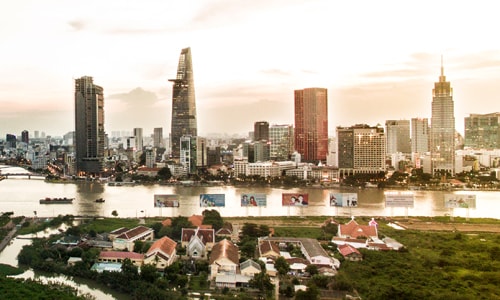 |
Many investors from the North have shifted their capital from Hanoi to Saigon to buy real estate because the return on investment in this market is higher. Photo: Lucas Nguyen |
In June 2016, Mr. Tuan sold three plots of land for a profit, along with the rental income from his apartment over the past 2.5 years, recovering his initial investment of 12 billion VND. The remaining plot of land, nearly 500 square meters, has increased in value by 1.5 times in the past 30 months, while the apartment continues to be rented out long-term. "This will be my net profit after three years of searching for real estate investment opportunities in Saigon. I will only sell when the return on investment doubles," he said.
Originally from Hanoi, Mr. Trung, a Vietnamese expatriate living in Germany, initially prioritized investing in the capital. However, after only a few years, seeing that the return on investment in the North didn't meet his expectations, he decided to move South. In 2012, this investor bought a house on Trung Hoa street worth 32 billion VND to rent out for 900 million VND per year. The lease contract was for 10 years, with a 6% annual increase from the third year onwards. However, for the past two years, the tenant has requested the old rental price due to unfavorable business conditions.
This investor calculated that if he sold the house, he could currently earn 37 billion VND before deducting brokerage fees and transfer of ownership documents. "The annual return on investment for the house is less than 5%, a figure far too low," Mr. Trung expressed his dissatisfaction.
Therefore, in 2015-2016, he decided to change his investment direction, shifting all his capital to the South. He exchanged the 15 billion VND he had planned to use to buy a storefront house in Hanoi for two luxury apartments in the heart of Ho Chi Minh City because the return on investment was guaranteed at least 7% and up to 8-9%, much higher than in Hanoi. "I will buy more storefront houses in Saigon soon to rent out," Mr. Trung revealed.
Following the trend of Hanoi investors, in the first three quarters of 2016, many developers of prominent projects in Ho Chi Minh City organized large-scale sales launches in the capital. Leading real estate giants from Ho Chi Minh City such as Khang Dien, Novaland, Phu My Hung, VinaCapital, and CapitaLand... all capitalized on the influx of Northern investors. A diverse range of properties, from villas and townhouses to luxury apartments and even resort properties, were aggressively offered for sale in Hanoi.
According to real estate experts in Ho Chi Minh City, surveys show that while investment flows from Hanoi to Saigon account for 100%, the reverse flow from Saigon to Hanoi is less than 5%. Areas like Thao Dien, Phu My Hung, Saigon Pearl, and The Manor attract 15-40% of residents from Hanoi or Northern Vietnam.
Mr. Nguyen Tho Tuyen, General Director of STDA Real Estate Project Supermarket System (Cengroup), believes that the return on investment in the Hanoi market is usually 2-3% lower than in Ho Chi Minh City. This may be the reason why many investors have shifted their focus recently. However, he also stated that this trend is not new, having appeared around 2008-2010, but was interrupted after the real estate crisis. Recently, many investors have returned to the market, so this trend has reappeared.
Mr. Tuyen also emphasized that not all areas in Ho Chi Minh City offer good returns on investment; it is concentrated in the city center, where returns can reach 8-9% per year. Therefore, he said that besides residential purposes, many investors from Hanoi also choose to buy high-end real estate in the city center of Ho Chi Minh City for rental income.
"Many FDI businesses, when investing in Vietnam, choose Ho Chi Minh City as their first destination. Therefore, the demand for high-end apartments for foreign experts here is always higher than in Hanoi," Mr. Tuyen said.
In addition, according to him, the real estate market in Ho Chi Minh City is always more vibrant than in Hanoi, and investors find it easier to buy, sell, and rent. That is also why it attracts customers from the North.
According to VNE