
Changes to watch out for while driving.
Since Decree 46/2016/ND-CP came into effect, with its notable increase in penalties for running a yellow light to the same level as running a red light, it has sparked much controversy.
Since Decree 46/2016/ND-CP came into effect, with its notable increase in penalties for running a yellow light to the same level as running a red light, it has sparked much controversy.
The Road Traffic Law and QCVN 41:2012/BGTVT (traffic light signals) stipulate that "A yellow signal means you must stop before the stop line, except if you have already crossed the stop line, in which case you may continue." QCVN 41:2016/BGTVT has added: "...If a vehicle has approached or crossed the 'Stop Line' and stopping would be dangerous, it must quickly proceed through the intersection." Therefore, instead of the difficulty in determining whether a vehicle has crossed the stop line when the yellow light is on, from November 1st, 2016, vehicles approaching the stop line and perceiving danger are permitted to continue. Understanding this will allow drivers to be more proactive in handling situations, ensuring maximum safety...
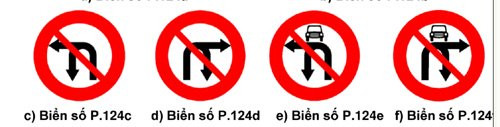 |
| Traffic signs 124c,d,e,f prohibit both turning and U-turns, one of the additions to QCVN 41:2016/BGTVT. |
The debate over what pickup trucks are, which lanes they should use in traffic, and whether they are subject to time restrictions has been ongoing for a long time. Many argue that pickup trucks should be treated similarly to trucks because they share license plates C and D. However, others believe that based on seating capacity and payload, pickup trucks should be treated like passenger cars. But now, with this new regulation, pickup trucks are considered passenger cars in cases where traffic signs, directional signs, and lane markings are in effect. Pickup trucks are not considered passenger cars in terms of vehicle lifespan or license plate registration.
Article 30.9, “If the section of road where the prohibition sign is in effect is very long, at intersections the prohibition sign must be repeated immediately after the intersection, in the same direction as the current sign. If there is no repeated sign, the sign is implicitly considered to have expired,” has been praised by many drivers as “excellent.” For example, on roads with signs and regulations prohibiting certain actions such as lane separation, speed limits, or densely populated areas, if a driver passes an intersection without a repeated sign, the sign is implicitly considered to have expired. Drivers can then drive at speeds outside of densely populated areas without being fined.
A relatively new point in QCVN 41:2016/BGTVT that many drivers should be aware of is the change in the regulations for sign 123a. Previously, many road users and authorities debated whether "prohibiting left turns also prohibits U-turns." Now, this situation will end, because QCVN 41:2016/BGTVT has added signs 124c, d, e, f, specifying locations where both left turns and U-turns are prohibited...
A correct understanding of the definition of "overtaking on the right" in QCVN 41:2016/BGTVT will likely help drivers end the recent debates on traffic forums: "Overtaking on the right is a traffic situation in which one vehicle overtakes another vehicle on the right side of the overtaken vehicle on the same direction of travel on roads with only one lane of motor vehicles in each direction. Vehicles are not allowed to overtake each other on the right except in certain cases stipulated in the Road Traffic Law."
And, the act of "overtaking on the right" is considered "overtaking" according to Article 3.61: "Vehicles in lanes traveling faster than each other is a traffic situation where vehicles in lanes traveling in the same direction on roads with more than two lanes in each direction may travel faster than each other provided they comply with speed regulations and the type of vehicle using the lane. When changing lanes, they must comply with road traffic rules." Thus, to overtake other slower vehicles, drivers can change lanes in the designated area, use proper signals, and drive at the correct speed to overtake, then return to their lane if desired.
Although the regulations contain many new points that are more practical and convenient for road users, the majority of road users believe that, in order to help disseminate road traffic regulations to a wider audience, the Ministry of Transport should improve the regulations by creating a statistical table comparing which regulations have been amended and which are new compared to the old regulations. This would allow road users to be more proactive in understanding the new points in road traffic regulations and simultaneously reduce disputes between road users and law enforcement officers in case of violations.
According to VNE