

What is the solution to violations of traffic safety corridors?
(Baonghean) - Violations of traffic safety corridors are currently quite common in many forms, appearing and existing in almost all districts and towns. To date, according to compiled data from the Department of Transport, the total number of violations is approximately 10,535 cases.
Widespread violations
Along with Mr. Ho Sy Ha, a road patrol officer from Hung Nghi Traffic Management Unit - Joint Stock Company for Water and Road Traffic Management and Construction, inspecting provincial road 542C from Km0+00 to Km7+500, it's not difficult to spot structures encroaching on the traffic corridor. Along the entire 5km stretch, people have built houses and stalls close together for business purposes.
Pointing to a newly constructed clothing store made of corrugated iron right by the roadside, Mr. Ha said: “This is a clothing kiosk belonging to Mr. Nguyen Van Hung in Hamlet 7, Hung Thong Commune (Hung Nguyen District). This kiosk was built in 2015, and although we have inspected it and drawn up a report, the local authorities have still not taken any action. This is not the only case; along this Route 542C, the people and local authorities are tacitly accepting the existence of violations, with kiosks brazenly erected right on the 12/9 canal, violating traffic safety corridors and irrigation works.”
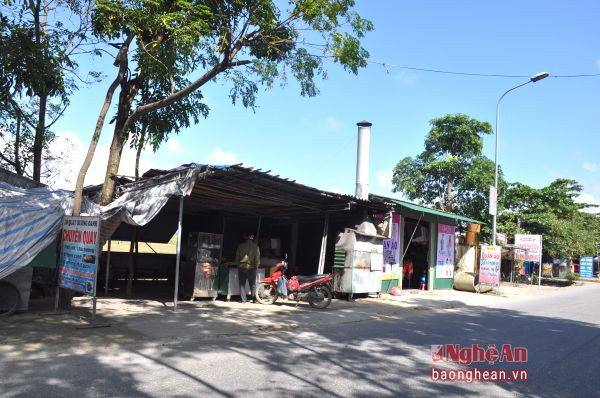 |
| The row of shops in Hamlet 7, Hung Thong Commune (Hung Nguyen District) is encroaching on the traffic safety corridor of Provincial Road 542C. |
Besides stalls and garbage dumps, there is also the problem of constructing permanent houses on the road safety corridor. A typical example is in Do Luong, where Mr. Nguyen Cong Bay's household in Hamlet 7, Minh Son Commune, built a house encroaching on the corridor by 61 square meters. The Road Management Unit 7B inspected the area and reported to the local authorities, who then issued a cease-and-desist order. The situation of individuals building permanent houses within the road safety corridor is particularly prevalent in the mountainous districts of Ky Son, Que Phong, Tuong Duong, and Quy Hop...
Leaving Hung Thong, we went up to Lieu Market in Hung Linh commune (Hung Nguyen district). The market is located right next to the road along the Lam River, and the traders and residents living nearby "carelessly" dump garbage right on the roadside. At noon, the garbage spills onto the dike road, obstructing traffic and emitting a foul odor. Furthermore, along this road, right at the foot of Vang Bridge, garbage is also piled up on the embankment, obscuring the traffic cones.
According to Mr. Le Thanh Binh, Deputy Head of the Traffic Infrastructure Management Department of the Department of Transport, violations are widespread and have persisted for many years without effective solutions. On roads outside urban areas, violations mainly involve illegal land leveling, construction of kiosks and fences, stockpiling of construction materials, and car washes. On urban roads, violations primarily involve the use of road lanes and sidewalks for markets, business activities, illegal parking, and the accumulation of construction waste. These violations occur in almost all 21 districts and cities, seriously affecting public order, security, and urban aesthetics.
Not only on roads, but encroachment on railway corridors is also quite common along railways. According to data compiled by Nghe Tinh Railway Management Company Limited, there are currently 37 instances of houses violating railway infrastructure protection regulations, totaling 960m2; 89 instances of auxiliary structures violating regulations, totaling 6021.5m2; 36 instances of makeshift stalls violating regulations, totaling 1,900m2; and 46 instances of fences violating regulations, totaling 3,613m. These violations are mainly historical issues that have not yet been resolved. The localities with the most violations are Nghi Kim commune (Vinh city) and Thai Hoa town.
What is the cause?
The encroachment on traffic safety corridors and sidewalks for non-traffic purposes, and the creation of illegal level crossings, has significantly impacted traffic safety in the area and caused widespread public concern.
According to Mr. Nguyen Que Su, Deputy Director of the Department of Transport, the reason is that the transportation infrastructure has not been built synchronously, causing difficulties in managing road boundaries and land markers, which have not been adequately placed according to regulations, and land clearance markers, etc.
Meanwhile, the involvement of local authorities and relevant agencies has not been truly decisive, and implementation has not been regular or continuous. Even when the Transport Department issues a construction suspension order, the handling of violations has not been serious, resolute, or thorough, and coordination between agencies and levels of government has been lacking. In general, the management of traffic safety corridors by local authorities at all levels and relevant agencies is still not rigorous enough.
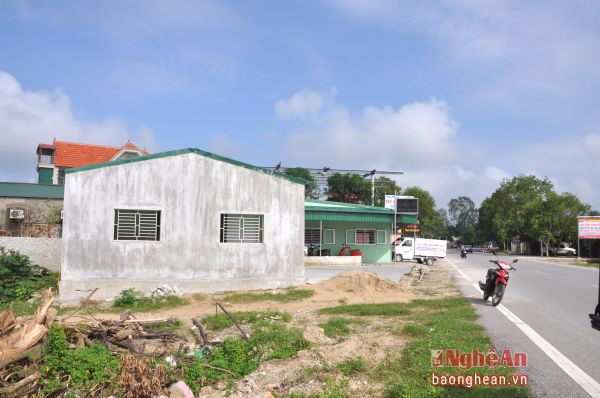 |
| Two eateries in Xuan Lam hamlet, Nghi Xuan - Nghi Loc district, are encroaching on the traffic safety corridor. |
In many cases, the Transport Department has inspected and issued violation notices, but local authorities, for various reasons, have still not taken action. Mr. Nguyen Huu Tho, a road patrol officer at Hung Nghi Transport Station, stated that in Xuan Lam hamlet, Nghi Xuan commune (Nghi Loc district), there are two cases where households, Nguyen Ngoc Cam and Mai Van Trang, built permanent eateries on the traffic corridor. We have issued violation notices to stop construction, but to date, the buildings have been completed and are in operation, and we have not seen any action from the local authorities. If a violation is not dealt with seriously, it cannot serve as a deterrent, and the violations will continue and spread.
Mr. Hoang Anh Tuan, from the General Planning Department of the Joint Stock Company for Management and Construction of Road and Waterway Transport, explained: “Within the scope of their duties and authority, the traffic inspection force and the unit directly managing road and rail transport projects only carry out the task of drawing up violation reports and issuing administrative penalty decisions. The organization of enforcement and demolition of violating structures falls under the authority and responsibility of the head of the local government at the district and commune levels. However, the authorities are showing a lack of power in dealing with violations.”
Furthermore, it is also observed that public awareness and compliance with traffic laws remain limited, particularly regarding regulations on managing and protecting traffic safety corridors. Many violations persist due to historical factors but have not been thoroughly resolved, especially in cases involving compensation and land clearance issues during project implementation. There are also difficulties in securing funding for the construction of access roads and connecting routes according to the approved plan.
Every year, the Department of Transport has proactively coordinated with relevant departments and agencies to advise the Provincial People's Committee on issuing numerous plans and directives on clearing traffic safety corridors, organizing many corridor clearing campaigns and urban beautification. It has directed traffic inspectors to coordinate with road management units to patrol and detect violations of traffic safety corridors, issue administrative violation reports for violators, and transfer them to local authorities for handling according to regulations; it has also coordinated with the Provincial Traffic Safety Committee to install many signs containing information on traffic safety corridor regulations on road routes to raise public awareness and understanding of road and rail traffic laws, especially in new residential areas and industrial zones... However, violations still persist.
Another shortcoming is that the system of boundary markers and building lines is mainly only placed on some national highways, provincial roads, and some important streets, but it is not complete according to regulations (50-100m/marker for urban roads, 300-500m/marker for non-urban roads, and 500-1,000m for mountainous roads with sparse population). Other roads and the entire railway system have not yet been implemented, causing significant difficulties in management. Among the violations of traffic safety corridors, many structures are located on land within the traffic safety corridor but have been granted land use rights with unclear or specific details (not separating residential land from garden land, etc.) or are due to historical reasons because of limited compensation funds for land clearance.
Based on the current situation regarding the clearance, management, and protection of traffic safety corridors in the province, the Department of Transport is proposing to the Provincial People's Committee to allow the drafting of a Resolution "Regulations on some measures to clear traffic safety corridors for roads, railways, and sidewalks in Nghe An province in the period 2017 - 2020" for submission to the Provincial People's Council for consideration and decision. The Department of Transport has developed comprehensive solutions including public awareness campaigns, patrols, inspections, and enforcement of violations; addressing encroachment and re-encroachment on traffic safety corridors; managing, maintaining, and protecting the corridors; and solutions for reasonable investment to prioritize the implementation of tasks aimed at effectively clearing and managing traffic safety corridors. The estimated budget for this work over the four years from 2017 to 2020 is over 100 billion VND from the provincial budget, social contributions, and the provincial road maintenance fund.
Thu Huyen