
TPP - A difficult choice for America
(Baonghean) - There is a silence in Washington following the noisy and shocking presidential election. It relates to the predicted future of US policy upheaval under the leadership of President-elect Donald Trump. Closing the door to protectionism or continuing to be a leading force in integration will be a major headache for the United States.
(Baonghean) - There is a silence in Washington following the noisy and shocking presidential election. It relates to the predicted future of US policy upheaval under the leadership of President-elect Donald Trump. Closing the door to protectionism or continuing to be a leading force in integration will be a major headache for the United States.
Give up
A week before the Asia-Pacific Economic Cooperation (APEC) summit in Lima, Peru, the outgoing administration of US President Barack Obama made a disappointing decision.
The U.S. Trade Representative's office announced on November 11 that it has temporarily suspended efforts to pass the Trans-Pacific Partnership (TPP) agreement in Congress before President Obama leaves office in January 2017.
This could be seen as a "compromise" by the current administration in the face of insurmountable obstacles. These include the rise of Republican candidate Donald Trump, who vehemently opposed the TPP after the election, and the Republicans' continued control of both houses of Congress, creating seemingly insurmountable barriers to the TPP. Therefore, although unexpected, President Obama's move is considered inevitable.
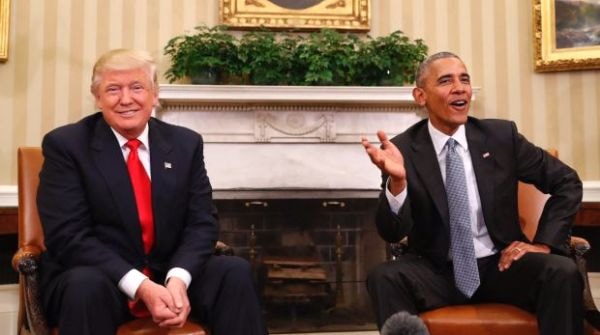 |
| The shock of the recent election has led the Obama administration to halt its efforts to secure the TPP in Congress. Photo: Quarz |
But that event is a sign that, in Lima this weekend, Obama is likely to have a difficult time dealing with his counterparts from the other 10 countries also participating in the TPP. It's not just about an agreement. It's about America's long-term commitment to its allies and partners around the world to the values of trade liberalization and globalization – values that Washington has never stopped advocating. A TPP without American participation would be considered dead, because the United States accounts for the largest share of trade among these 11 countries around the Pacific Rim.
Does America still stand with the rest of the world?
Under the leadership of real estate billionaire Donald Trump, the United States is predicted to become more conservative and stricter on globalization, immigration, and multilateral relations over the next four years. This is based on the statements made by the US President-elect throughout his campaign. But whether he wants to participate in the globalized world or not, Trump and the United States cannot unilaterally stop it.
This view was put forward by Professor Joseph S. Nye, the "father" of the soft power theory. In a recent article, this expert argued that the question arising from Trump's victory is whether the period of globalization that began after World War II has essentially come to an end. This is because he won the presidency by convincing American voters that globalization is threatening the interests of many Americans and therefore needs to be eliminated.
But the reality doesn't align with that wish. Professor Nye writes: “It’s true that the future of trade agreements like the Trans-Pacific Partnership (TPP) or the Transatlantic Trade and Investment Partnership (TTIP) has become uncertain and the process of economic globalization has slowed down.” But Trump is unlikely to reverse the “wheels of history,” because “technological advancements are still driving globalization in social, political, and ecological terms, through manifestations such as climate change, transnational terrorism, and migration.”
So, is the US at a disadvantage because of globalization? Not at all, because currently, the US is the only major developed country not experiencing population decline. This is largely due to immigration. The US's dependence on energy imports is decreasing, and it remains a leader in technology and education. And with that leading position, the US has more options and attracts more partners. Professor Joseph Nye concludes: the US under Trump cannot continue with the self-isolating slogans of the campaign period and must remain committed to its allies and partners.
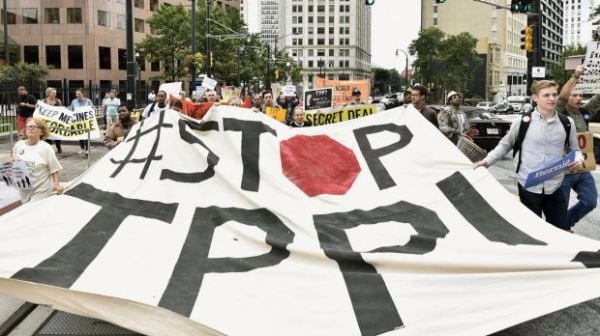 |
| The TPP sparked significant debate in the US. Photo: Sydney Morning Herald. |
What are America's allies doing in the face of this bleak outlook? Two days after billionaire Trump was declared the winner over former Secretary of State Hillary Clinton, the Japanese House of Representatives voted on November 10th to ratify the TPP – a move intended to alert the US about the agreements, both strategically and economically.
On the same day, speaking outside Parliament in Canberra, Australian Foreign Minister Julie Bishop said that the country would shift its focus to boosting trade with China and other Asian countries instead of a free trade agreement with the United States. This was a warning to Donald Trump's conservative views during the US presidential election.
The China problem
In the context of future global political and security dynamics, the TPP is not just a matter of economic interests, but also one of the effective strategies for the US to counter the rise of China. With TPP participating countries potentially controlling 40% of global trade in the future, along with high standards for goods, services, and labor, the TPP is a tool for the US to promote its values and attract the world.
If the TPP collapses, China will benefit. This is simply because Beijing is aggressively pursuing a similar agreement: the Regional Comprehensive Economic Partnership (RCEP), along with a host of other initiatives aimed at promoting its standards and serving Chinese interests.
And if the TPP is never implemented, the scenario will be that China dominates regional policies. Author Roger Cohen analyzed this in the New York Times not long ago. That's not something a future US administration would want. It's quite possible that President-elect Donald Trump is also considering this.
Thanh Son