

Mr. Fillon has become the leading candidate for the French presidency.
Francois Fillon continued his winning streak, officially becoming the right-wing candidate for the French presidency in 2017.
If there was any surprise, it was that Fillon continued his overwhelming victory over his opponent, Alain Juppé. Vote counts from over 10,000 polling stations showed Fillon winning over 67% of the vote compared to Alain Juppé's 32%.
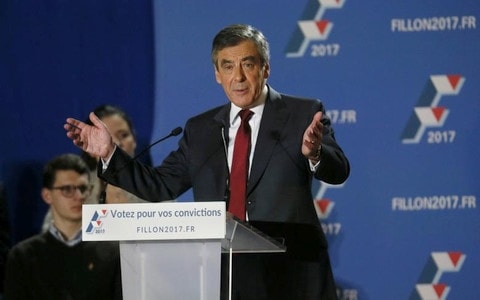 |
| Francois Fillon is emerging as a leading candidate for the French presidency. Photo: AFP |
Although few doubted Fillon's victory after the first round of the election a week ago, this large margin was still a minor surprise. In the first round, Francois Fillon received 44.1% of the French vote, while Alain Juppé received just over 28%.
Analysts this week predict that Alain Juppé has little chance of closing the gap, but they also wouldn't dare predict an overwhelming victory for Fillon.
With this result, Francois Fillon officially became the candidate of the right-wing and centrist parties in the race for the French presidency in 2017.
And in the current balance of power between political parties in the French political arena, Francois Fillon has emerged as the leading candidate for the presidency.
For the French right wing, the first-ever primary election was a resounding success. Including the two rounds of voting on November 20th and 27th, nearly 9 million French voters of all political leanings cast their ballots.
The voter turnout in the second round was even higher than in the first round, at 4.2-4.5 million voters. This impressive figure is crucial for the right wing because after the 2012 French presidential election, there were serious internal conflicts within the right wing, and at one point, it faced the risk of collapse.
Mobilizing nearly 9 million voters in two rounds of internal elections shows that right-wing parties, with the Republican Party (LR) as their core, still have the ability to attract the French people and will certainly carry significant political weight in the French presidential election to be held in five months.
However, with the primary elections over, the French right wing now faces a much bigger challenge: healing internal divisions and uniting all right-wing voters around the party's candidate, Francois Fillon.
The recent primary election was seen as a "civil war" within the right wing, as the candidates fiercely attacked each other during the debates, and the divisions in their political views and ideologies were very clear.
Francois Fillon's task, therefore, is to win over voters who previously supported Alain Juppé and Nicolas Sarkozy. This is no simple matter, given Fillon's campaign platform, which is considered extremely conservative, liberal, and "brutal," especially in its economic policy arguments (dismissing 500,000 civil servants).
However, Francois Fillon also has the advantage of overwhelming victories in both primary elections, which have given him immense legitimacy and prestige, and he has a great opportunity to regain power from the left. Right-wing voters are expected to soon unite in support of him.
For the ruling left, the immediate challenge now lies not in Francois Fillon or any other opponent, but in choosing a candidate, or more precisely, in deciding who will run in the left-wing primary election to be held next January.
Unlike the right wing, this is a headache for the left because, theoretically, incumbent President Francois Hollande should be considered a natural candidate for re-election. However, due to Hollande's currently very low popularity, the left is forced to consider putting other candidates forward.
All eyes are now on incumbent Prime Minister Manuel Valls. In an interview with a French newspaper on November 27th, Valls hinted for the first time at the possibility of participating in the left-wing primary elections, a possibility he had previously remained secretive about.
In fact, this is not surprising because French political circles believe that Manuel Valls had been secretly preparing to run for office for months but was choosing the right time to avoid accusations of betraying President Francois Hollande.
The second major challenge for the French left is securing the participation of other "liberal" candidates in the primary elections, such as Jean-Luc Melenchon or, especially, Emmanuel Macron, who considers himself "non-partisan" and has consistently opposed primary elections.
If this appeal fails, the left will risk being divided into factions, and its already slim chances of winning the presidential election will become even slimmer.
However, what French left-wing voters are most eagerly awaiting are clear statements of intention from President Francois Hollande and Prime Minister Manuel Valls regarding their candidacies, which are expected to appear early this week.
According to VOV
| RELATED NEWS |
|---|