

A university... without lecturers
A truly unique university, with students but no faculty, opened in the US last month.
The school was named 42, after the answer to the question of the meaning of life in Douglas Adams' bestselling science fiction novel "The Hitchhiker's Guide to the Galaxy".
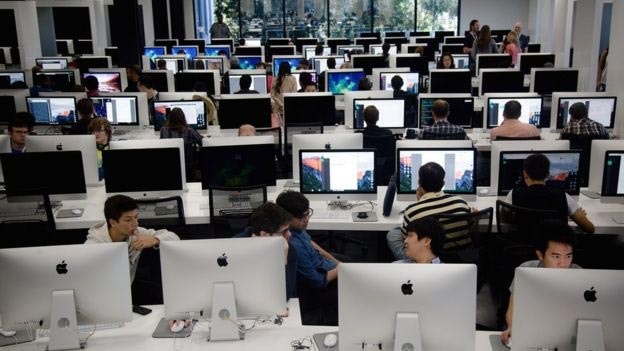
University 42 in the US, a branch of Academy 42 in France, will train approximately 1,000 students annually in coding and software development. What's unique about this school is that students will support each other through projects, and then grade each other's work.
 |
It all seems like "the blind leading the blind," and it's hard to imagine parents feeling comfortable entrusting their children to a school without a teacher to guide them.
However, since Academy 42 opened in Paris in 2013, the number of applications has consistently exceeded the school's capacity.
No tuition fees
Recent graduates from Academy 42 are working for a variety of large companies, including IBM, Amazon, and Tesla, as well as starting their own businesses.
The academy, initiated and sponsored by French tech billionaire Xavier Niel, aims to ensure that students studying there receive free tuition and free accommodation.
Niel and the school's co-founders all come from the tech industry and are leaders of startups. They are trying to impact education in a similar way to what Facebook has done with media and how Airbnb has impacted the accommodation industry.
They aim to achieve this goal by combining a form of "peer-to-peer learning" with project-based learning. Both are popular methods in educational research, but they often require teacher supervision.
Students at School 42 are given the opportunity to choose project topics, such as taking on the role of a software engineer to design a website or a computer game.
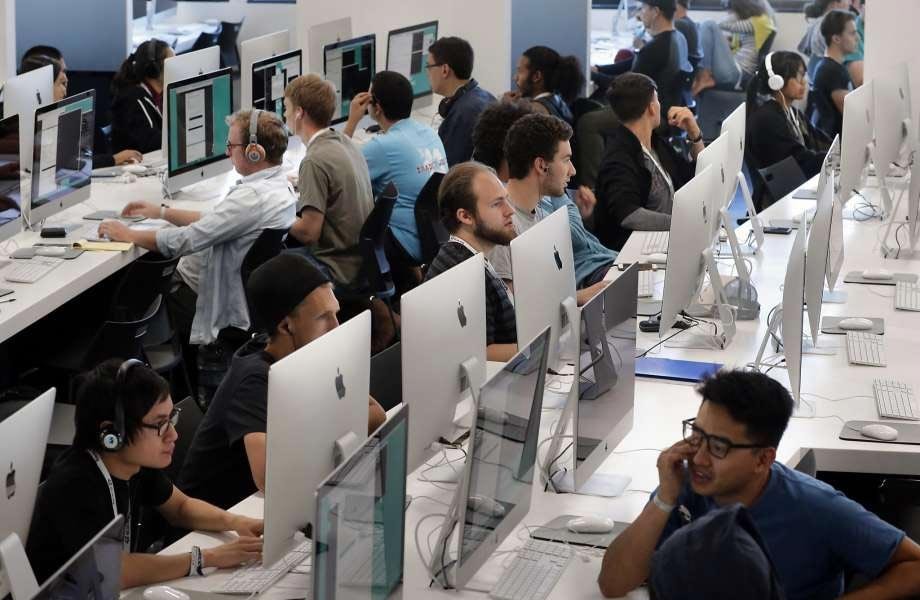 |
They completed the project using free, readily available resources on the internet and the help of classmates tinkering alongside them in a large room filled with computers. Another student would then be randomly assigned to grade their work.
Just like in computer games, students will be promoted to a higher rank after completing a project.
They graduate upon reaching level 21, and the entire process typically takes 3-5 years. Ultimately, students receive a certificate, not a formal diploma.
Independent people
The founders of Academy 42 claim that this learning method compensates for the shortcomings of the traditional education system, which turns students into passive recipients of knowledge.
"The feedback we've received from employers is that our graduates are better able to learn and find the information they need on their own, rather than waiting for superiors to tell them what to do next," said Brittany Bir, who heads branch 42 in California and is also an alumnus of the Paris academy.
The idea of learning from peers is not new. The ancient Greek philosopher Aristotle is said to have used "archons" (leaders of students) to assist in teaching his disciples.
Recent studies have also shown that learning from peers can help students gain a deeper understanding of a particular subject.
Professor Dan Butin, founding dean of the School of Education and Social Policy at Merrimack University (Massachusetts, USA), argues that both peer learning and project-based learning methods should be applied more widely in colleges and universities.
According to him, they are "far better learning tools" than lectures, which do not stimulate students to think.
The value of teaching
However, Professor Butin believes that Academy 42 has gone too far in completely eliminating teachers.
His research found that learning from peers is most effective when students are placed under the supervision of a subject-specific teacher.
"The primary reason for a teacher's existence is to guide students in accurately grasping complex, ambiguous, and challenging issues that often lie beyond their self-awareness and capabilities," Butin explained.
Professor Butin emphasized that the primary value of a university lies in verifying, adjusting, and supplementing students' prior knowledge and perceptions of the world.
42's model offers an alternative to MOOCs (large-scale, open online courses that allow a large number of students to learn a subject online at a low cost).
The establishment of University 42 also follows the trend of the rise of "coding academies" in the US, which offer short, intensive courses to thousands of students wanting to capitalize on the high demand for software engineers in society.
Active students
However, would a teacherless learning model like School 42 be effective in today's traditional universities? Bir acknowledges that it's not suitable for all students.
During the month-long admissions process, some applicants were rejected because they couldn't handle the pressure of studying together in such close proximity. A student is very likely to react negatively if a classmate sitting right next to them gives them a low grade.
"This learning method is only suitable for highly disciplined and very proactive individuals who are not afraid to learn in their own way," said the manager of School 42 in the US.
According to Nicolas Sadirac, director of Academy 42 in Paris, this model is particularly good for students who are disillusioned with being told what to do and how to do it in contemporary education. The school's admissions process disregards applicants' previous qualifications. 40% of students at the Paris school haven't even completed high school.
"School 42 reminds them that learning is enjoyable if they pursue what interests them, rather than being told by teachers to focus on a specific thing," Sadirac asserted.
According to VNN
| RELATED NEWS |
|---|