

The leader of the Thai people in the Tom Valley.
(Baonghean.vn) - Visiting Thung Tom (Chau Ly, Quy Hop) today, amidst vast stretches of lush green acacia forests and herds of healthy livestock, one forgets the past of Thung Tom as a remote, impoverished area surrounded by dense forests and mountains. Nguyen Duc Binh is a key figure in transforming the landscape of Thung Tom.
Mr. Binh, originally from the lowlands, was born and raised in Chau Ly and became a pioneer in reclaiming land to develop the economy, creating a ripple effect that helped more than 30 Thai ethnic minority households residing there to rise out of poverty and become wealthy.
It has been exactly two months since the start of the autumn acacia planting season. These days, Mr. Nguyen Duc Binh (Chau Cuong, Quy Hop) is busy weeding, building fences, and watering to maintain soil moisture, ensuring that his more than 5 hectares of young acacia trees will develop in the best possible way.
Acacia trees have been present in the Dền village for a long time, but only in the last 5 years has the area under cultivation expanded, becoming a crop that helps alleviate poverty for the villagers. Nguyen Duc Binh alone owns more than 20 hectares of acacia trees, stretching lush green across the Tồm valley of the village.
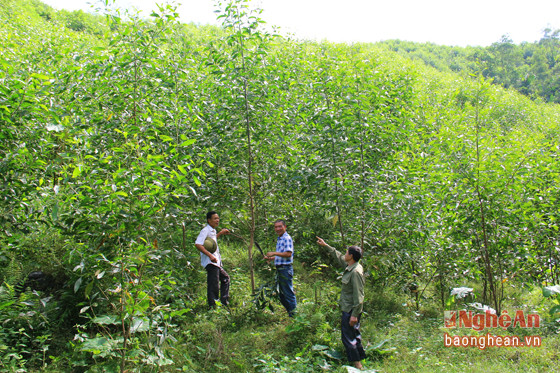 |
| Area planted with acacia trees in the Tồm valley belonging to Mr. Nguyen Duc Binh (center). |
Recounting the process of bringing acacia trees to the Dền village, he still vividly remembers the early days in 2006, when the Tồm valley was a remote and dangerous area, with narrow trails barely wide enough for one person to walk on. To bring the saplings in, he and his family had to carry them on foot for kilometers to plant the first 7 hectares. Then, clearing weeds and preparing the land also had to be done manually because machinery couldn't be transported in.
After the seedlings had started to thrive, he worked tirelessly for four months, clearing mountains and building a road over 3 km long from the foot of the mountain into the valley. His efforts paid off; after six years of diligent care, his family's 7 hectares of acacia trees yielded an income of over 500 million VND. From there, he gradually expanded the area and invested in technology, increasing the total planted area to 20 hectares in Den village and 30 hectares in Na Lang and Xao villages.
According to calculations, each hectare of acacia trees yields an average of about 120 tons. After 6 years of care, each hectare generates an average income of 100 million VND. Especially in areas with good soil, the yield per hectare can reach up to 150 tons, and the care time is shortened from 6 months to 1 year. Transportation costs, seedling costs, and maintenance account for about 40% of the total income. Calculated annually, one hectare of acacia trees yields a net profit of around 60 million VND. Although this is not a large sum, for him, it is the key to escaping poverty.
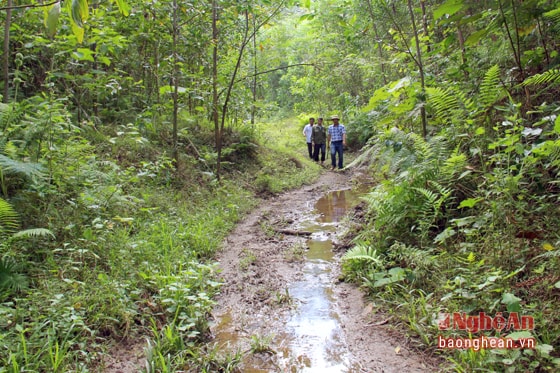 |
| In addition to the 3 km main road leading from Den village to the acacia plantation area, Mr. Binh has also invested in digging and building many connecting roads between the cultivated hillside areas. |
Thanks to the stable income from acacia trees, he has the resources to expand his livestock farming. Currently, he raises 25 cows and over 30 local goats in a semi-intensive system. The soil in this area is very suitable for goats. Goats are less susceptible to disease than other livestock, are easy to care for, and have an abundant food source. It only takes 7 to 12 months for young goats to mature and become breeding stock, at which point they reach a weight of 30-35 kg/animal, with some mature goats weighing nearly 45 kg. With a selling price of over 120,000 VND/kg live weight, this brings the family tens of millions of VND in income per litter.
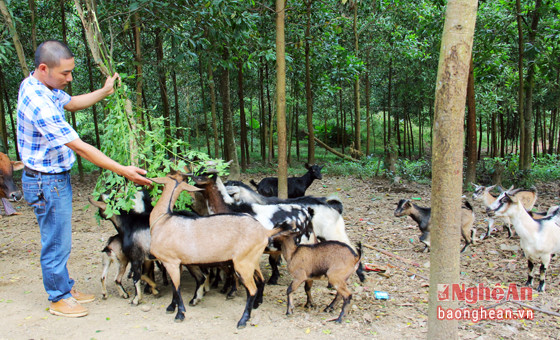 |
| Taking advantage of the vast hilly area, he developed his mountain goat herd using a semi-intensive grazing method, which yielded high economic efficiency. |
Similarly, the family's herd of cattle, raised annually, also brings in a considerable income, with each adult cow earning over 20 million VND. Besides traditional feed, he supplements their diet with high-nutrient feeds such as VA06 grass, corn leaves, and bran, resulting in faster growth, better disease resistance, and, importantly, regular vaccinations to prevent outbreaks, leading to significantly improved efficiency. On average, each cow gives birth to one calf per year, and after deducting expenses, each cow brings in tens of millions of VND.
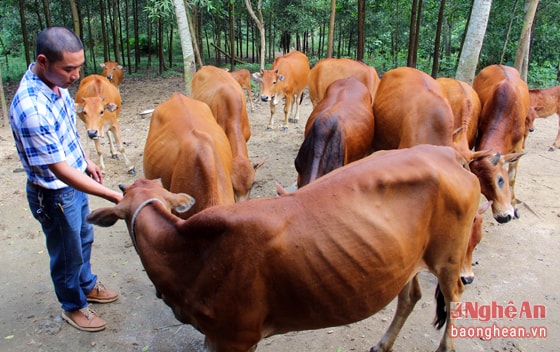 |
| The herd of 25 yellow cows is also thriving and has a stable market. |
His success has opened up a new path, creating a ripple effect for the people here to realize their dreams of escaping poverty in the village. The entire Dền village has 28 households, all of whom are Thai people. Previously, life was very difficult and arduous. Since some households boldly reclaimed hillside land to plant acacia trees combined with semi-intensive livestock farming, the long-standing practice of free-range grazing has gradually been abandoned.
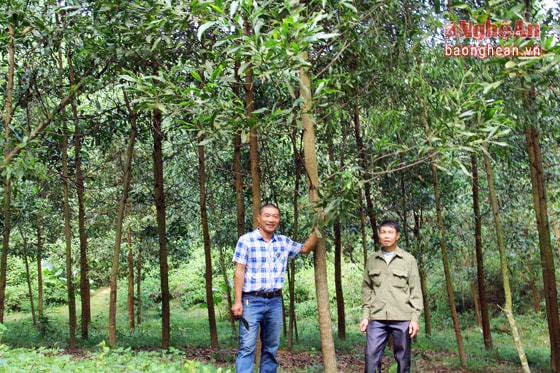 |
| Besides tending to his family's acacia plantation, Mr. Binh has also become a close associate of the villagers, sharing his experience. In the photo, Mr. Binh is instructing Mr. Luong Van Chau, the head of Den village, on how to care for acacia trees. |
For the people of Bản Dền village in particular and Châu Lý commune in general, Mr. Nguyễn Đức Bình is a source of inspiration, helping them escape poverty and become wealthy in their own homeland.
Thanh Quynh
| RELATED NEWS |
|---|