
Quy Chau: Risk of food shortages after flash floods.
(Baonghean) - Two months after the historic flood (September 14th) in Quy Chau, the consequences are truly alarming. Many infrastructure projects, bridges, and houses were damaged and cannot yet be repaired. Hundreds of hectares of agricultural land were buried under sand, rocks, and gravel, making cultivation impossible. The risk of food shortages is beginning to become apparent.
(Baonghean) - Two months after the historic flood (September 14th) in Quy Chau, the consequences are truly alarming. Many infrastructure projects, bridges, and houses were damaged and cannot yet be repaired. Hundreds of hectares of agricultural land were buried under sand, rocks, and gravel, making cultivation impossible. The risk of food shortages is beginning to become apparent.
The historic flood
Ms. Lu Thi Minh (56 years old), residing in Don village, Chau Hoi commune (Quy Chau district), is still struggling to clear the piles of rotten wood that were swept by the floodwaters to the foot of her house. Her garden, located next to the Tan stream, is littered with trash and wood. Her husband passed away early, and her children work far away, leaving Ms. Minh to single-handedly cope with what is considered the biggest flash flood in the area's history. "The older people here all say that there has never been a flood this big. That night I slept soundly, and when I woke up in the morning, I saw the water everywhere – it was a terrifying sight," Ms. Minh said, tears welling up in her eyes.
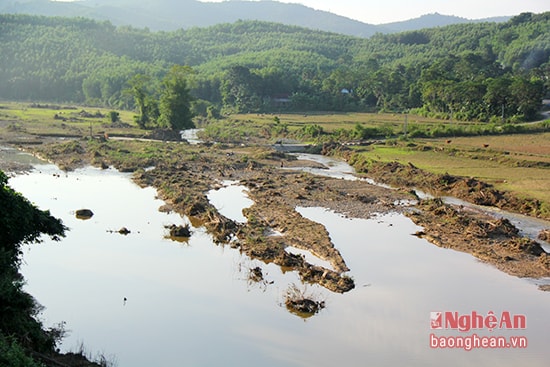 |
| Although it is planting season, most of the rice-growing land in Chau Hoi commune (Quy Chau district) is still uncultivated. |
The floodwaters from the Tan stream rose nearly ten meters, almost reaching Mrs. Minh's stilt house. Large logs were swept away by the water, colliding with the pillars and causing the house to tilt and threaten to collapse. The single woman's meager possessions—her flock of young ducks—were also carried away by the flood.
After the flood, Mrs. Minh had to ask her neighbors to erect a small makeshift tent because her house was damaged. “Now I don’t dare go back into the house for fear it will collapse. In just one night, I’ve lost everything. The floodwaters swept away everything I owned,” the woman said, her face etched with hardship, gazing wistfully at the rice paddies that were once rice paddies, now transformed into a battlefield of rocks and sand.
Like other people in these highland villages, Mrs. Minh only had a few small plots of land for growing rice, but even with careful farming, it was enough to make ends meet. However, as harvest time approached, the rice fields she had painstakingly tended for months were submerged in water.
As the floodwaters receded, Mrs. Minh rushed to the fields to try and salvage what she could, but only managed to gather about a dozen kilograms of rice. According to her, this rice was inedible because most of it was immature, flattened, and mixed with stones and pebbles.
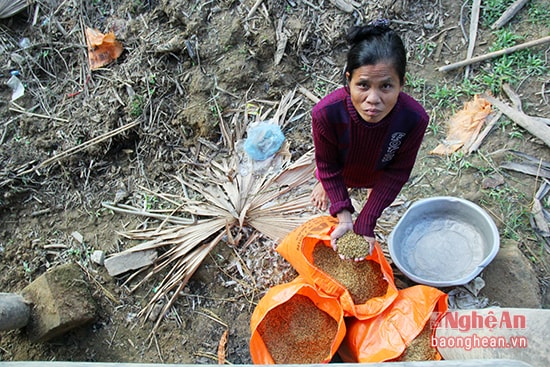 |
| Ms. Lu Thi Minh from Don village, Chau Hoi commune (Quy Chau district) only harvested 3 bags of unripe rice after the flood. |
Meanwhile, in Chau Nga commune, sitting sobbing in her small house, Le Thi Huong (40 years old) from Lien Minh village said that the flash flood nearly two months ago still haunts her dreams. The body of her husband, Vi Van Hai (44 years old), has still not been found despite the efforts of local authorities and family members to search every tree and rock along the Mun stream. Huong recounted that the couple had been living together for five years, and because they were both poor, they had never held a wedding ceremony.
To make ends meet, the couple had to go into the forest, set up a makeshift shelter, and stay there for many days to harvest bamboo shoots to sell at the market. At dawn on September 14th, while sleeping in their shelter, they saw the water rising and hastily gathered their belongings to escape. As they waded across the stream, the floodwaters rushed in, and the wife was swept away first, but luckily she managed to cling to a large tree after being carried hundreds of meters, thus surviving and returning home.
As for Hai, it's unknown where he was swept away by the floodwaters. As the main breadwinner for the family, Hai lived with his parents, who are nearly 80 years old. His father, Vi Van Quyen, said that the rice crop was all gone, and he didn't know who they would rely on next.
Risk of food shortages
Along the Tằn and Mưn streams in Châu Hội and Châu Nga communes, most of the rice fields are buried under pebbles and sand. The once fertile rice paddies have become vast stretches of sand after the flood; many rice fields are covered with nearly half a meter of sand. Châu Nga is one of the poorest communes in Quỳ Châu district, with only a little over 50 hectares of land, but nearly 40 hectares, previously submerged in floodwaters, are now completely covered in sand and gravel.
In Chau Hoi commune, flash floods completely destroyed more than 224 hectares of rice, corn, and annual industrial crops; and after the floods, hundreds of hectares of rice paddies were buried under mud…
According to Mr. Luong Tri Dung, Chairman of the People's Committee of Chau Nga commune, the winter-spring crop has not yet been implemented despite being past the planting season. In addition, many irrigation and transportation systems have been damaged and have not yet been repaired.
"The sand has completely covered the rice fields, so it will take a long time to recover. However, if we remove all the sand, the fertile soil of the fields could be affected, and if we continue to grow rice, the yield will not be high," Mr. Dung said.
According to the Chairman of the Chau Nga Commune People's Committee, the flash flood occurred during the "lean season," when the rice crops in many families had already been harvested, making the consequences even more severe. People were waiting to harvest, but the flood swept everything away, leaving hundreds of households struggling and having to borrow money for each meal. After nearly two months, when even the wealthier families in the commune had run out of rice to lend, people had to seek help from other areas.
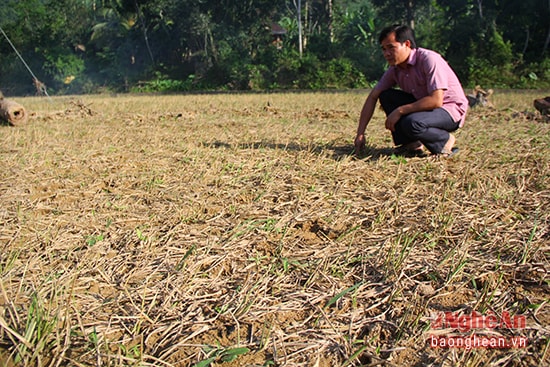 |
| Many hectares of rice fields have been covered with sand, making it impossible to produce a winter-spring crop. |
According to a report from the People's Committee of Quy Chau district, the flash flood that occurred in the early morning of September 14th resulted in one death, swept away and completely destroyed four houses, and severely flooded 240 others. Nearly 180 hectares of ponds and lakes were flooded or breached; 19 poultry cages and thousands of livestock were swept away; and 463 households lacked clean water for daily use. The flash flood also caused severe damage to 23 irrigation works and 24 transportation infrastructure projects… |
Regarding agriculture, according to Mr. Le Hai Ly, Head of the Agriculture and Rural Development Department of the district, the flash flood on the morning of September 14th, although lasting only a few hours, caused extremely serious consequences. Nearly 750 hectares out of a total of 1,800 hectares of rice fields in the area were flooded, eroded, or buried. Similarly, hundreds of hectares of corn, vegetables, and other crops were also affected.
Mr. Le Hai Ly stated: “The total estimated damage caused by the flood in Quy Chau is nearly 300 billion VND. However, that is only the immediate consequence. Because after the flood, hundreds of families are having to borrow money to eat every day while they cannot cultivate the winter-spring crop yet…”
According to the leaders of Quy Chau district, in the face of this difficult situation, the Quy Chau District People's Committee is, on the one hand, accurately assessing the damage and reporting to the province for support, and on the other hand, directing local authorities to mobilize people to continue caring for and recovering the remaining crops in order to harvest them.
Preparations are underway for the winter-spring crop season in areas with less than 50% damage, while areas with over 70% damage are being converted to other crops, with a focus on corn cultivation for livestock feed. Program 30a is being integrated to provide corn seeds to farmers; in addition, plans are being made to repair 26 irrigation works to enable farmers to resume agricultural production as soon as possible.
Regarding the agricultural land that has been completely buried, in addition to providing financial assistance for restoration to the people as stipulated, it is proposed that a portion of the land from the forestry farms that the province will reclaim be returned to the households.
Tien Hung - Ha Giang