

Antarctic ice shelf is breaking apart, threatening to submerge many cities.
The Antarctic ice shelf is breaking apart from the inside, threatening to cause sea levels to skyrocket and submerge many coastal cities.
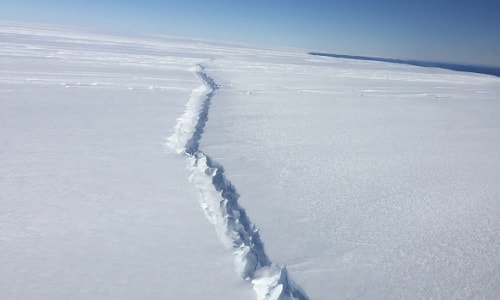 |
| A crack in the Pine Island Glacier, west of Antarctica, as seen from above by a NASA satellite on November 4. Photo: NASA. |
American scientists have gathered evidence from satellite imagery showing that the West Antarctic ice shelf is disintegrating from within due to global warming, according to Science Alert. This crack has formed in the center of the ice shelf over the past few months, foreshadowing a worrying trend. The research was published on November 28 in the journal Geophysical Research.
A research team at Ohio University in the US is trying to predict how the breakup of this ice shelf will affect future global sea levels. This is crucial because half the world's population lives in coastal areas.
"We're no longer asking whether the Antarctic ice sheets will melt. The question is when they will melt," said researcher Ian Howat of Ohio University. "The way the ice sheets are cracking shows that glacial melting is happening rapidly, and it's highly likely we're about to see the collapse of the West Antarctic ice shelf."
According to researchers, warm ocean currents seep into the cracks between icebergs, heating them from below. Over time, this warm current melts more and more of the surrounding ice until a large crack forms.
"Cracks frequently form at the edges of icebergs, where the ice is thin and prone to fracturing. However, the large fracturing of the Pine Island Glacier last year was due to a crack originating from within and extending outward to the iceberg's edge," Howat explained. "This means the center of the iceberg weakened for some reason, most likely a large crack appearing underneath due to ocean warming."
If all of Antarctic ice were to melt into the ocean, sea levels would suddenly rise by three meters globally, endangering many coastal cities such as London, England, and New York, USA.
"We need to understand exactly how cracks form on ice sheets and their role in stabilizing the ice shelf. Monitoring disintegration from the inside is limited when observed from space, so we need to go there directly to collect data and observe in more detail," Howat emphasized.
According to VNE