

IMF 'boss' is guilty but will not face punishment.
(Baonghean) - After a lengthy investigation and trial, the French Court of Justice has finally determined that International Monetary Fund (IMF) Managing Director Christine Lagarde was guilty of "negligence" during her time as French Finance Minister.
It's worth noting that despite being convicted, Ms. Lagarde faced no punishment. Will this "escape route" help her maintain her position as the most powerful woman in the world's financial empire?
Past mistakes
In fact, Ms. Lagarde's involvement in a decades-long legal case has been known since her election as IMF Managing Director in June 2011, replacing Dominique Strauss-Kahn. This occurred when Ms. Lagarde was the French Finance Minister and was tasked with overseeing the adjudication of a politically charged case.
This case dates back to the 1990s, when businessman Bernard Tapie – a close friend of former President Nicolas Sarkozy and a major shareholder in the sportswear company Adidas – filed a lawsuit against the French state-owned bank Credit Lyonnais, alleging that the bank deliberately suppressed the price when he had to sell his company.
In 2007, the protracted lawsuit was brought before Ms. Lagarde's arbitration committee. The three-member arbitration committee decided to award Mr. Taipei $417 million in 2008. This decision was considered to have a conflict of public and private interest and sparked public outrage.
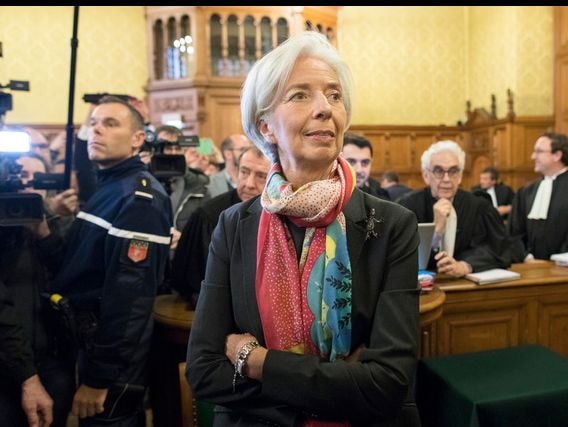 |
| IMF Managing Director Lagarde is present at a court hearing in France. (Photo: Bloomberg) |
Shortly afterward, Lagarde's advisors recommended that she appeal the arbitration committee's decision, but she did not, leading to public scrutiny of her role in the compensation case.
After several rounds of investigation and trial, on December 19, the French Court of Justice concluded that Christine Lagarde was guilty of "negligence," but she would not face any punishment. For her part, Lagarde argued from beginning to end that she always acted in good faith and without self-interest.
Guilty but not liable.
Previously, legal experts suggested that if convicted, Ms. Lagarde would face at least a year in prison and a substantial fine. However, the court's decision is understandable, as a prison sentence would force her to relinquish her powerful position within the IMF.
Of course, this is not just a "black mark" on Ms. Lagarde personally, but also on the image of France. And if the matter is not resolved thoroughly, it will not satisfy public opinion.
Since evidence emerged linking Ms. Lagarde to the compensation case involving billionaire Tapie, the French public has expressed outrage over corruption at the highest levels, demanding that the close relationships between politicians and businessmen, and the large sums of money used to "grease" the wheels of politics, be brought to light.
Therefore, a "guilty but not punished" approach could resolve the dilemma faced by the executive and judicial branches. Explaining the legitimacy of the sentence, Judge Martine Ract Madoux stated that they "took into account the context of the global financial crisis when Ms. Lagarde got into trouble."
Furthermore, Lagarde's good reputation and international standing were also among the reasons. However, the guilty verdict also led many to question whether Lagarde's position at the IMF would be jeopardized.
In fact, the fund's board of directors, which had consistently supported Lagarde throughout the affair, held a meeting after the ruling and "reaffirmed their complete confidence" in her abilities.
This suggests that the IMF does not want a personnel crisis like the one five years ago to happen again, and thus, Ms. Lagarde may have "escaped"!
The resilience of a "steel rose"
Always appearing in public with an elegant and "fashionable" look, she wears French designer outfits, Chanel clothes, Hermès scarves with pretty bracelets, and fur-lined coats. But those aren't the most captivating aspects of the IMF boss.
She won people's hearts with her eloquence, her ability to handle even the most difficult problems, and her tireless efforts in her work. She once told a French newspaper: "Success never stops. It's an endless battle. Every morning, one must put their abilities to the test once again."
Lagarde once revealed that, in addition to her passion for financial management, she loves roses. Therefore, she was once nicknamed the "iron rose." In 2011, she was elected head of the IMF, becoming the first female Managing Director in the organization's more than 60-year history.
 |
| Lagarde is always welcomed at important financial conferences. (Photo: Reuters) |
Objectively speaking, now is the time when the IMF desperately needs a leader as quick-witted and decisive as Ms. Lagarde. Following the French court ruling, the Financial Times (UK) commented, "The IMF cannot afford to lose Lagarde," and that her trial was simply a way to "teach a lesson" to future French politicians.
In fact, since taking office, Ms. Lagarde has made significant contributions to this major financial institution. She played a key role in IMF bailouts of countries on the brink of collapse, such as Greece and Ukraine. US Treasury Secretary Jack Lew called Lagarde a “strong leader,” and expressed “confidence in her ability to lead the IMF at this critical time for the global economy.”
Currently, the IMF faces numerous challenges as protectionist sentiment grows. How to leverage the benefits of trade and globalization, while simultaneously implementing policies to combat inequality, is a major headache for those in charge of international finances.
Furthermore, the election of billionaire Donald Trump as US President raises many big questions about the future of international financial institutions. In this context, the IMF cannot afford to lose a leader who is considered to have "conflict-solving abilities" and "influence over many countries" like Ms. Lagarde.
Thanh Huyen
| RELATED NEWS |
|---|