

Improving urban order management in Hoang Mai Town
(Baonghean) - In recent times, the management and licensing of private housing construction in Hoang Mai town have faced limitations, affecting urban aesthetics, especially the encroachment on land and illegal construction. To restore order in this area, the Standing Committee of the Hoang Mai Town Party Committee issued Directive 06 on rectifying and managing urban order...
Accurately assess the current situation.
Hoang Mai town is undergoing a process of development and transformation, aiming to become a type III urban area and a dynamic economic zone and growth pole of the province. However, in this "from village to town" process, the people have not yet caught up with the town's development trends, and urban planning and order management are facing limitations.
Based on this situation, the Hoang Mai Town Party Committee and People's Committee have set requirements for restoring order in urban management and construction permit management, identifying and resolving old violations related to land encroachment and illegal construction, and resolutely preventing the emergence of new violations.
Nevertheless, the reality is that construction projects without permits or in violation of permits still occur in most localities, especially the situation where private houses are built without permits.
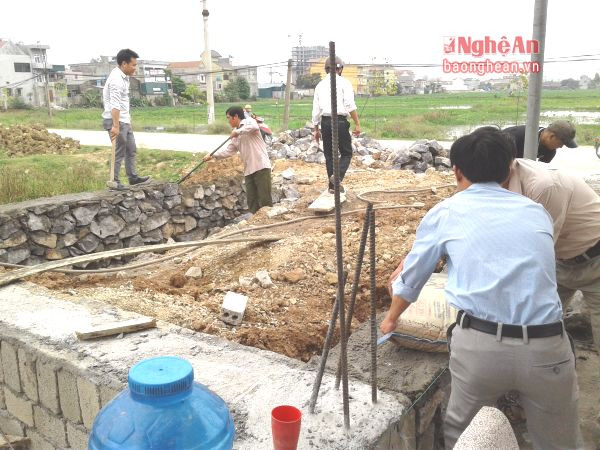 |
| Enforcement action against illegally constructed buildings in Hamlet 20, Quynh Vinh Commune (Hoang Mai Town). |
Quynh Di Ward is one of the central wards of the town. The requirement for urban planning and order management is that private housing construction must have a building permit. However, according to our findings, only a few households were aware of the permit requirement through announcements from the authorities via loudspeakers, leading to confusion and a lack of adherence to the regulations regarding building permit procedures. In 2016, over 50 households in the ward built houses and private construction projects, but only 9 cases received building permits.
Explaining the reasons for violations in the field of private housing construction permits, Mr. Van Huy Thang, Chairman of the People's Committee of Quynh Di Ward, said: "People's awareness of granting private housing construction permits is still limited, and some households are confused about the construction procedures. In addition, due to planning constraints, some households request permits from higher authorities but are not approved, yet they still proceed with construction on their own, making it very difficult to inspect and handle violations."
Recognizing this as an issue requiring attention and resolution, the People's Council of the town established a monitoring team to oversee the implementation process in the wards and communes.
Monitoring results show that: In 2015, the town only issued 132 construction permits; in 2016, it issued 185 permits. Of the total 634 private residential construction projects in the town, 317 cases of illegal construction were discovered (accounting for 50%), including 218 cases of construction on prohibited land, garden land, or encroached land (accounting for 32%). From 2015 to 2016, the wards and communes only enforced demolition in 38 cases.
A review conducted from 2014 to the present shows that the issuance of building permits for private houses and construction projects in the wards and communes of the area has been low (Quynh Lap commune only issued 48 permits; Quynh Loc commune 46 permits, Quynh Vinh commune 63 permits. Quynh Xuan ward only issued 1 permit; Mai Hung ward did not issue any construction permits). It is noteworthy that most of the unlicensed constructions have not been penalized for violations. Typical examples include the households of Mr. Dau Sy Tuong in Quynh Thien ward and Mr. Ho Sy Cuong in Quynh Lap commune. The situation of encroachment and expansion on traffic corridors along roads is complex, with over 72 cases of encroachment and re-encroachment.
The aforementioned shortcomings stem from lax land management and construction order enforcement, with the primary responsibility resting with the heads of local Party committees and governments. Local authorities have not considered construction permit issuance as a crucial solution to address violations of construction regulations and illegal construction at its root. Coordination between the Urban Management Department and the local wards and communes is inadequate. Some residents are unaware of the permit application procedures but are not given timely guidance, or the permit application process is prolonged due to excessively long waiting times. Residents proceed with construction without intervention or penalties from any agency, creating a negative precedent in the community.
Furthermore, the inspection and handling of violations have been inconsistent and have failed to deter offenders. Local authorities have not fully fulfilled their responsibilities in detecting and documenting illegal constructions. This is also one of the many reasons that create opportunities for illegal constructions to develop, negatively impacting urban aesthetics.
Firmly rectify the situation.
To restore order in this area, the Standing Committee of the Hoang Mai Town Party Committee issued Directive 06 on rectifying and managing urban order. The content regarding land management and illegal or unauthorized construction was included in the meetings of the Standing Committee and the Executive Committee of the Town Party Committee for discussion and guidance on solutions to address the issues. Following the directives of the Town Party Committee, the Town People's Committee organized training conferences, required the People's Committees of wards and communes to periodically report on the situation of construction order management, and established inspection teams to oversee state management of land and construction order in the town.
In addition to organizing annual training courses for commune and ward officials, the People's Committee of the town receives applications for construction permits at the one-stop service center; and publicly displays the procedures for issuing construction permits at the one-stop service center.
Mr. Ho Van Son, Head of the Urban Management Department of Hoang Mai town, said: "The town has implemented steps regarding the management of construction order and the issuance of permits for private housing construction. However, the communes and wards have not been truly proactive in implementing this policy."
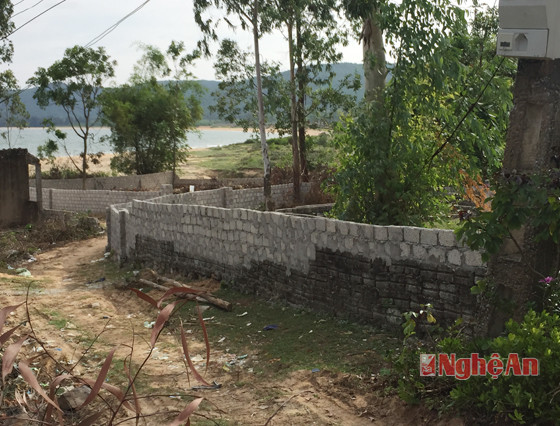 |
| Illegal construction projects are scattered throughout Quynh Lap commune. |
Currently, the People's Committee of the town is reviewing and rectifying the issue of unauthorized construction projects throughout the area. At the same time, they are seeking the Provincial People's Committee's approval to establish an urban regulations team to assist the People's Committee in carrying out tasks in the areas of construction management, urban order, environmental sanitation, and the enforcement of administrative decisions and coercive measures against those who do not voluntarily comply with construction regulations.
In the coming period, to effectively implement Directive 06, the Hoang Mai Town Party Committee requests the Town People's Committee to deploy comprehensive measures to strictly manage this work, especially by promoting propaganda to raise public awareness and responsibility in contributing to building the town in a civilized and modern direction. Strengthening guidance and inspection at every level of government is also crucial.
Any ward or commune where violations occur will hold its head accountable. In addition, the relevant departments and agencies of the town, and local authorities are required to urgently coordinate and take decisive action, conduct serious assessments, develop specific and comprehensive solutions, and promptly implement measures to address shortcomings and improve the effectiveness and efficiency of urban management in the area.
Mr. Nguyen