

Linking with local communities to sustainably develop raw materials for MDF factories.
(Baonghean) - Comrade Ho Xuan Hung - former Deputy Minister of Agriculture and Rural Development, gave an interview to Baonghean Newspaper about the potential for developing Nghe An's forest economy.
PV:Comrade, having previously served as Chairman of the People's Committee of Nghe An province and Deputy Minister of Agriculture and Rural Development, how do you assess the potential for forestry economic development in Nghe An?
Comrade Ho Xuan Hung:Nghe An province has over 80% forest land, with 70% of its population living in 11 districts and towns, encompassing both highland and lowland areas. Nghe An's forests exhibit many typical characteristics of Vietnamese forest vegetation and are an important source of raw materials for the exploitation and development of various industries. Along with its diverse and rich topography, Nghe An's forests offer many advantages for tourism development. Western Nghe An boasts tourist areas linked to nature reserves such as Pu Mat and Pu Huong, and natural scenic spots like Sao Va Waterfall and Khe Kem Waterfall.
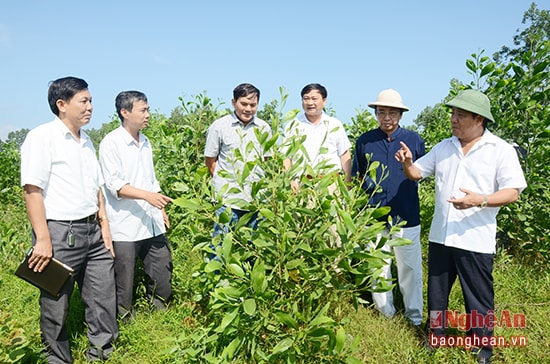 |
| Comrade Ho Xuan Hung (far right) and the working group survey the raw material area for the MDF factory in Yen Thanh district. Photo: HN |
Nghe An's mountainous region is characterized by its high potential for fruit tree and forestry development in the lower mountainous areas, and its high potential for utilizing forestry trees and developing medicinal plants under the forest canopy. This is a strength of the province. Nghe An's export results in 2015 showed that forestry accounted for a large proportion of exports, replacing previously prioritized products like seafood. In particular, Nghe An's planted forest land has enormous potential, with a thick soil layer and high moisture content, creating favorable conditions for forestry development.
Along with favorable natural conditions, the Central Government and the province have identified Western Nghe An as a key economic region and have implemented numerous policies to encourage and prioritize its development. In particular, on July 30, 2013, the Politburo issued Resolution No. 26-NQ/TW on the direction and tasks for the development of Nghe An province until 2020 (in which the Politburo identified Western Nghe An as one of the three key economic regions of the province, along with the Southern Thanh Hoa - Northern Nghe An region and the Southern Nghe An - Northern Ha Tinh region). Subsequently, on December 4, 2013, the Prime Minister issued Decision No. 2355/QD-TTg approving the socio-economic development plan for Western Nghe An province until 2020... aiming to create favorable conditions for businesses investing in Western Nghe An.
PV:The potential is enormous, but so far we haven't exploited it to its fullest potential. In your opinion, what are the reasons for this?
Comrade Ho Xuan Hung:That's right! We've exploited very little of that potential so far. We've only focused on raw processing, forest productivity is low, and we're exploiting young forests. The reasons are the difficult natural and socio-economic conditions in the western part of Nghe An province; the socio-economic infrastructure doesn't meet the requirements, especially transportation and information and communication infrastructure; the planning of raw material areas linked to processing is limited; and the quality of human resources is low, especially in the industrial and service sectors. These reasons lead to high investment costs in the western districts, resulting in high investment rates and low investment efficiency. As I mentioned above, the central and provincial governments have implemented many policies to attract businesses to invest in mountainous regions in general. However, these policies are not strong enough to attract businesses, especially large businesses with strong financial resources.
I am very pleased that Nghe An has attracted investment in the MDF wood processing project, and the factory is now operational. The project requires at least 40,000-50,000 hectares of forest land for development. That's for phase 1; if we expand the large-scale wood panel production line and increase the MDF production capacity from 130,000 m³/year to 400,000 m³/year in phase 2, we will need at least one and a half times that area. I have a very positive outlook on the success of this project, but this is only possible if there is sufficient raw material for the processing plant. And, almost crucially, besides expanding the factory area, it is essential to double or triple the productivity of planted forests. Secondly, if we keep extending the harvesting time for 10-15 years, we won't be able to meet the demand and won't have enough raw materials. We must choose varieties that can be shortened to 7-8 years; that's a mandatory requirement. Thirdly, we cannot reclaim land from the people or force them out of the forest. We must find ways to cooperate with them and allocate them a certain amount of land. What kind of cooperation should we do? Firstly, we must use our own varieties; secondly, our own technology; and thirdly, we must guarantee the purchase of 100% of the product. That is the best cooperation and the most sustainable development for the MDF factory.
Recently, the province assigned several Youth Volunteer Brigades to work at the Nghe An MDF Wood Processing Plant, such as Youth Volunteer Brigade 3 and Youth Volunteer Brigade 6 – this is a good direction. The MDF project has allocated certain land areas – where they will plant sample raw materials, where they will plant control forests with local people, and the rest will mainly rely on collaboration with the people. In particular, there are policies to promote linkages between businesses and farmers; the MDF wood plant has implemented several policies such as coordinating with the State to invest in infrastructure and technology, and providing loan support for local people…
PV:To fully utilize the potential and strengths of Nghe An's forestry sector, what do you think the province needs to do in the coming period?
Comrade Ho Xuan Hung:The challenge is that the potential of the Mekong Delta is enormous, but the crucial question is how to exploit the strengths of its forestry economy. If we only export timber blocks, boards, wood chips, and paper pulp, it's inefficient; we need to shift to finished products like MDF and wide-panel wood. First and foremost, to achieve this, we must attract businesses; they will organize large-scale investments and expand linkages with local households.
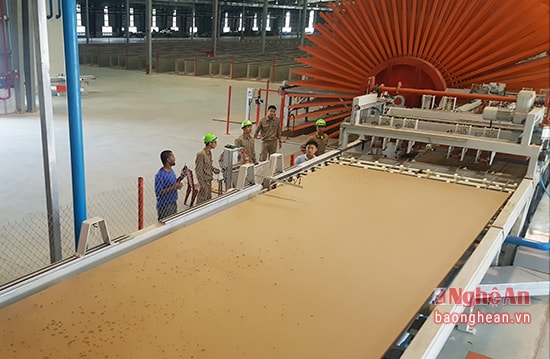 |
| Wide-format MDF products from Nghe An Wood Factory. Photo: HN |
Along with that, we need to introduce high-quality varieties. In recent years, I am very pleased that Nghe An has acquired new varieties and achieved high productivity. Now, the productivity of planted forests in Nghe An is above the national average. While the national average is only 90 cubic meters/hectare, Nghe An has over 100 cubic meters/hectare. However, these varieties still do not yield the highest productivity, as some areas in the country have already achieved 150-160 cubic meters/hectare in planted forest productivity, and Nghe An should aim to reach this level. To achieve this, Nghe An must quickly establish a Forestry Seed Center. For example, Australia currently has 105 varieties of acacia with yields ranging from 90 to 200 cubic meters/hectare. We must select suitable varieties for high productivity to implement so that people's incomes can improve. When people's incomes increase, they will become more involved with the forest. I understand that the Thang Nam Forestry Joint Stock Company has a plan to invest in a forestry seed center using tissue culture, which is a very encouraging sign from the policy of developing sustainable raw material areas.
Secondly, Nghe An must soon develop products grown under the forest canopy, an area where we lag behind many other localities. Products from trees and animals grown under the forest canopy must provide both short-term gains to support long-term growth and directly increase income for forest planters and protectors. Going forward, the province must focus more on introducing high-yield varieties and exploiting resources under the forest canopy. Success and increased income for the people depend on these resources, such as cultivating medicinal plants and raising more poultry, which will lead to higher incomes and encourage people to stay connected to the forest.
Thirdly, developing ecotourism is crucial. Nghe An's forests have immense tourism potential, unmatched by many other places. They boast waterfalls and unique characteristics of rare ethnic groups, all located near major highways. To facilitate tourism, local people cannot organize tours independently. Therefore, connecting with large tour operators in Hanoi and Ho Chi Minh City, key hubs, is necessary. This would create a link between historical site tourism and ecotourism, encouraging tourists to stay longer and overnight.
Fourth, Nghe An needs to exploit some local products to serve tourists, because the current offerings are too monotonous and tourists almost always leave empty-handed, even though we have the potential to do so. Previously, we focused heavily on seafood products, but from now until 2020, seafood products for tourists will certainly face many difficulties due to the recent marine environmental incident in Central Vietnam. Therefore, we must immediately create products from the forest. We have many products from the forest and forestry land, for example, tea, medicinal plants, and specialty animals from the forest that we can use to create a highlight…
Furthermore, it is necessary to strengthen the role of state management agencies in establishing clear forest planning. Land and forest allocation should be implemented to enable people to proactively organize production and business; promoting joint ventures and linkages between people and businesses in the process of buying and selling raw materials, creating sustainable mechanisms such as through cooperatives. Investing in infrastructure and facilities will create favorable conditions for production and exploitation, reducing the costs of forest planting and harvesting…
\
PV:Thank you very much, comrade!
Thanh Le(Perform)
| RELATED NEWS |
|---|