

Dishes and medicinal remedies from the wild ginseng plant.
According to traditional Chinese medicine, the plant known as "sâm cau" (sâm cau) has a pungent taste, warm nature, and is slightly toxic. It enters the kidney meridian and has the effects of warming and nourishing kidney energy, strengthening male potency, warming the middle, drying dampness, dispersing stagnation, eliminating cold and dampness, strengthening tendons and bones, and regulating digestion.
Curculigo orchioides Gaertn, also known as Sâm cau, ngải cau, tiên mao, cồ nốc lan, belongs to the Hypoxidaceae family.
Sâm cau is a perennial herbaceous plant, 20-30 cm or more in height. It has 3-6 leaves, narrowly lanceolate, pleated, and veined like betel leaves, 20-40 cm long and 2.5-3 cm wide, with petioles about 10 cm long. The rhizome is long, cylindrical, erect, and in the form of a finger-sized tuber, tapering at both ends, bearing many secondary roots resembling the rhizome itself. The outer skin is rough and brown, while the flesh is yellowish-ivory. The inflorescence consists of 3-5 small yellow flowers, growing on a short axis within overlapping bracts. The fruit is a capsule, oblong, 1.2-1.5 cm long, containing 1-4 seeds.
Fruit season: May - July.
Wild ginseng grows on grassy hillsides near forests and mountains in several provinces in northern Vietnam, and is also found in high mountainous areas of Lam Dong province.
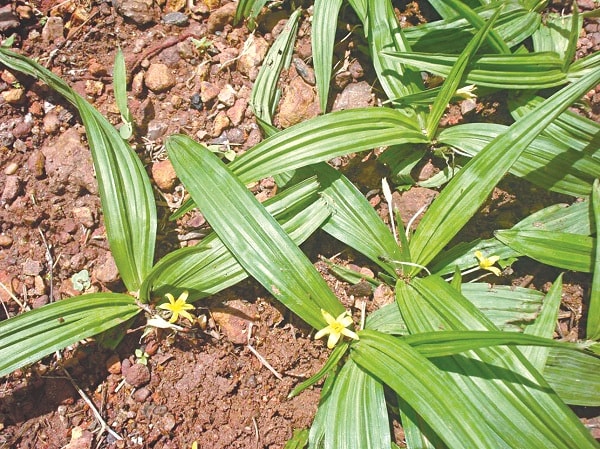 |
| The ginseng plant. |
The medicinal part is the rhizome (root), known as Curculiginis rhizome. It is harvested year-round, but best in autumn. The rhizomes are dug up, the rootlets are removed, washed clean, the outer skin is scraped off, and they are soaked in rice water overnight to remove toxins, then dried in the sun or in a drying machine.
The rhizome of Curculigo contains starch, mucilage, tannins, fatty acids, beta-sitosterol, stigmasterol, and flavonoid compounds, as well as cycloartan, triterpenic, and cycloartan glycoside compounds such as curculigosaponin (A, B, C, D).
Sâm cau is a medicinal herb containing natural steroids, which have effects similar to testosterone (a male sex hormone).
Modern pharmacology recognizes that Cynomorium has antioxidant effects, the ability to boost the immune system, enhance the function of the male reproductive glands, improve the body's adaptability to oxygen deficiency or high temperatures, enhance heart function, dilate coronary arteries, protect the liver, fight inflammation, prevent thrombosis, fight fungi, prevent convulsions, calm the nerves, reduce pain, improve skin, enhance muscle activity, fight aging, and help prevent diabetes and cancer.
It is commonly used to treat men with kidney yang deficiency, cold semen, low sperm count, impotence, decreased vitality, weakness and fatigue in the limbs, asthma, and jaundice; women with cold uterus, leucorrhea, cloudy urine, and postmenopausal osteoporosis; and the elderly who frequently experience nocturia, urinary incontinence, cold abdomen, cold and painful back and knees, rheumatism, chronic arthritis, difficulty in movement, and nervous exhaustion.
The daily dose is 6-12g, taken alone or in combination with other herbs. It can be taken as a decoction or steeped in alcohol.
Some traditional remedies use the plant known as "sâm cau" (a type of ginseng).
To treat asthma and diarrhea: dry the roots of the wild ginseng plant, slice them thinly, and roast them until golden brown.
Use 12-16g, boil with 250ml of water, reduce to 50ml, drink once a day, before meals.
To treat rheumatism and general body aches: take 20g each of the roots of the Polygonum multiflorum plant, Polygonum multiflorum (processed with black beans), and Siegesbeckia orientalis (also known as *Hyptis capitata*), chop them thinly and finely, then soak them in 500ml of white wine for 7-10 days (or longer if possible).
Take 30ml twice a day, before meals.
Treatment for dengue fever: 20g of *Panax notoginseng* (roasted), 12g of *Eclipta prostrata*, 10g of *Thuja orientalis* (roasted), 8g of *Gardenia jasminoides* (roasted).
Boil with 600ml of water, reduce to 200ml, divide into 2-3 doses and drink before meals throughout the day.
Treatment for erectile dysfunction due to functional nervous disorders: 20g of Polygonum multiflorum, 12g each of Panax pseudoginseng, Rhus chinensis, Lycium barbarum, Achyranthes bidentata, Dipsacus japonicus, Dendrobium nobile, Dioscorea opposita, and Morinda officinalis; 8g each of Ligustrum lucidum and Acanthopanax senticosus.
Wash all ingredients thoroughly, slice them thinly, dry them in the sun or in a dryer, then boil them with 750ml of water until only 300ml remains. Divide this into 2-3 portions and drink before meals throughout the day.
Alternatively, use: 20g of Polygonum multiflorum, 16g each of Morinda officinalis, Psoralea corylifolia, walnut kernel, and Rehmannia glutinosa, and 4g of Foeniculum vulgare. Boil with 750ml of water, reduce to 250ml, and divide into two doses to be taken before meals.
The "Nhi Tien Thang" herbal remedy consists of: 12g each of *Panax notoginseng* (*Tien Mao*), *Epimedium grandiflorum* (*Tien Linh Ty*), *Angelica sinensis*, and *Morinda officinalis*. Boil with 750ml of water, reduce to 250ml, and divide into two doses to be taken before meals.
Used to treat high blood pressure, suitable for men with erectile dysfunction due to kidney yang deficiency, and women during menopause.
Some dishes and medicinal recipes use Cynomorium.
Chicken cooked with ginseng:
Ingredients: 250g chicken meat, 15g Cynomorium songaricum, 15g Epimedium grandiflorum. Various seasonings.
Instructions: Wash the chicken, cut it into bite-sized pieces, marinate with spices, and let it sit for about 20 minutes to absorb the flavors. Wash the two medicinal herbs. Put everything into an earthenware pot and cook with enough water until the chicken is tender. Adjust the seasoning to taste. Serve hot.
Effects: Nourishes kidney yang, replenishes qi and blood, enhances vitality, and relieves rheumatism. Very beneficial for people with erectile dysfunction due to kidney yang deficiency, and those with back pain and knee weakness.
Immortal Herb Wine:
Ingredients: 50g of dried and thinly sliced *Tien Mao* (also known as *Tien Mao*), 500ml of rice wine.
Preparation method: Soak the Cynomorium in alcohol for 7-10 days (gently shake the container 1-2 times daily).
Drink twice a day with meals, about 30ml each time.
This wine is said to tonify kidney yang and dispel wind and dampness. It is commonly used to treat impotence, cold back pain, rheumatism, and nervous exhaustion.
According to Health & Life
| RELATED NEWS |
|---|