
Tho Son sugarcane molasses
(Baonghean) - As the cool autumn weather arrives and the vast sugarcane fields in Anh Son begin to be harvested, the molasses pressing season in Tho Son commune (Anh Son district) also enters the Tet holiday season. Famous for its delicious aroma and beautiful color, sugarcane molasses from this area is favored by many consumers.
(Baonghean) - As the cool autumn weather arrives and the vast sugarcane fields in Anh Son begin to be harvested, the molasses pressing season in Tho Son commune (Anh Son district) also enters the Tet holiday season. Famous for its delicious aroma and beautiful color, sugarcane molasses from this area is favored by many consumers.
In the final days of the year, while rural people are busy with the harvest, the famous sugarcane syrup factories in Tho Son are burning brightly all day long. People extract syrup from sugarcane year-round, but this time of year is particularly bustling. This is because the demand for sugarcane syrup usually increases at the end of the year, especially during the Lunar New Year.
We arrived at the molasses processing facility of Mr. Ngan Van Ha's family in Hamlet 4 at a time when the family was operating at full capacity, with the molasses pressing machines running at full power. With over 10 years of experience in the trade, Mr. Ha shared: "Processing one liter of molasses is a complex and labor-intensive process. The most difficult part is pressing the sugarcane. In the past, it was done entirely by hand using the strength of buffaloes and oxen, which was very strenuous and time-consuming. In recent years, sugarcane pressing machines have been invented, making the work much easier."
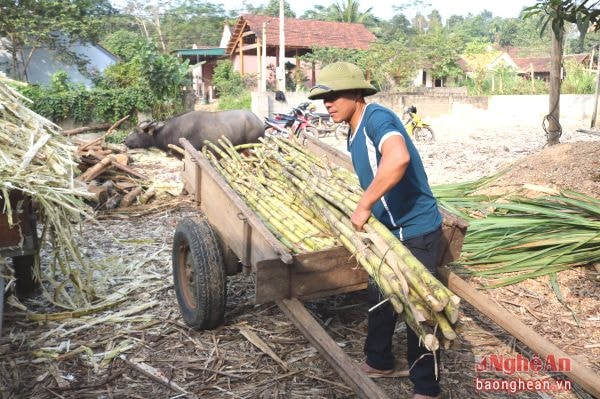 |
| Sugarcane is being transported to be prepared for pressing to extract molasses. |
Sugarcane brought from the fields and plantations is cleaned. Nowadays, customers have high demands regarding food safety and hygiene, so this step is given great attention. After washing, the sugarcane is further cleaned of its inner core using a curved knife. Next, the sugarcane is put into a press to extract the juice. The extracted sugarcane juice is then transferred to large pans to be boiled.
According to Mr. Ha, the process of cooking the finished product is also complex, requiring skill and experience to produce delicious batches of molasses. The most important thing is to maintain a stable fire in the oven. If the fire is too strong, the molasses will burn if not stirred evenly. If the fire is too weak, the thickening process will take a very long time. During the cooking process, one must stir constantly and continuously skim off the foam to prevent the molasses from burning, turning black, and to preserve its sweet and fragrant flavor. The sugarcane juice is boiled continuously. It usually takes 5-6 hours to thicken into molasses…
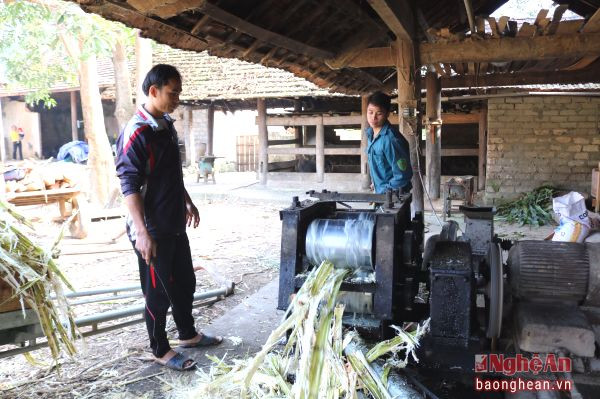 |
| Previously, people in Tho Son used buffaloes and human strength to extract honey, but now they use machines to press it. |
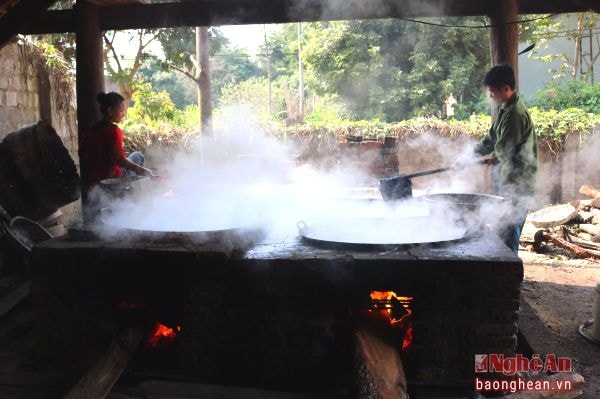 |
| The process of boiling honey. |
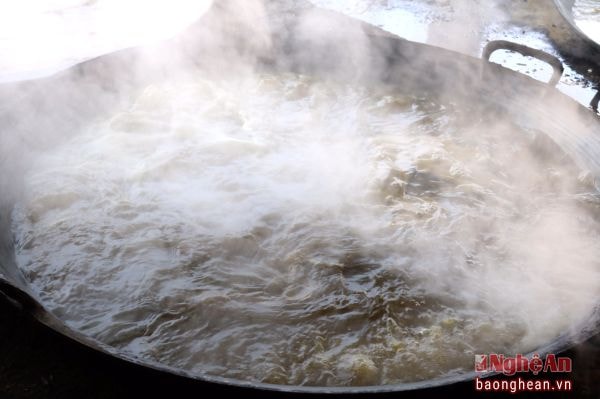 |
| Boiled sugarcane juice. |
After the molasses is cooked, it is poured into pots or basins to cool before being bottled and sold to customers. Vi Van Quang, a resident of Tho Son commune, said: “The molasses here is fragrant and delicious, so it's very popular. In recent years, thanks to molasses production, our lives have improved significantly.”
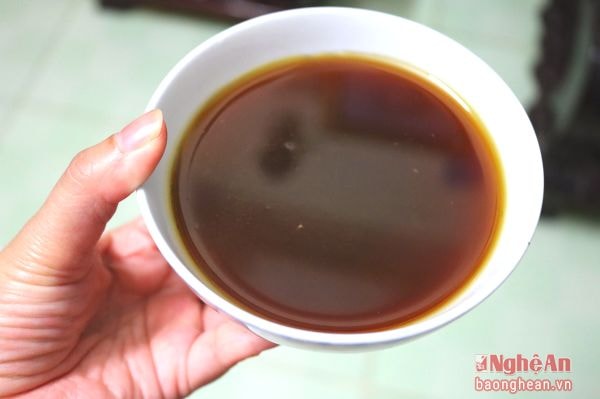 |
| A bowl of freshly made sugarcane syrup. |
Currently, the entire Tho Son commune has about 10 households engaged in sugarcane molasses pressing. Besides purchasing sugarcane from local people, this profession also contributes to creating jobs for local laborers. For many people in western Nghe An, sugarcane molasses is an indispensable part of the Lunar New Year celebrations. The product is often used to make dishes such as honey cakes, glutinous rice balls, and honey cakes, or to cook sweet soups for the 23rd day of the 12th lunar month (the day of worshiping the Kitchen God) or for the New Year's Eve offering on the 30th day of the 12th lunar month.
Huyen Trang
| RELATED NEWS |
|---|