

Identifying characteristics of Vinh oranges.
(Baonghean) - Vinh oranges are a specialty fruit of Nghe An province, known for their sweet, mild flavor, fragrant aroma, and beautiful appearance. The excellent quality of Vinh oranges is the culmination of three factors: the natural environment, the land, and the people of this region. Over many years, on the land of Nghe An, with its unique climate, weather, and soil, the diligent people, through their intelligence and hard work, have selected and cultivated this specialty orange, renowned far and wide, creating a distinctive cultural feature of Nghe An.
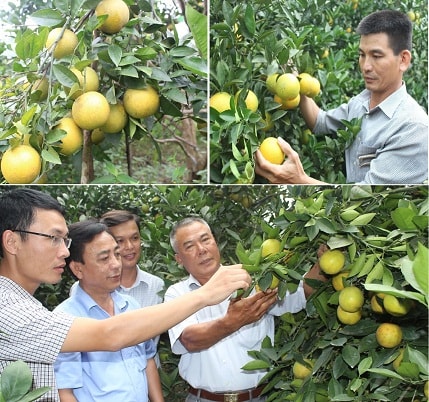 |
| Oranges in Nghe An are grown in several localities with suitable microclimates. |
To protect a local specialty product, in 2007, Vinh oranges were granted geographical indication certification. The geographical indication "Vinh" for oranges was recorded in the National Register of Geographical Indications: Registration number 000012 according to Decision No. 386/QD-SHTT dated May 31, 2007, of the Director of the Intellectual Property Office. Oranges from Nghe An province have been granted indefinite intellectual property protection throughout Vietnam.
In its role as the state agency responsible for intellectual property, the Department of Science and Technology conducted a survey of orange-growing areas within the Vinh Orange Geographical Indication region. We would like to introduce some identifying characteristics of Vinh oranges currently available on the market.
1. Vinh orange growing region
The geographical indication for Vinh oranges clearly states that 12 communes/5 districts have land identified within the geographical indication area, totaling 1681.48 hectares. Specifically: In Nghi Loc district, Nghi Hoa commune has 0.76 hectares planted with Xa Doai 1 oranges, and Nghi Dien commune has 1.3 hectares planted with Xa Doai 1 oranges; In Hung Nguyen district: Hung Trung commune has 19.1 hectares planted with Xa Doai 1 oranges; In Nghia Dan district: Nghia Son commune has 513.5 hectares planted with Xa Doai 2, Van Du, and Song Con orange varieties; Nghia Lam commune has 141.5 hectares planted with Xa Doai 2, Van Du, and Song Con orange varieties; Nghia Binh commune has 68.18 hectares planted with Xa Doai 2, Van Du, and Song Con orange varieties; Nghia Hong commune has 38.27 hectares planted with Xa Doai 2, Van Du, and Song Con orange varieties; Nghia Hieu commune has 186.4 hectares planted with Xa Doai 2, Van Du, and Song Con orange varieties; In Quy Hop district: Minh Hop commune has 534.81 hectares planted with Xa Doai 2, Van Du, and Song Con orange varieties; In Tan Ky district: Tan Phu commune has 77.2 hectares planted with Xa Doai 2, Van Du, and Song Con orange varieties; Tan Long commune has 46.1 hectares planted with Xa Doai 2, Van Du, and Song Con orange varieties; and Tan An commune has 54.52 hectares planted with Xa Doai 2, Van Du, and Song Con 1 orange varieties.
However, after nearly 10 years, the area of orange cultivation in the localities has changed. In Quy Hop district, the area of orange cultivation has increased significantly...
2. Types of Vinh oranges and how to identify them.
a. Cam Xã Đoài
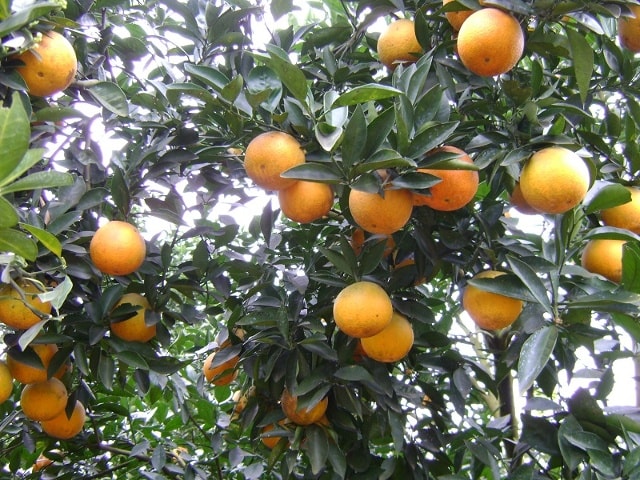 |
| Cam Xã Đoài. |
Xã Đoài oranges originate from Nghi Diên commune, Nghi Lộc district. Currently, they are grown in Minh Hợp commune, Quỳ Hợp district; Nghĩa Bình, Nghĩa Hiếu, Nghĩa Lâm, and Nghĩa Sơn communes, Nghĩa Đàn district; Nghi Diên and Nghi Hoa communes, Nghi Lộc district; Tân Long, Tân An, and Tân Phú communes, Tân Kỳ district; and Hưng Trung commune, Hưng Nguyên district. Xã Đoài oranges begin to ripen in late September (lunar calendar), reaching peak ripeness in October and typically lasting until the end of November (lunar calendar). The peel of Xã Đoài oranges is thick, crisp when peeled by hand, and emits a very pleasant aroma. The riper the orange, the sweeter it becomes, leaving a rich and lingering flavor. When ripe, the oranges have a beautiful golden-yellow color, like honey, which then turns a darker yellow. Notably, when peeled, the juice clings to the hands, leaving a unique sticky texture when dry. Xã Đoài oranges are sweet, fragrant, crisp, have many seeds, and are low in fiber and pulp.
b. Cam Van Du
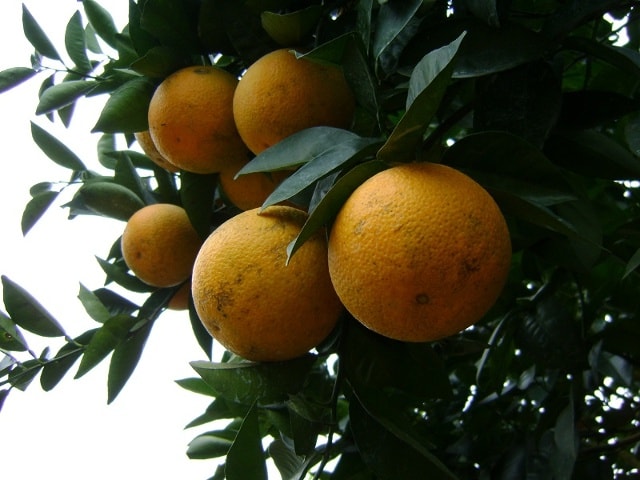 |
| Cam Van Du. |
Imported in the 1940s, this is a key orange variety in Vietnam. The tree has strong branching, a cylindrical canopy, dense branches, and thorns. Van Du oranges are round or oval, with thick, juicy peels, crisp segments (more firm than Xa Doai oranges), a sweet and refreshing taste, many seeds, and large flesh. When cut open, the fruit is yellow (but not as bright yellow as Xa Doai oranges), and the juice is viscous rather than sticky. This variety yields high productivity, is resistant to pests and diseases, and tolerates drought well, making it widely grown in many localities.
c. Cam Song Con
The Song Con orange variety was created through selective breeding from an imported variety named after a river in Nghe An province. The Song Con orange tree grows vigorously, with a spherical canopy, numerous short and densely clustered branches. The fruit is spherical, juicy, with a thin peel, few seeds, and a rich, sweet, and fragrant flavor. The Song Con orange variety has a medium yield, is resistant to pests and diseases, and has wide applications, making it suitable for cultivation in many regions such as the midlands, hills, coastal areas, and plains. Currently, Song Con oranges are grown in many localities throughout the country.
Besides the Vinh oranges mentioned above, there is another type of orange favored by locals for its quality and appearance: the V2 orange (Valenxia 2). This orange is considered the "queen of oranges" because it is both beautiful and delicious. V2 originates from Spain. The tree has short branches, a spherical or oval canopy, rough leaves, large leaf nodes, and a dark green, reflective color. The fruit is large, with an average weight of 200-250g, oval in shape, with a slightly thick peel, juicy, with few seeds, little fiber, and a crisp pulp. This is a high-yielding variety that ripens late (usually from the end of December to February of the following year), so it has a very high selling price.
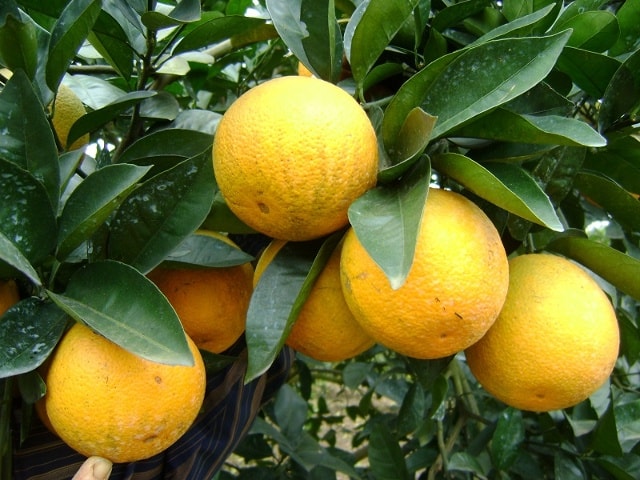 |
| Valencia. |
Besides its good quality and attractive appearance, Vinh oranges are also trusted by consumers because they are grown according to the technical standards and cultivation methods stipulated by the Provincial Department of Agriculture and Rural Development. In particular, for 45-60 days before harvest, no pesticides, stimulants, or preservatives of any kind are used, ensuring the oranges are safe for consumers' health.
Sea Swallow
Department of Science and Technology
| RELATED NEWS |
|---|