

Did Hitler's Titanic carry a treasure of 64 chests of gold?
The Nazi German cruise ship Wilhelm Gustloff, sunk during World War II, is believed to have carried 64 chests of gold or the Amber Room, but the story remains unclear to this day.
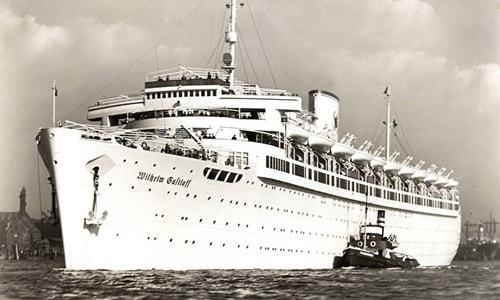 |
The Nazi German passenger ship Wilhelm Gustloff. Photo: eutopress. |
On January 30, 1945, three torpedoes launched from the Soviet submarine S-13 sank the Nazi German passenger ship Wilhelm Gustloff as it was carrying civilians and Nazi soldiers fleeing Gdniya, then known as Gotenhafen, a city in East Prussia.
More than 9,300 people died in the attack. This is considered the deadliest shipwreck in maritime history, according to the International Business Times.
Dubbed "Hitler's Titanic," the Wilhelm Gustloff was a ship belonging to the Nazi German "Strength Through Joy" amusement park. Workers loyal to the Nazi Labor Front were often rewarded with trips aboard the ship to Spain and Norway. During World War II, the Wilhelm Gustloff served as a hospital ship and transported Nazi German submarine crews.
Decades after the Wilhelm Gustloff disaster, rumors began to circulate about a secret cargo on board the ship when it sank. Heinz Schoen, the ship's assistant treasurer and a survivor, wrote several books about the sinking, one of which mentioned crates being loaded onto the ship before it departed.
Mysterious chests
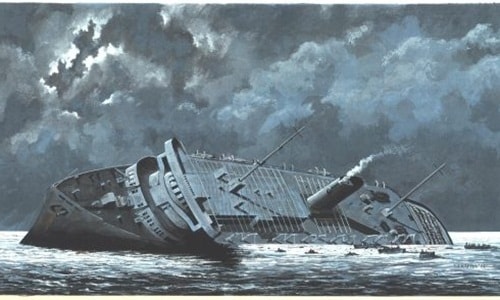 |
The Wilhelm Gustloff ship at the time it was sunk. (Illustrative image: wilhelmgustloff.com) |
During his time as a diver in Germany in the late 1980s, Philip Sayers, author of the book "Baltic Gold," met Rudi Lange, a radio technician on the Wilhelm Gustloff, who claimed to have personally witnessed the coffins being loaded onto the ship.
"He told me the story of this shipwreck, and it sounded similar to the Titanic disaster. He had to find a way to survive in the open sea and swam for a long time among dead bodies and dying people. He broke down in tears as memories of the victims and the children who were barely alive flooded back," Sayers said.
"He explained to me that on the night the Wilhelm Gustloff set sail, a convoy of trucks loaded with goods appeared at the harbor as the ship was preparing to depart, and he witnessed a group of Nazi soldiers carrying small but heavy crates onto the pier," Sayers recounted.
Speculation and speculation about the contents of these chests continue to this day. Schoen believes they contain the famous Amber Room panels, looted by Nazi soldiers from Catherine Palace during the siege of St. Petersburg. The Nazis are believed to have taken the Amber Room, valued at approximately $400 million, to the city of Koenigsberg (later renamed Kaliningrad), near Gdniya.
However, Rudi Lange found the above hypothesis questionable because the chests he saw were small in size. Furthermore, Lange also asserted that he had discovered what the chests actually contained.
Lange revealed to Sayers that he had met one of the Nazi soldiers who loaded the mysterious boxes onto the ship at a memorial event for the victims of the Cap Arcona sinking held in the town of Neustadt, Germany, in 1972. The Cap Arcona was a Nazi German transport ship sunk by British air force fighters in May 1945, killing approximately 5,000 people on board, mostly prisoners from German concentration camps.
"Those crates didn't contain the walls of the Amber Room. The soldier said he had transferred 64 crates of gold bars from the Nazi Reichsbank in Koenigsberg onto the Wilhelm Gustloff," Lange told Sayers. The estimated value of these gold crates is over $125 million, at current prices.
The soldier said the chests of gold were stored in a special suite of rooms on the Wilhelm Gustloff, reserved exclusively for Hitler. The plan was to later transfer them to small boats and take them to a secret location, but unfortunately, the Wilhelm Gustloff was sunk.
However, some experts do not believe the rumors about treasure on board the Wilhelm Gustloff.
American journalist Cathryn J. Prince interviewed many survivors of the Wilhelm Gustloff shipwreck to write the book "Death in the Baltic: The World War II Sinking of the Wilhelm Gustloff".
"None of the survivors I spoke to, nor any documents, described the crates being loaded onto the ship. I spoke with people who worked on the Wilhelm Gustloff before they started receiving refugees, but they said they hadn't seen any crates. Every centimeter of the ship was crammed with people," Prince described.
Regarding the hypothesis that the Amber Room was brought aboard the ship, Prince shared: "The historians I spoke with believe that a treasure of that kind is more likely to have been hidden in mountain caves or mines." Prince argued that it was unlikely the Nazis would entrust such a valuable item to a cruise ship carrying desperate refugees.
Was the shipwreck ransacked?
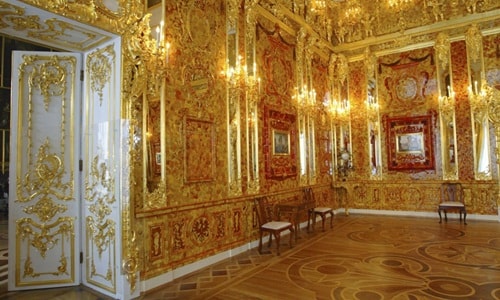 |
The Amber Room has been recreated in Russia. Photo: Reuters. |
To verify the rumors, Sayers and a fellow diver descended into the sea to survey the wreck of the Wilhelm Gustloff in 1988. The ship lay at a depth of 50 meters and about 60 kilometers off the coast of Poland. However, upon arrival, they discovered they were not the first to descend to the shipwreck site.
"Clearly, someone dived down here and ransacked and vandalized the shipwreck. They might have been looking for the Amber Room," Sayers said.
According to Sayers, the Soviet Union destroyed the wreck to eliminate the risk of other ships colliding with it. The remaining fragments of the Wilhelm Gustloff lie scattered in piles on the seabed. Some parts of the ship look as if they were blown apart.
"You could clearly see the holes drilled through the hull and the parts that required the use of powerful cutting tools. It felt as though the ship had exploded due to explosives," Sayers recounted.
Sayers and his colleagues removed a charred window from the medical room of a shipwreck to take ashore. However, upon returning to the port in Kiel, Germany, they were arrested and charged with stealing from the wreck.
Eventually, they were released, and shortly afterward, at the request of the German government, Polish authorities established a no-go zone around the wreck of the Wilhelm Gustloff, designating it as a war graveyard. Divers are only permitted access to the area with special permits.
Mike Boring, the diver Prince spoke with, surveyed the wreck of the Wilhelm Gustloff in 2003. He confirmed that the ship had been cleared out. But what was even more puzzling was the complete absence of human remains.
Legends about the hiding place of Nazi gold continue to fascinate many adventurers. For Prince, the Wilhelm Gustloff tragedy and the mysterious fate of the Amber Room will continue to attract rumors, perhaps for a long time to come.
According to VNE
| RELATED NEWS |
|---|