

The F-20 'Tiger Shark,' America's least-selling fighter jet.
Despite possessing many superior features, the F-20 Tigershark still missed the opportunity to become the most exported fighter jet of the United States.
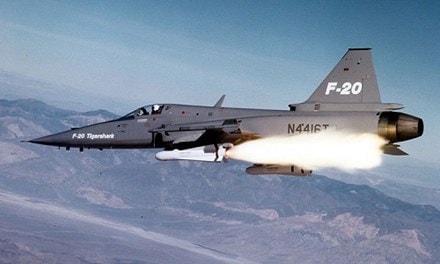 |
| A model of the American F-20 fighter jet. Photo: Aviations militaires |
The F-20 Tigershark is a fighter jet model that Northrop Grumman began developing in 1975 with its own funding, aiming to capture the booming fighter jet export market at the height of the Cold War, according to Aviations militaires.
The F-20 was developed based on the F-5E Tiger II fighter jet, which the US mass-produced and supplied to allied nations since World War II, but with significant improvements in engines and electronic warfare systems, resulting in more powerful combat capabilities than the original version.
Compared to the F-5E, the F-20 is faster, has effective beyond-visual-range air combat capabilities, and can strike ground targets with its high-precision weapon systems.
The F-20 has a length of 14.4 m, a wingspan of 8.53 m, a height of 4.2 m, an empty weight of 5.96 tons, a maximum takeoff weight of over 7 tons, a maximum speed of Mach 2 (68 m/s), and a maximum service ceiling of 16 km.
In terms of weaponry, the F-20 is equipped with five pylons on its wings and fuselage, capable of carrying 3.6 tons of bombs, missiles, and rockets. Its air-to-air weapons include multiple AIM-9 and AIM-7 Sparrow missiles, and two M39 20mm automatic cannons with 280 rounds of ammunition.
When attacking ground targets, the F-20 uses AGM-65 Maverick air-to-ground missiles, two CRV-7 or LAU-10 rocket launchers with four 127 mm rockets, and Mk80 conventional bombs or CBU cluster bombs.
Another strength of the F-20 compared to its competitors is its ability to respond quickly to emergencies. In a test exercise in 1980, the F-20 took only 2 minutes and 30 seconds to reach an altitude of 12 km, ready to engage any threats of airspace intrusion.
The F-20 made its maiden flight on August 30, 1982. However, this seemed like an inopportune time for the launch and promotion of this new fighter jet, as President Ronald Reagan had decided to ease restrictions on supplying the famous F-16 Fighting Falcon to allied countries.
By 1986, the US Department of Defense did not order F-20s but instead used F-16s to equip the National Guard Air Force. This decision significantly impacted countries considering purchasing American fighter jets.
After six years without selling a single aircraft, Northrop officially terminated the F-20 program, worth over $1.2 billion, in 1988.
The last F-20 is on display at the California Science Center. The two remaining test versions crashed during promotional flights, both due to pilot error.
According to VNE
| RELATED NEWS |
|---|