

Spring 2017: Strictly adhere to the planting schedule.
(Baonghean) - The 2017 spring crop is predicted to take place in warm weather conditions, but there will be some late cold spells towards the end of the season. Given the unpredictable weather, strictly adhering to the recommended planting schedule is crucial to minimizing losses in agricultural production.
With the goal of achieving 669,700 tons of food, the province aims to plant 89,000 hectares of rice in the spring of 2017, including an increase of 30,000 hectares of high-quality rice. In 2017, the beginning of spring will fall on February 4th, which is the 8th day of the first lunar month, therefore rice planting will be concentrated after the Lunar New Year.
Generally speaking, the spring crop of 2017 was warm, approximately the same as the spring crop of 2016 and 0.5-1°C higher than the multi-year average. However, forecasts still predict some late cold spells at the end of the season. The agricultural sector has divided the planting schedule into three basic groups: Group 1 (using varieties with a growth period of 140-145 days) sowing seedlings from January 5-10 and transplanting from January 3-5; Group 2 (varieties with a growth period of 130-135 days) sowing seedlings from January 15-20 and transplanting from February 6-10; and Group 3 (varieties with a growth period of around 125 days) sowing seedlings from January 20-25 and transplanting from February 10-15. Specifically for flood-prone areas during the summer-autumn season, to ensure rice flowers bloom between April 20th and 25th, based on the growth period of the variety, seedlings should be sown 5-7 days earlier. Priority should be given to varieties with a growth period of approximately 125 days, sowing seedlings between January 15th and 20th to ensure timely harvesting of the summer-autumn rice crop before August 30th.
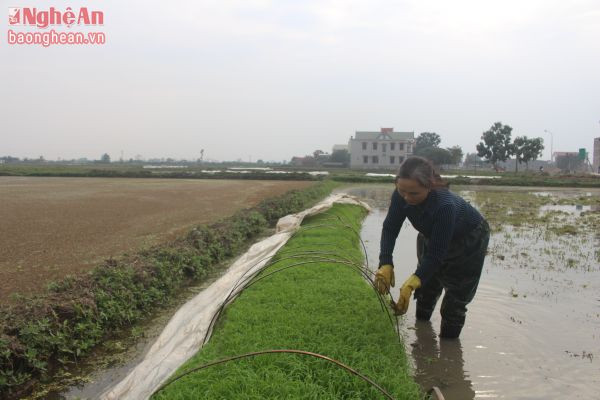 |
| Farmers in Quynh Luu district are out in the fields tending to their rice seedlings. |
Thus, except for some early spring varieties, most late spring varieties are planted after the Lunar New Year, from around the 4th day of the first lunar month onwards. However, in reality, in some localities such as Yen Thanh, Quynh Luu, Dien Chau, etc., from December 20th onwards, some farmers have already planted short-day varieties such as Thien Uu 8 and VTNA2, 15-20 days earlier than the scheduled planting season, or even more. Ms. Nguyen Thi Hong, from Hamlet 11, Quynh Hung commune (Quynh Luu district), said: This spring, her family planted 5 sao (approximately 0.5 hectares) of rice, mainly the Thai Xuyen variety. She sowed the seedlings after December 20th, and the current warm weather has resulted in very good seedlings. She plans to transplant them around January 15-17 (close to December 20th in the lunar calendar).
With the current warm weather conditions favorable for rice seedling growth, these areas could all be transplanted before the Lunar New Year. Therefore, the risk of the rice flowering and then being hit by cold weather is entirely possible, seriously affecting yield.
According to the Deputy Director of the Department of Agriculture and Rural Development, Mr. Nguyen Van Lap, in order to ensure the yield of the spring rice crop, localities must urgently inspect and review areas where rice seedlings were sown too early, especially those with short-growing varieties of 130 days. If necessary, these seedlings should be destroyed and replanted with a different variety, as the planting season is just beginning. Using these seedlings for transplanting will cause the rice to flower too early, making it susceptible to late-season cold weather, resulting in a high percentage of empty grains and seriously affecting yield.
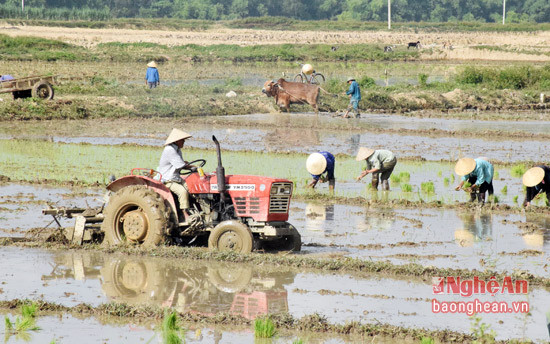 |
| Farmers in Ky Son commune, Tan Ky district, are planting rice. (Photo: Archival image) |
For localities that have not yet sown rice seedlings or broadcast sowing, it is absolutely essential to strictly adhere to the planting schedule to ensure that the rice flowers within a safe timeframe. It is especially important to note that this year's main rice seedling sowing season will fall during the coldest period of the year. Therefore, farmers must cover the seedlings 100% with plastic sheeting, prepare necessary cold protection measures such as wood ash, and properly manage water resources according to the instructions of agricultural officials.
During cold spells, avoid applying nitrogen fertilizer to rice seedlings and minimize direct sowing to reduce frost damage. Transplant seedlings at the correct age and with the required number of leaves, and avoid transplanting on days with severe cold. Simultaneously, increase the use of organic fertilizers from the beginning of the season, use lime to treat the soil, and apply high-content NPK fertilizers, balancing phosphorus, nitrogen, and potassium to promote healthy plant growth and resistance to adverse environmental conditions.
Phu Huong